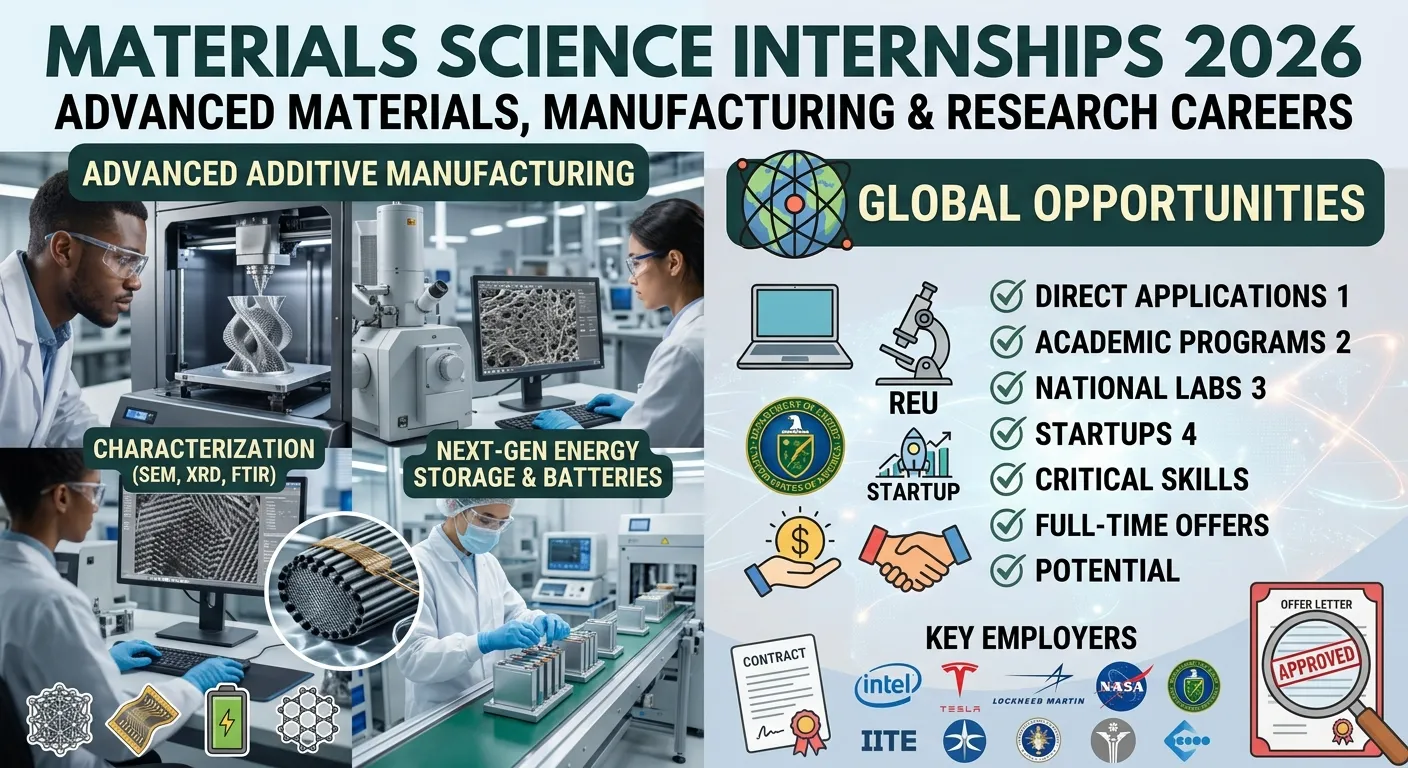
STEM internships 2026–2027 are opening opportunities for students who want practical experience in science, technology, engineering and mathematics before graduating.
For many students, an internship is more than a short-term job. It can provide an opportunity to work alongside researchers, engineers, developers and technical professionals while applying university knowledge to real projects.
The range of STEM opportunities is also broader than software engineering. Students can find internships connected with aerospace, mechanical engineering, electrical engineering, artificial intelligence, biotechnology, materials science, physics, environmental science, data science, robotics, mathematics and scientific research.
Several major programs illustrate how diverse the current landscape has become. NASA’s paid OSTEM program gives college students hands-on experience on real NASA projects, while the U.S. Department of Energy’s Science Undergraduate Laboratory Internships (SULI) and Community College Internships (CCI) provide research and technical experience at national laboratories.
International students also have options. For example, the Mitacs Globalink Research Internship offers competitive 12-week research placements in Canada for eligible international undergraduates, including students from Pakistan, across disciplines such as science, engineering and mathematics.
This guide explains how STEM internships work, which fields are available, what students may need to qualify, how paid internships differ from funded research programs, and how to prepare a competitive application for 2026–2027.
STEM Internships 2026–2027: Job Overview
| Category | Details |
|---|---|
| Internship type | STEM, engineering, science, technology and research |
| Main applicants | Undergraduate and graduate students |
| Common fields | Engineering, computer science, AI, mathematics, physics, biology, chemistry and research |
| Experience | Varies by program |
| Compensation | Paid, stipend-based or funded depending on program |
| Duration | Typically several weeks to several months |
| Locations | USA, Canada, Europe, Asia and other international locations |
| Work format | On-site, hybrid or occasionally remote |
| Degree levels | Undergraduate, Master’s and PhD depending on program |
| International opportunities | Available through selected programs |
| Research opportunities | Universities, laboratories, government agencies and technology organizations |
| Application method | Organization-specific application portals |
The important distinction is that “STEM internship” is a broad category rather than one single program. Eligibility, compensation, duration and visa rules can therefore vary significantly.
What Are STEM Internships?
STEM stands for:
- Science
- Technology
- Engineering
- Mathematics
A STEM internship is a temporary learning and work experience related to one or more of these areas.
Unlike a generic summer job, a STEM internship normally involves technical, scientific, analytical or research-based work.
For example, an engineering intern might assist with product design and testing, while a computer science intern could contribute to software development.
A research intern may spend several weeks working with a university laboratory and analyzing experimental results.
Common STEM internship activities include:
- Engineering design
- Laboratory research
- Software development
- Data analysis
- Scientific experiments
- Product testing
- Computer modeling
- Artificial intelligence research
- Robotics
- Materials research
- Technical documentation
- Mathematical modeling
- Environmental research
Why Are STEM Internships in Demand?
Technology and scientific research are developing rapidly, increasing the need for students with practical technical experience.
Employers often want graduates who can do more than pass university examinations. They want candidates who understand how to apply their knowledge to real-world problems.
An internship can help bridge that gap.
Practical Experience
Students can apply classroom concepts to actual projects.
Professional Networking
Interns may work alongside scientists, engineers, researchers and managers who can become valuable professional contacts.
Career Exploration
An internship allows students to discover whether a particular field is genuinely suitable for them.
Graduate School Preparation
Research internships can be especially useful for students considering a Master’s or PhD.
Stronger Resume
Relevant technical experience can help distinguish a graduate from candidates who have only academic qualifications.
The DOE, for example, describes its SULI and CCI programs as opportunities for students to gain hands-on learning, develop new skills and work with scientists, engineers and technical professionals on real-world problems.
Popular STEM Internship Fields for 2026–2027
1. Engineering Internships
Engineering remains one of the largest STEM internship categories.
Students can find opportunities in:
- Mechanical engineering
- Electrical engineering
- Civil engineering
- Aerospace engineering
- Chemical engineering
- Biomedical engineering
- Environmental engineering
- Industrial engineering
- Materials engineering
- Computer engineering
Typical responsibilities may involve design, testing, simulation, manufacturing, quality control or research.
2. Computer Science and Software Engineering
Technology companies and research organizations recruit students for software-related internships.
Common areas include:
- Software development
- Cloud computing
- Cybersecurity
- Artificial intelligence
- Machine learning
- Data engineering
- Web development
- Mobile development
- Embedded systems
- Computer vision
Students applying for these positions should ideally have practical programming experience rather than relying only on coursework.
3. Artificial Intelligence and Machine Learning
AI internships are becoming an important part of the STEM landscape.
Possible areas include:
- Machine learning
- Natural language processing
- Computer vision
- Generative AI
- Robotics
- Data modeling
- AI safety
- Deep learning
A strong candidate may have experience with Python, statistics, algorithms, machine learning frameworks or research projects.
4. Science Research Internships
Research opportunities are available in disciplines such as:
- Physics
- Chemistry
- Biology
- Astronomy
- Environmental science
- Earth science
- Materials science
- Biotechnology
- Neuroscience
- Computational science
Research internships can involve laboratory work, computer modeling, literature reviews, data collection and analysis.
5. Mathematics and Statistics
Mathematics students can find opportunities involving:
- Statistical analysis
- Mathematical modeling
- Optimization
- Probability
- Data science
- Quantitative research
- Financial mathematics
- Computational mathematics
Strong analytical skills can be useful across technology, research and business environments.
Notable STEM Internship Opportunities for 2026–2027
The following programs illustrate the variety available to students.
NASA OSTEM Internships
NASA’s Office of STEM Engagement offers paid internships for college students to contribute to NASA’s science, technology, aeronautics and space exploration mission.
NASA says OSTEM internships provide short-term, hands-on opportunities to work on real NASA projects with mentors. The agency offers three annual sessions.
For the 2026–2027 cycle, NASA lists these application deadlines:
- Spring 2027: September 14, 2026
- Summer 2027: February 26, 2027
- Fall 2027: May 21, 2027
NASA currently lists U.S. citizenship as a requirement for its OSTEM and Pathways programs, along with academic requirements such as a 3.0 GPA for OSTEM.
This makes NASA an excellent example of why students should always check citizenship and eligibility requirements before applying.
DOE Science Undergraduate Laboratory Internships
The U.S. Department of Energy opened applications for Spring 2027 SULI and CCI internships in July 2026.
Students work with scientists, engineers and technical professionals at DOE national laboratories.
Current research areas highlighted by the DOE include:
- Artificial intelligence
- Quantum technology
- Nuclear energy
- Biotechnology
- Critical minerals and materials
- Fusion science and engineering
The program is designed to give students practical experience and exposure to scientific and technical careers.
Mitacs Globalink Research Internship
Students seeking international research experience should consider the Mitacs Globalink Research Internship.
It is a competitive program for eligible international undergraduate students who complete a 12-week research internship in Canada under university faculty supervision. The program covers a wide range of disciplines, including science, engineering and mathematics.
Importantly for South Asian applicants, the 2027 eligibility information includes Pakistan.
For Pakistani students, the current information states that applicants can be full-time undergraduate students or students in combined undergraduate-Master’s programs. A minimum cumulative GPA of 80% is listed, and all disciplines are eligible under the Pakistan-specific criteria.
The program also provides support such as a food and incidentals stipend, emergency health insurance and student mentorship.
The summer 2026 application call is closed, with the program indicating that the 2027 call will open soon.
STEM Internship Salary and Stipends
One of the biggest differences between STEM internships is how students are compensated.
Some are conventional paid employment positions.
Others are research programs that provide a stipend or financial support package.
Therefore, there is no universal STEM internship salary.
Hourly Pay
Technology companies may compensate interns using hourly wages.
The amount depends on:
- Employer
- Location
- Role
- Academic level
- Technical specialization
- Experience
Monthly Pay
Research internships may provide a monthly stipend rather than an hourly wage.
For example, international research programs may structure funding around living expenses rather than a conventional employee salary.
Annualized Salary
Students should be careful when converting internship compensation into annual salaries.
A 10- or 12-week internship is temporary. Annualizing the pay can create an unrealistic picture of total earnings.
The better comparison is:
Total internship compensation − expected living costs = approximate financial benefit.
Are STEM Internships Paid?
Many STEM internships are paid, but not all programs use the same compensation model.
You may encounter:
Paid Internships
The student becomes an intern or temporary employee and receives wages.
Research Stipends
The organization provides financial support for living expenses and research participation.
Fully Funded Programs
Some international research programs may provide a combination of:
- Stipend
- Accommodation
- Travel support
- Insurance
- Visa support
Unpaid Academic Research
Some university research experiences may not provide direct compensation.
Students should therefore carefully read the financial information before accepting an opportunity.
Benefits of STEM Internships
A good STEM internship can provide benefits beyond the paycheck.
Technical Experience
Students gain exposure to professional tools, systems and research methods.
Mentorship
Working under experienced professionals can help students understand how technical careers actually work.
Networking
Internships can create relationships with:
- Researchers
- Professors
- Engineers
- Developers
- Scientists
- Hiring managers
- Other interns
Research Experience
For students interested in graduate school, research experience can strengthen future applications.
Career Development
Internships can help students identify the technical areas they enjoy most.
International Exposure
Programs such as Mitacs Globalink allow eligible international students to gain research experience in another country.
Visa Sponsorship and International STEM Internships
International applicants should pay close attention to immigration requirements.
There is no universal visa policy for STEM internships.
Requirements depend on:
- Country
- Employer
- Internship program
- Citizenship
- Academic institution
- Internship duration
- Type of work
- Government regulations
For example, NASA’s current OSTEM requirements specify U.S. citizenship.
By contrast, Mitacs Globalink specifically operates as an international research exchange and includes eligible students from multiple countries, including Pakistan.
Therefore, international students should prioritize programs that explicitly describe international eligibility.
Do not assume that a famous company or university automatically accepts overseas applicants.
Eligibility Requirements for STEM Internships
Requirements differ, but common criteria include:
Current Student Status
Many internships require applicants to be enrolled in a degree program.
Relevant Degree
The degree should generally match the internship.
For example:
- Mechanical engineering → mechanical engineering internship
- Computer science → software internship
- Physics → physics research
- Chemistry → laboratory research
Academic Performance
Some programs establish minimum GPA or percentage requirements.
For example, Mitacs lists an 80% minimum cumulative GPA for eligible Pakistani applicants in its 2027 Globalink Research Internship criteria.
Technical Skills
Certain positions require programming, laboratory, engineering or analytical skills.
Language Ability
International programs may require English proficiency or another language depending on the host organization.
Availability
Internships may require students to commit to a specific period, often several weeks or months.
Education and Experience
Students should not assume they need extensive professional experience.
For many internships, relevant academic experience can be enough.
Useful evidence includes:
- University projects
- Laboratory work
- Research papers
- Capstone projects
- Coding projects
- Robotics competitions
- Engineering designs
- Science competitions
- Open-source contributions
- Previous internships
- Research assistant positions
A first-year student can still build a strong application by demonstrating curiosity and practical work.
Skills That Increase Your Chances
Technical Skills
Depending on the field:
- Python
- C++
- Java
- MATLAB
- R
- SQL
- CAD
- Data analysis
- Machine learning
- Laboratory techniques
- Statistical modeling
- Simulation
- Electronics
- Robotics
Research Skills
Research-oriented candidates should understand:
- Literature review
- Data collection
- Experimental design
- Data analysis
- Scientific writing
- Research methodology
- Presentation
Soft Skills
Employers also value:
- Communication
- Teamwork
- Problem-solving
- Critical thinking
- Time management
- Adaptability
- Attention to detail
Where Can You Find STEM Internships?
STEM opportunities are available across many regions.
United States
The U.S. has a large ecosystem of:
- Technology companies
- Universities
- National laboratories
- Aerospace companies
- Biotechnology firms
- Government research agencies
NASA and DOE programs are examples of U.S. government-backed STEM opportunities.
Canada
Canada offers university and research internships for international students through programs such as Mitacs Globalink.
Europe
European universities, research institutions and technology companies regularly recruit students for research and technical internships.
Asia
Technology and research centers in countries such as Japan, Singapore, South Korea, Hong Kong and India provide opportunities across engineering and scientific disciplines.
For example, ASTRI’s 2026 internship program in Hong Kong included undergraduate and postgraduate STEM students working on applied R&D projects in areas such as AI, communications, IoT sensing and intelligent perception.
How to Find STEM Internships 2026–2027
Step 1: Define Your STEM Field
Do not search only for “STEM internships.”
Use specific terms such as:
- Mechanical engineering internships 2027
- Software engineering internships 2027
- AI research internships 2027
- Physics research internships
- Biotechnology internships
- Electrical engineering internships
- International engineering internships
- Paid science internships
Specific searches produce more relevant results.
Step 2: Check Official Sources
Look at:
- Company career pages
- University research pages
- Government agencies
- National laboratories
- Research institutes
- Scholarship and exchange organizations
Step 3: Check Eligibility First
Before spending time preparing an application, verify:
- Degree
- Year of study
- GPA
- Citizenship
- Work authorization
- Location
- Internship dates
- Required skills
Step 4: Prepare Your Resume
Your resume should prioritize relevant technical achievements.
Step 5: Prepare a Personal Statement
Research internships may ask why you want to work in a specific research area.
Avoid generic statements.
Explain:
- What you have studied.
- What project you completed.
- What research area interests you.
- Why the internship fits your goals.
How to Write a Strong STEM Internship Resume
A good student resume can be one page if you have limited experience.
Include:
Education
Mention:
- Degree
- University
- Expected graduation
- GPA if strong and relevant
Technical Skills
List only skills you can genuinely use.
Projects
Describe what you built, tested, researched or analyzed.
Research
Include:
- Research topic
- Methods
- Tools
- Findings
- Publications if applicable
Experience
Include previous internships, part-time technical work and research assistant positions.
Achievements
Mention:
- Competitions
- Scholarships
- Academic awards
- Publications
- Certifications
Tips to Increase Your Chances of Selection
Apply Early
Competitive STEM programs can receive large numbers of applications.
Some 2027 programs are already beginning their recruitment cycles.
Match Your Background
Do not apply randomly to every internship.
Choose positions where your education and skills genuinely match.
Build Projects
A practical project can make a student more memorable.
For example, a computer science student could create an AI application, while an engineering student could design and test a prototype.
Contact Professors
For research internships, faculty members can sometimes be important sources of opportunities.
Read their research before contacting them.
Prepare for Technical Interviews
Review the fundamental concepts related to your field.
Proofread Everything
Technical errors, inconsistent dates and spelling mistakes can make an otherwise strong application look careless.
For international students, immigration arrangements depend on the specific internship.
Potential routes may include:
- Student exchange arrangements
- Short-term research visas
- Internship-specific authorization
- Student work authorization
- Employer-sponsored temporary visas
- Country-specific training programs
There is no universal “STEM internship visa.”
Before applying internationally, check the host country’s official immigration guidance and the program’s instructions.
If the internship is through a university exchange program, the university’s international office may also provide guidance.
Cost of Living During an International STEM Internship
A paid internship does not necessarily mean that every expense will be covered.
Budget for:
- Accommodation
- Food
- Local transportation
- Flights
- Visa fees
- Insurance
- Utilities
- Study materials
- Emergency expenses
A funded research program may reduce some of these costs.
For example, Mitacs Globalink provides support including a food and incidentals stipend, emergency health insurance and student mentorship.
However, students should still confirm exactly what is included in their individual offer.
STEM Internships for Pakistani Students
Pakistani students have several potential routes into international STEM research.
Mitacs Globalink is particularly notable because its 2027 eligibility information specifically includes Pakistan.
For eligible Pakistani applicants, the current criteria state:
- Full-time undergraduate or combined undergraduate-Master’s enrollment
- All academic disciplines eligible
- Minimum cumulative GPA of 80%
- No language proficiency exam requirement
- No additional requirements listed in the current criteria
Students should still verify the final 2027 application requirements when the new application cycle opens.
Other opportunities may be available through universities, research laboratories and international exchange programs.
The most important strategy is to search for programs that explicitly accept international applicants instead of assuming that every U.S. or European internship does.
Frequently Asked Questions
1. What are STEM internships?
STEM internships are temporary educational and professional opportunities related to science, technology, engineering or mathematics. They can involve research, software development, engineering design, laboratory work, data analysis and other technical activities.
2. Are STEM internships paid?
Many are paid, while others provide stipends, scholarships or funding. Compensation depends on the employer or research program.
3. Can international students apply for STEM internships?
Yes, some programs specifically accept international students. However, eligibility varies considerably by country, organization and internship.
4. Can Pakistani students apply for international STEM internships?
Yes. Some international programs specifically include Pakistan among eligible countries. Mitacs Globalink, for example, currently lists Pakistan among its eligible locations for the 2027 cohort.
5. What degree is required for a STEM internship?
Requirements vary. Many opportunities are designed for undergraduate students, while others accept Master’s or PhD candidates.
6. What GPA is needed for STEM internships?
There is no universal GPA requirement. Some programs have minimum academic standards. For example, the current Mitacs criteria for eligible Pakistani applicants list an 80% minimum cumulative GPA.
7. Are there STEM research internships for undergraduate students?
Yes. Many research programs specifically target undergraduates. DOE SULI and CCI, NASA OSTEM and Mitacs Globalink are examples of programs offering hands-on technical or research experiences.
8. Are STEM internships available without professional experience?
Yes. Students can qualify through academic projects, research, coursework, competitions and personal projects when the specific program permits it.
9. Can STEM internships lead to full-time jobs?
They can strengthen a student’s professional profile and, depending on the employer, may provide a pathway to future employment. However, an internship does not guarantee a permanent job.
10. When should I apply for 2027 STEM internships?
Apply as early as possible because deadlines differ significantly. Some 2027 opportunities are already accepting applications or announcing upcoming cycles. NASA, for example, has published 2027 OSTEM deadlines beginning in September 2026.
Final Thoughts
STEM internships 2026–2027 can be an important stepping stone for students who want careers in engineering, science, technology, mathematics or research.
The strongest opportunities are not limited to large technology companies. Government agencies, universities, national laboratories and international research organizations also provide valuable experiences.
For example, NASA offers paid project-based internships, DOE laboratories provide hands-on scientific and technical opportunities, and Mitacs Globalink connects eligible international undergraduates with Canadian university research projects.
International students should pay particular attention to eligibility. Citizenship, work authorization and visa rules can eliminate otherwise attractive opportunities, so always check the official program requirements before applying.
Students should also avoid focusing exclusively on salary. A research internship with strong mentorship, meaningful project work and an experienced research team can be extremely valuable even when the financial package differs from a corporate internship.
If you are targeting 2027, begin preparing now. Build relevant projects, strengthen your technical skills, improve your resume and maintain a list of programs with their deadlines.
Most importantly, apply only where your academic background and experience genuinely match the opportunity. A targeted, well-prepared application is usually more valuable than submitting dozens of generic applications.