Materials Science Internships 2026: Advanced Materials, Manufacturing and Research Careers

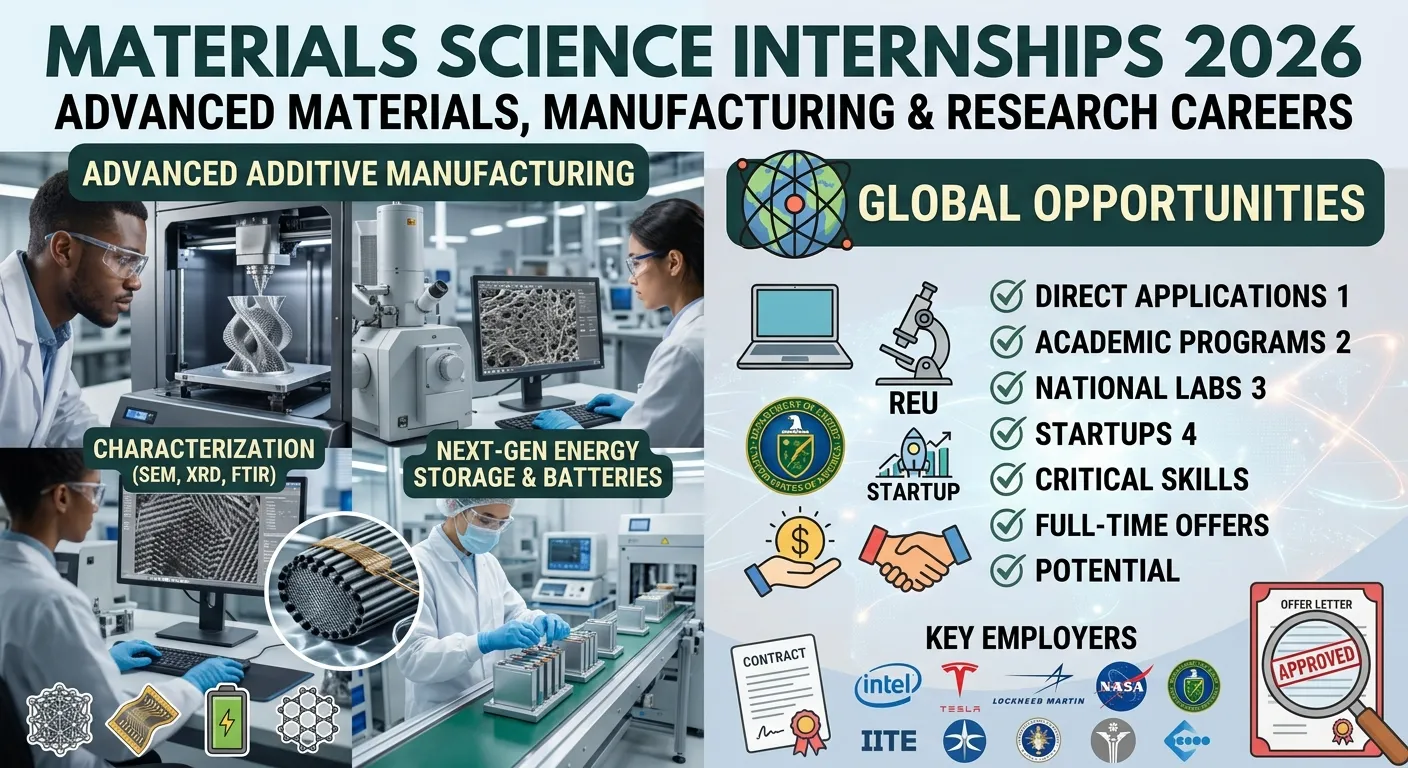
Materials science is one of the engineering and scientific fields behind many of today’s most important technologies. From semiconductor chips and batteries to aerospace components, medical devices, renewable-energy systems and advanced manufacturing, the performance of modern products often depends on the materials used to create them.
For students and recent graduates, Materials Science Internships 2026 offer an opportunity to gain practical experience in materials research, manufacturing, testing, characterization and product development.
Depending on the employer, an intern may work in a university laboratory, manufacturing facility, research center, semiconductor company, aerospace organization, energy company or advanced materials startup.
Current 2026 opportunities demonstrate the breadth of the field. Programs and internships are covering advanced materials research, nanomaterials, sustainable materials, critical minerals, composites, semiconductor materials, materials characterization and advanced manufacturing.
For students interested in combining engineering, chemistry, physics, manufacturing and research, materials science internships can provide a strong foundation for both industrial and academic careers.
Materials Science Internships 2026 at a Glance
| Category | Details |
|---|---|
| Field | Materials Science and Materials Engineering |
| Main Areas | Advanced materials, manufacturing, nanotechnology, testing and research |
| Typical Candidates | Undergraduate students, graduate students and recent graduates |
| Common Degrees | Materials Science, Materials Engineering, Metallurgy, Mechanical Engineering, Chemical Engineering and related fields |
| Key Skills | Materials characterization, laboratory work, data analysis and technical research |
| Work Settings | Laboratories, manufacturing facilities, R&D centers, universities and industrial sites |
| Common Technologies | SEM, XRD, microscopy, spectroscopy, additive manufacturing and materials testing |
| Industries | Aerospace, automotive, semiconductors, energy, electronics, healthcare and manufacturing |
| Career Paths | Materials Engineer, Materials Scientist, Process Engineer, R&D Engineer and Manufacturing Engineer |
Why Materials Science Internships Are Important in 2026
Materials determine how products behave.
Engineers need materials that can withstand heat, pressure, corrosion, mechanical stress, electrical demands and increasingly demanding operating environments.
At the same time, companies are looking for materials that are lighter, stronger, more sustainable, recyclable and economical to manufacture.
This creates opportunities for students who understand the relationship between material structure, processing, properties and performance.
A 2026 UCL advanced materials internship, for example, involves high-performance eco-friendly materials, advanced analytical techniques and optimization of manufacturing processes for potential automotive and packaging applications.
Materials science is therefore not limited to laboratory research. It can connect directly to manufacturing, product development, energy, electronics, construction, transportation and sustainability.
Types of Materials Science Internships in 2026
1. Advanced Materials Research Internships
Advanced materials research focuses on developing materials with improved or specialized properties.
Projects may involve:
- Nanomaterials
- Functional materials
- Smart materials
- Lightweight materials
- High-temperature materials
- Energy materials
- Magnetic materials
- Electronic materials
- Sustainable materials
- Advanced coatings
Students may work alongside researchers to synthesize, characterize and evaluate new materials.
2. Materials Characterization Internships
Characterization is essential for understanding why a material performs the way it does.
Interns may receive exposure to:
- Scanning Electron Microscopy (SEM)
- X-Ray Diffraction (XRD)
- Optical microscopy
- Thermal analysis
- Spectroscopy
- Surface analysis
- Mechanical testing
- Hardness testing
- Electrical measurements
For example, a 2026 advanced materials internship at UCL includes SEM, TGA and XRD to investigate material microstructure and thermal stability.
3. Nanotechnology Internships
Nanotechnology deals with materials and structures at extremely small scales.
Possible research areas include:
- Nanoparticles
- Nanocomposites
- Thin films
- 2D materials
- Nanoelectronics
- Catalysts
- Sensors
- Energy materials
- Biomedical materials
These internships can be particularly useful for students considering postgraduate research.
4. Semiconductor Materials Internships
Semiconductor manufacturing is one of the most advanced applications of materials science.
Interns may work around:
- Thin films
- Deposition
- Etching
- Process development
- Materials integration
- Wafer processing
- Device materials
- Process characterization
- Failure analysis
A current 2026 Micron internship focuses on process development for 3D DRAM metals at the intersection of advanced materials science, process engineering and semiconductor manufacturing.
Applied Materials is also advertising 2026 internships connected with materials science, semiconductor manufacturing and advanced display technologies.
5. Metallurgy Internships
Metallurgy focuses on metals and alloys.
Students may study:
- Steel
- Aluminum
- Titanium
- Nickel alloys
- Copper
- Superalloys
- Powder metallurgy
- Heat treatment
- Corrosion
- Failure analysis
These skills can lead to opportunities in automotive, aerospace, energy, manufacturing and construction.
6. Composites Internships
Composite materials combine two or more materials to produce specialized properties.
Internships may involve:
- Carbon-fiber composites
- Glass-fiber composites
- Polymer composites
- Composite manufacturing
- Material testing
- Structural analysis
- Resin systems
- Lightweight structures
The IACMI internship program, for example, connects students with companies, universities and national laboratories working in composites, materials science and advanced manufacturing.
7. Additive Manufacturing Internships
Additive manufacturing, commonly known as 3D printing, is creating new opportunities for materials specialists.
Interns may work with:
- Metal 3D printing
- Polymer printing
- Ceramic printing
- Powder characterization
- Process optimization
- Material qualification
- Post-processing
- Microstructure analysis
The field combines materials science with manufacturing engineering and mechanical engineering.
8. Energy Materials Internships
Materials are essential to the development of new energy technologies.
Internships may focus on:
- Batteries
- Solar cells
- Hydrogen technologies
- Fuel cells
- Thermal storage
- Energy-efficient materials
- Catalysts
- Electrochemical materials
The 2026 materials internship landscape includes opportunities connected to energy storage, solar technology and advanced materials development.
9. Sustainable Materials Internships
Sustainability is increasingly influencing materials research.
Projects can involve:
- Recyclable materials
- Low-carbon manufacturing
- Circular materials
- Waste-derived materials
- Critical mineral recovery
- Bio-based materials
- Resource efficiency
A 2026 materials science internship at Revora Materials, for example, involves turning industrial residues and other feedstocks into valuable materials while working on carbon mineralization and critical-mineral recovery technologies.
What Does a Materials Science Intern Do?
Responsibilities depend on whether the internship is primarily research, manufacturing or product development.
Typical activities may include:
- Preparing material samples
- Conducting laboratory experiments
- Operating characterization equipment
- Analyzing test results
- Performing literature reviews
- Collecting experimental data
- Processing research data
- Supporting material synthesis
- Evaluating material properties
- Preparing technical reports
- Creating presentations
- Supporting manufacturing trials
- Investigating material failures
- Assisting R&D engineers and scientists
Graduate-level research internships can involve more advanced experimental design, modeling and independent research.
Materials Science Skills to Develop
Laboratory Skills
Useful laboratory capabilities include:
- Sample preparation
- Material synthesis
- Microscopy
- Spectroscopy
- XRD
- SEM
- Thermal analysis
- Mechanical testing
- Data collection
- Laboratory safety
Data and Computational Skills
Modern materials science increasingly uses computational tools and data analysis.
Useful skills can include:
- Excel
- Python
- MATLAB
- Statistical analysis
- Data visualization
- Materials databases
- Computational modeling
- Machine learning
Research groups are increasingly combining materials science with data science and artificial intelligence. The UT–Oak Ridge advanced materials and manufacturing program, for example, includes data science and AI-related research alongside materials projects.
Manufacturing Skills
Students interested in industry should understand:
- Manufacturing processes
- Process control
- Quality assurance
- Materials processing
- Scale-up
- Failure analysis
- Process optimization
Materials Science Internship Salary and Stipend
Compensation varies considerably depending on country, employer, academic level and internship type.
Research internships may provide a stipend, while industrial internships can use hourly or monthly compensation.
For example, the 2026 UT–ORII/UTK advanced materials and manufacturing research internship lists a $700 weekly stipend, along with housing and travel support for eligible participants.
Other internships have completely different compensation structures.
Students should therefore check the official internship advertisement for:
- Pay rate
- Stipend
- Housing
- Travel support
- Meals
- Insurance
- Working hours
- Internship duration
Do not assume that one research program’s compensation represents the entire materials science internship market.
Benefits of Materials Science Internships
Hands-On Research
Students can move beyond textbooks and conduct real experiments.
Laboratory Experience
Working with professional equipment can strengthen both technical knowledge and a CV.
Manufacturing Exposure
Industrial internships can show how materials research becomes a commercial product.
Research Networking
Students may work with:
- Materials scientists
- Engineers
- Professors
- Laboratory technicians
- Manufacturing specialists
- R&D managers
- Product developers
Graduate School Preparation
Research experience can be particularly useful for students considering master’s or PhD programs.
Industry Exposure
Internships can help students understand how materials science is applied in commercial environments.
Materials Science Internships for International Students
International opportunities are available across several regions.
Potential destinations include:
- United States
- Canada
- United Kingdom
- Germany
- Switzerland
- Netherlands
- Singapore
- Hong Kong
- Australia
- Japan
- South Korea
- India
- United Arab Emirates
Research universities, national laboratories, semiconductor manufacturers, aerospace companies, automotive organizations and materials startups can all offer relevant experience.
Current 2026 opportunities illustrate the geographic diversity of the field, including programs in the UK, United States, Switzerland, Singapore, Hong Kong and India.
Do Materials Science Internships Offer Visa Sponsorship?
Visa sponsorship depends entirely on the employer and internship program.
Some programs accept only students who already have permission to work in the relevant country. Others may be designed specifically for international researchers or students through institutional arrangements.
Before applying, check:
- Whether international students are eligible.
- Whether the internship requires current work authorization.
- Whether sponsorship is available.
- Whether university enrollment is required.
- Whether the program is restricted by nationality.
- Whether a student or research visa is necessary.
Never assume that an international internship automatically includes visa sponsorship.
Eligibility Requirements
Typical requirements can include:
- Undergraduate enrollment
- Graduate enrollment
- Materials Science degree
- Materials Engineering degree
- Metallurgical Engineering degree
- Chemical Engineering degree
- Mechanical Engineering degree
- Physics or Chemistry background
- Strong academic performance
- Laboratory experience
- Research interest
Requirements depend heavily on the internship.
For example, the 2026 ARCI Summer Research Internship accepts eligible students from areas including metallurgy, materials, ceramics, chemical engineering, nanotechnology, mechanical engineering, physics and chemistry, subject to its specific academic criteria.
Education for Materials Science Internships
The most directly relevant degrees include:
- BS Materials Science
- BS Materials Engineering
- Metallurgical Engineering
- Materials Science and Engineering
- Chemical Engineering
- Mechanical Engineering
- Physics
- Chemistry
- Nanotechnology
Interdisciplinary backgrounds can be particularly useful because materials science combines concepts from several scientific and engineering disciplines.
How to Find Materials Science Internships in 2026
University Research Programs
Check university engineering and materials science departments.
Research programs can be excellent for students interested in graduate school.
For example, Rice University’s Advanced Materials Institute offers a paid 10-week summer research program focused specifically on advanced materials research.
National Laboratories
National laboratories can provide exposure to advanced research and large-scale scientific facilities.
Company Career Pages
Look at companies in:
- Semiconductors
- Aerospace
- Automotive
- Electronics
- Energy
- Chemicals
- Advanced manufacturing
- Medical devices
- Mining
- Construction materials
Materials Research Institutes
Specialized research institutes can offer internships involving advanced characterization and experimental materials development.
University Career Centers
University placement offices can connect students with companies and research groups.
Materials Science Internships in Pakistan
Students in Pakistan can explore opportunities through universities, research institutions, engineering companies and manufacturing organizations.
Research-focused programs can provide experience in:
- Nanomaterials
- Materials characterization
- Metallurgy
- Energy materials
- Thin films
- Manufacturing
- Advanced engineering research
For example, LUMS’ 2026 RISE program included materials-focused research areas such as X-ray diffraction and functional nanomaterials.
NUST-related 2026 materials opportunities have also included work involving material selection, microstructure analysis, coatings, deposition, sintering, manufacturing optimization and characterization techniques such as SEM, FTIR and XRF.
Students should monitor university placement offices and laboratory announcements because many research internships are advertised through academic channels rather than conventional job boards.
Materials Science and Semiconductor Careers
Semiconductor manufacturing is one of the most technically demanding applications of materials science.
Materials engineers can contribute to:
- Thin-film development
- Wafer processing
- Deposition
- Etching
- Materials integration
- Failure analysis
- Process development
- Device manufacturing
As semiconductor technologies become more complex, materials and process engineering remain closely connected.
Current 2026 internship postings from companies such as Micron and Applied Materials illustrate the overlap between materials science, process engineering and semiconductor manufacturing.
Materials Science and Advanced Manufacturing
Materials development only creates commercial value when materials can be manufactured reliably.
That is why modern materials science increasingly overlaps with:
- Additive manufacturing
- Automation
- Process optimization
- Robotics
- Digital manufacturing
- Quality engineering
- Computational materials science
- Artificial intelligence
This combination creates opportunities for students who want to work between research laboratories and industrial production.
How to Apply for Materials Science Internships
Step 1: Prepare Your CV
Include:
- Degree
- University
- CGPA if relevant
- Laboratory experience
- Research projects
- Technical skills
- Software
- Publications or presentations
- Relevant coursework
Step 2: Highlight Laboratory Experience
Mention specific techniques rather than simply writing “laboratory experience.”
For example:
- XRD
- SEM
- TGA
- DSC
- FTIR
- Mechanical testing
- Sample preparation
- Metallography
Step 3: Build a Research Portfolio
A research portfolio can include:
- University projects
- Research posters
- Experimental results
- Technical reports
- Published papers
- Conference presentations
Step 4: Contact Research Supervisors
For academic internships, identifying faculty members whose research matches your interests can be useful.
Step 5: Apply Early
Research programs often have fixed deadlines.
For example, Rice’s 2026 advanced materials program had an application deadline several months before its summer start date.
How to Increase Your Chances of Selection
Choose a Specialization
Decide whether you are most interested in:
- Metals
- Ceramics
- Polymers
- Composites
- Nanomaterials
- Semiconductors
- Energy materials
- Biomaterials
Learn Characterization Techniques
Understanding how materials are tested can make your profile stronger.
Develop Data Skills
Learn how to analyze and visualize experimental data.
Read Research Papers
Regularly reading materials science publications can help you understand current research directions.
Build Practical Projects
University projects involving material testing, synthesis, modeling or manufacturing can demonstrate genuine interest.
Improve Technical Writing
Research and industrial materials roles frequently involve reports, experimental documentation and technical presentations.
Career Opportunities After a Materials Science Internship
An internship can lead toward several career paths.
Materials Engineer
Works on selecting, developing, testing and improving materials.
Materials Scientist
Focuses more heavily on material research, structure and properties.
Metallurgical Engineer
Specializes in metals, alloys, processing and performance.
Process Engineer
Improves manufacturing processes used to produce materials or components.
R&D Engineer
Develops and tests new technologies and products.
Manufacturing Engineer
Works on production systems and manufacturing processes.
Failure Analysis Engineer
Investigates why materials or components fail.
Semiconductor Process Engineer
Works on materials and manufacturing processes used in semiconductor production.
Quality Engineer
Focuses on material and product quality, testing and process control.
Research Scientist
Conducts advanced research in universities, laboratories or industrial R&D organizations.
Materials Science Internship vs Materials Engineering Internship
The two terms are often used interchangeably, but some organizations emphasize different aspects.
| Feature | Materials Science | Materials Engineering |
|---|---|---|
| Main Focus | Structure, properties and research | Application and processing |
| Laboratory Work | Very common | Common |
| Manufacturing | Possible | Very common |
| Research | Strong emphasis | Moderate to strong |
| Characterization | Very important | Very important |
| Product Development | Common | Very common |
| Industrial Process | Sometimes | Strong emphasis |
| Graduate Research | Common pathway | Common pathway |
The exact distinction depends on the university and employer.
Frequently Asked Questions
1. Who can apply for Materials Science Internships 2026?
Materials science, materials engineering, metallurgy, chemical engineering, mechanical engineering, physics, chemistry and related students may be eligible depending on the internship.
2. Do materials science internships require previous experience?
Usually not. Academic laboratory work, university projects and research experience can strengthen an application but are not always required.
3. What does a materials science intern do?
Interns may conduct experiments, prepare samples, analyze materials, use characterization equipment, support manufacturing trials and prepare technical reports.
4. Which techniques should materials science students learn?
Useful techniques include XRD, SEM, microscopy, thermal analysis, spectroscopy, mechanical testing and materials sample preparation.
5. Are materials science internships paid?
Some are paid while others offer research stipends, academic credit or other support. Compensation depends on the program and location.
6. Can international students apply for materials science internships?
Some programs accept international students, while others have work authorization or nationality restrictions. Applicants should verify eligibility with the specific program.
7. Are materials science internships useful for PhD applications?
Yes. Research experience, laboratory skills, technical reports, presentations and research projects can be valuable preparation for graduate study.
8. Can materials science students work in semiconductor companies?
Yes. Materials science is closely connected to semiconductor manufacturing, especially in areas such as thin films, process development, materials integration and characterization.
9. Is materials science a good field for manufacturing careers?
Yes. Materials selection, processing, quality, characterization and manufacturing are closely connected, creating opportunities across many industrial sectors.
10. Can materials science internships lead to permanent jobs?
An internship can provide relevant experience and professional connections, and some employers recruit interns for future positions. However, a permanent job is not guaranteed.
Final Thoughts
Materials Science Internships 2026 can provide students with a valuable entry point into advanced technology, manufacturing and scientific research.
The field is much broader than traditional laboratory work. Materials specialists contribute to semiconductors, aerospace, automotive manufacturing, batteries, renewable energy, medical technology, composites, nanotechnology and sustainable production.
Students who combine materials knowledge with laboratory skills, characterization techniques, data analysis and manufacturing experience can develop a versatile professional profile.
If you are planning a career in materials science, start by identifying the area that interests you most. Whether that is nanotechnology, metallurgy, composites, semiconductor materials, energy storage or sustainable materials, a focused internship can help you build practical knowledge and discover where you want your career to go.
For students considering graduate school, research internships can also provide experience with experimental methods, technical writing, scientific presentations and collaboration with researchers.
The most valuable internship is not necessarily the one with the most impressive title. Look for an opportunity where you can work on real materials, use relevant equipment, learn from experienced professionals and contribute to a meaningful research or engineering project.