Psychology Internships 2026: Research, Mental Health and Organizational Career Opportunities

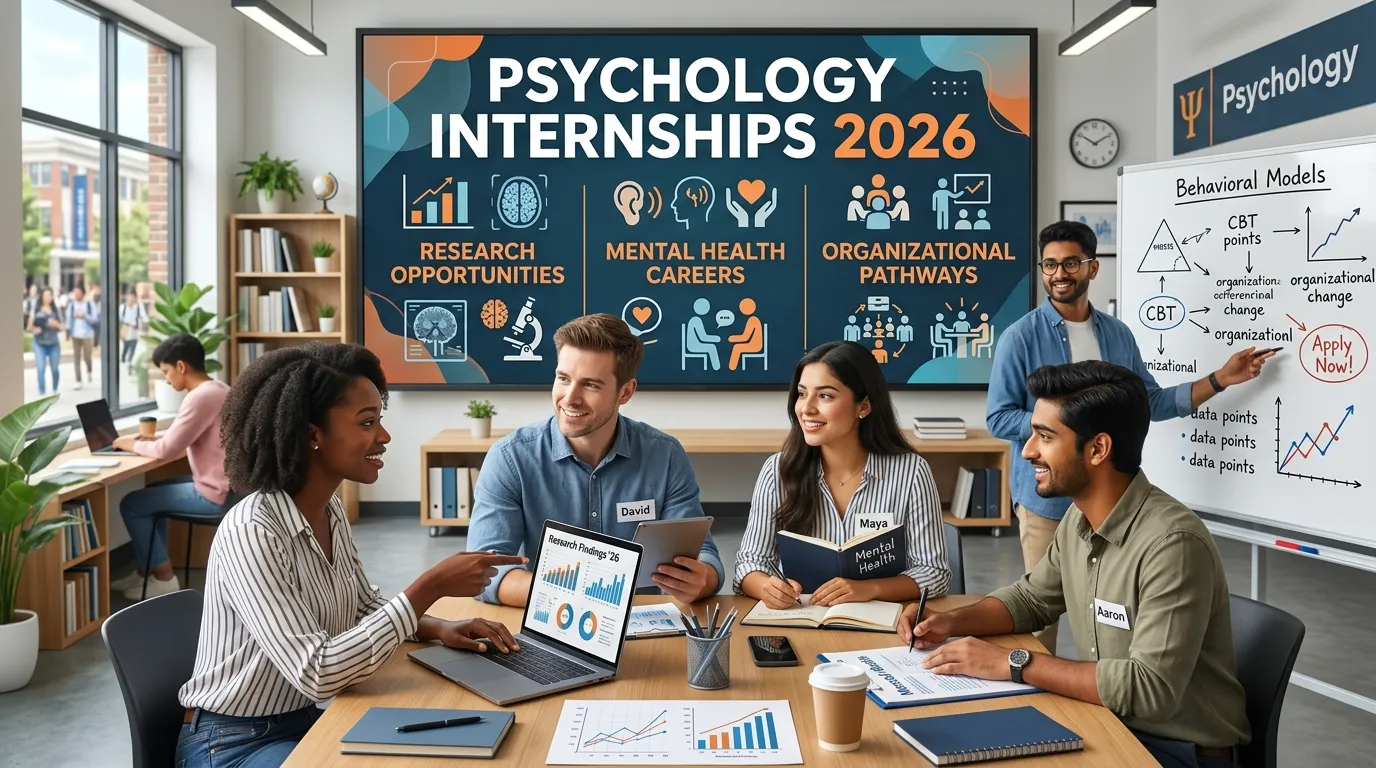
Psychology is a broad field that connects human behavior, mental health, research, education, healthcare, business, and organizational development. For students studying psychology, applied psychology, clinical psychology, counseling, neuroscience, or related subjects, an internship can provide valuable experience before entering professional employment or postgraduate study.
Psychology Internships 2026 are available across several areas, including psychological research, clinical and mental health services, counseling, child development, behavioral science, human resources, organizational psychology, education, and community programs.
Unlike classroom learning, an internship can expose students to real-world professional environments. Depending on the placement, students may assist with research, observe psychological assessments, support mental-health awareness activities, analyze behavioral data, participate in community programs, or learn about workplace psychology.
Current 2026 opportunities show how diverse the field has become. Aga Khan University’s 2026 international internship listings included Mental Health Research and Behavioural Health Research positions in Pakistan, while its program provides mentorship, logistical support, completion certification, and access to the Aga Khan Development Network professional community.
In Pakistan, psychology students can also find clinical, research, community, and school-based opportunities. The Balochistan Institute of Psychiatry and Behavioral Sciences announced a six-month Psychology Internship Program for 2026, while Punjab’s Psychological Well-being and Development Program offered a three-month school-based placement for BS/MS psychology students and recent graduates.
Internationally, psychology research internships can provide experience in areas such as mental health, developmental psychology, social psychology, cognitive science, behavioral neuroscience, and psychological assessment. Harvard’s 2026 summer opportunities, for example, included psychology research placements and programs from organizations and universities across the United States.
Psychology Internships 2026 at a Glance
| Category | Details |
|---|---|
| Main fields | Psychology, Applied Psychology, Behavioral Science |
| Common applicants | Psychology, neuroscience, social science and related students |
| Education levels | Undergraduate, Master’s and postgraduate |
| Research areas | Clinical, cognitive, developmental, social and behavioral psychology |
| Mental health areas | Counseling, clinical psychology, behavioral health and community support |
| Business areas | Organizational psychology, HR, workplace wellbeing and psychometrics |
| Useful skills | Research, interviewing, statistics, communication and observation |
| Software | SPSS, R, Python, Excel and statistical tools |
| Typical duration | 4 weeks to 6 months or longer |
| Work settings | Hospitals, clinics, universities, schools, NGOs and companies |
| Possible outcomes | Research experience, professional references, practical skills and career direction |
What Are Psychology Internships?
Psychology internships are structured learning experiences that allow students to apply psychological concepts in professional or research settings.
The work can vary dramatically depending on the specialization.
A clinical psychology intern may observe professional sessions, learn about psychological assessments, participate in case discussions, and develop an understanding of clinical procedures under appropriate supervision.
A research intern may collect data, conduct literature reviews, analyze research findings, or assist with academic projects.
An organizational psychology intern may work on employee engagement, workplace wellbeing, recruitment assessment, training, organizational behavior, or psychometric projects.
A community psychology intern may participate in awareness campaigns, social programs, school initiatives, or public mental-health projects.
This variety makes psychology internships useful for students who have not yet decided which branch of psychology they want to pursue.
Why Psychology Internships Matter in 2026
A psychology degree provides theoretical knowledge about human behavior, cognition, development, personality, mental health, and research methods.
However, professional psychology requires more than theoretical understanding.
An internship can help students develop:
- Professional communication
- Observation skills
- Research techniques
- Data-analysis experience
- Ethical awareness
- Interviewing skills
- Report writing
- Teamwork
- Case documentation
- Workplace professionalism
- Understanding of professional boundaries
For students considering clinical careers, supervised exposure can help them understand what professional psychological practice actually involves.
For students interested in research, an internship can demonstrate whether they enjoy collecting and analyzing evidence.
For organizational psychology students, an internship can provide exposure to real workplace problems.
Types of Psychology Internships in 2026
1. Clinical Psychology Internships
Clinical psychology internships focus on mental health and psychological assessment.
Depending on the student’s level and the organization’s rules, activities may include:
- Observing clinical sessions
- Learning about case history
- Psychological assessment exposure
- Mental-status examination training
- Case documentation
- Psychoeducation
- Clinical research
- Professional ethics
Students must understand that an internship does not automatically qualify them to independently provide psychological treatment.
Clinical work should be performed according to the student’s education level, local regulations, institutional policies, and supervision requirements.
In Pakistan, Synapse’s clinical internship program describes practical exposure for psychology students from the fifth semester onward, including interviewing, history taking, mental-status examinations, clinical scenarios, and ethics.
2. Mental Health Research Internships
Mental health research is an important area for psychology students interested in evidence-based practice.
Research interns may work on:
- Mental health surveys
- Behavioral data
- Clinical research
- Literature reviews
- Interviews
- Research databases
- Psychological measurements
- Research reports
Aga Khan University’s 2026 internship listings included a Mental Health Research Intern at its Brain & Mind Institute and a Behavioural Health Research Intern at Aga Khan University Hospital.
These types of placements can be particularly valuable for students considering research-focused Master’s or PhD programs.
3. Counseling Psychology Internships
Counseling psychology focuses on helping individuals manage emotional, educational, social, and life-related challenges.
Internship activities can include exposure to:
- Counseling environments
- Intake procedures
- Communication techniques
- Psychoeducation
- Group activities
- Case discussions
- Mental-health awareness
Students should always work within the limits of their training and supervision.
4. Child and Adolescent Psychology Internships
Children and adolescents have specific psychological, developmental, educational, and social needs.
Internships in this area may involve:
- Child development
- Behavioral observation
- Educational support
- Emotional regulation
- Parent communication
- Autism-related services
- Youth mental health
- School-based wellbeing
This can be a valuable pathway for students interested in developmental psychology, educational psychology, or child mental health.
5. Developmental Psychology Internships
Developmental psychology examines changes in behavior and cognition throughout life.
Research areas can include:
- Childhood development
- Adolescence
- Aging
- Cognitive development
- Language development
- Social development
- Emotional development
Students may assist with experiments, observations, interviews, assessments, or research-data analysis.
6. Cognitive Psychology Internships
Cognitive psychology focuses on mental processes such as:
- Memory
- Attention
- Learning
- Decision-making
- Perception
- Language
- Problem-solving
These internships can overlap with neuroscience, human-computer interaction, artificial intelligence, education, and experimental psychology.
Social psychology examines how people think, feel, and behave in social environments.
Research may involve:
- Group behavior
- Social influence
- Prejudice
- Relationships
- Identity
- Communication
- Social decision-making
These skills can also be useful in advertising, consumer research, communications, and organizational psychology.
8. Organizational Psychology Internships
Organizational psychology applies psychological principles to workplaces.
Interns may work on:
- Employee engagement
- Workplace wellbeing
- Recruitment
- Training
- Performance
- Organizational culture
- Leadership
- Employee surveys
- Psychometric assessment
This is one of the strongest areas for students who want to combine psychology with business.
Psychology programs in Pakistan also recognize organizational settings as part of practical training. The University of Central Punjab’s BS Psychology internship course specifically describes exposure to both clinical and organizational environments.
What Do Psychology Interns Do?
Responsibilities vary according to the internship.
Common activities can include:
- Conducting literature reviews
- Collecting research data
- Entering and cleaning data
- Observing professional sessions
- Supporting surveys
- Preparing research materials
- Assisting with assessments
- Creating awareness materials
- Preparing reports
- Participating in team meetings
- Supporting community programs
- Conducting supervised interviews
Research placements may be more analytical, while clinical placements may be more observational and practice-oriented.
Psychology Research Internships
Research experience can be extremely valuable for students planning postgraduate education.
A psychology research project may involve:
- Identifying a research question.
- Reviewing existing literature.
- Developing a research design.
- Collecting data.
- Organizing participant information.
- Conducting statistical analysis.
- Interpreting findings.
- Writing a research report.
- Presenting results.
The APA’s 2026 SUPER Fellowship required participating undergraduates to complete at least 20 hours per week for nine weeks in a laboratory, followed by a reflection presentation and paper about the research experience.
This illustrates the difference between simply attending an internship and becoming actively involved in a structured research experience.
Psychology Internships for Undergraduate Students
Undergraduate psychology students can find opportunities in:
- Research laboratories
- Hospitals
- Mental-health organizations
- Schools
- NGOs
- Community programs
- HR departments
- Universities
- Behavioral research projects
Some programs accept students after their first or second year, while specialized clinical placements may require students to have completed several semesters.
Students should carefully check:
- Academic requirements
- Minimum semester
- Age requirements
- Research experience
- Background checks
- Supervision requirements
- Nationality restrictions
The APA SUPER Fellowship, for example, was designed for undergraduate students enrolled for the Fall 2026 term and required a faculty-supervised, student-driven research project.
Psychology Internships for Master’s Students
Master’s students can pursue more specialized opportunities.
Potential areas include:
- Clinical psychology
- Counseling psychology
- Health psychology
- Organizational psychology
- Behavioral research
- Neuropsychology
- Psychometrics
- Developmental psychology
Students at this level may also have more opportunities to participate in research projects, assessments, and specialized clinical training, depending on local regulations and institutional requirements.
Psychology Internships in Pakistan
Pakistan has opportunities across clinical services, mental health research, schools, NGOs, universities, and workplace psychology.
Balochistan Institute of Psychiatry and Behavioral Sciences
The Balochistan Institute of Psychiatry and Behavioral Sciences announced a six-month Psychology Internship Program for 2026. The program is based in Quetta and provides exposure through psychiatric and behavioral-health settings.
Punjab Psychological Well-being Program
Punjab’s Psychological Well-being and Development Program offered a three-month internship for BS/MS Psychology students and recent graduates.
The reported activities included mental-health awareness sessions, student wellbeing activities, assessments, and interactive programs in government schools. The program was described as volunteer-based and unpaid.
Aga Khan University
Aga Khan University’s 2026 international internship listings included psychology-related opportunities in mental health and behavioral health research in Pakistan.
The program also listed professional mentorship, logistical support, completion certification, meal vouchers, and access to the Aga Khan Development Network professional network among its program features.
Clinical Training
Private psychology organizations also offer supervised training opportunities.
For example, Logics Psychological Services lists an eight-week clinical psychology internship with online, Karachi, and Islamabad options for its 2026 program.
Students should distinguish between a training internship and a professional license or independent clinical qualification. Completing an internship alone does not grant the legal authority to practice independently.
Psychology Internships in Mental Health
Mental health is one of the most important areas for psychology students.
Internship opportunities may involve:
- Mental-health awareness
- Community outreach
- Research
- Clinical observation
- Youth programs
- Psychological wellbeing
- Behavioral health
- Psychoeducation
Synapse Pakistan’s summer internship program, for example, includes research, outreach and advocacy, and digital storytelling tracks related to youth mental health. Its research track includes data collection, literature reviews, surveys, interviews, and report presentations.
This shows that mental-health careers are not limited to therapy. Students can also work in research, advocacy, education, communications, and public-health programs.
Organizational Psychology Internships
Organizational psychology can provide an alternative career path for students who do not want to focus on clinical work.
Interns may gain experience in:
Recruitment
Understanding employee selection, interviews, and assessment processes.
Employee Engagement
Studying how employees experience their workplace.
Workplace Wellbeing
Supporting initiatives related to employee mental health and wellbeing.
Training and Development
Helping organizations design employee learning programs.
Psychometrics
Working with structured assessments and measurement tools.
Organizational Research
Analyzing employee surveys and organizational data.
Organizational psychology can lead toward careers in HR, people analytics, talent development, consulting, workplace wellbeing, and organizational development.
Psychology Internship Skills
Research Skills
Learn how to:
- Search academic literature
- Evaluate research quality
- Design surveys
- Collect data
- Organize research information
- Write reports
Statistical Skills
Psychology students should understand:
- Descriptive statistics
- Correlation
- Regression
- Hypothesis testing
- Sampling
- Research design
Software Skills
Useful tools include:
- SPSS
- R
- Python
- Excel
- Qualtrics
- REDCap
- NVivo
The specific tools vary by research area.
Communication Skills
Psychology professionals frequently communicate with:
- Clients
- Researchers
- Teachers
- Parents
- Managers
- Healthcare professionals
- Community organizations
Strong written and verbal communication is therefore essential.
Psychology Internship Portfolio Ideas
Students without professional experience can demonstrate their skills through academic projects.
Research Project
Conduct a small literature review on a psychology topic.
Possible topics:
- Social media and wellbeing
- Sleep and academic performance
- Stress among university students
- Workplace motivation
- Emotional regulation
Survey Analysis
Design a non-clinical survey, collect appropriate responses, and analyze the results using SPSS, R, or Python.
Literature Review
Prepare a structured review of research on a psychological topic.
Organizational Psychology Project
Analyze employee engagement research and propose a workplace wellbeing framework.
Behavioral Observation Project
Use ethically appropriate observational data to study a non-sensitive behavior and explain the methodology and limitations.
Always protect participant privacy and follow appropriate ethical procedures when collecting psychological or personal data.
How to Write a Psychology Internship CV
A psychology CV should emphasize education, research, practical experience, and relevant skills.
Education
Include:
- Degree
- University
- Expected graduation
- Relevant coursework
Useful courses may include:
- Research methods
- Statistics
- Clinical psychology
- Cognitive psychology
- Social psychology
- Developmental psychology
- Organizational psychology
Research Experience
Include:
- Research projects
- Lab work
- Literature reviews
- Surveys
- Academic presentations
- Research assistant work
Practical Experience
Mention relevant:
- Volunteer work
- Mental-health programs
- School experience
- Community projects
- HR experience
Technical Skills
List software you genuinely know, such as:
SPSS, R, Python, Excel, Qualtrics, NVivo
How to Find Psychology Internships in 2026
Search beyond the phrase “Psychology Internship.”
Useful searches include:
- Psychology Intern 2026
- Clinical Psychology Intern
- Psychology Research Intern
- Mental Health Research Intern
- Behavioral Health Intern
- Counseling Psychology Intern
- Organizational Psychology Intern
- Industrial Organizational Psychology Intern
- Child Psychology Intern
- Developmental Psychology Research Intern
- Psychometric Intern
- Behavioral Science Intern
- Human Resources Psychology Intern
Also search university laboratories, hospitals, mental-health organizations, schools, NGOs, research institutes, and corporate HR departments.
International Psychology Internships
International opportunities can provide exposure to different research systems and professional environments.
Harvard’s 2026 psychology summer-opportunities page listed research placements involving clinical assessment, adolescent risk prevention, neuroscience and society, social and cognitive development, and other psychology-related areas.
Nationwide Children’s Hospital’s 2026 Research Intensive Summer Experience was a 10-week program involving neuropsychological, mental-health, and behavioral-health data and measurement-based care, with opportunities for undergraduate, postbaccalaureate, and graduate students.
These examples demonstrate that psychology research internships can overlap with:
- Neuroscience
- Medicine
- Public health
- Child development
- Psychiatry
- Behavioral science
- Data science
Psychology Internships and Visa Sponsorship
International students should carefully check immigration requirements.
A psychology internship does not automatically include visa sponsorship.
Before applying internationally, check:
- Whether international students are eligible.
- Whether the internship requires local citizenship.
- Whether work authorization is needed.
- Whether the organization sponsors visas.
- Whether accommodation is included.
- Whether travel costs are covered.
- Whether insurance is required.
- Whether the placement is paid or unpaid.
Clinical psychology can have additional professional and licensing requirements, so international applicants should be especially careful when considering clinical placements.
Psychology Internship Stipends and Salaries
Psychology internship compensation varies considerably.
Some programs offer:
- Monthly stipends
- Research fellowships
- Hourly pay
- Housing
- Travel assistance
- Academic credit
Others are unpaid.
For example, the APA SUPER Fellowship provided a $4,000 student stipend for its 2026 summer research fellowship, while other psychology research opportunities listed by Harvard included both paid and unpaid placements.
In Pakistan, several psychology internships are structured primarily as training or volunteer experiences rather than salaried employment. The 2026 Punjab PWDP internship, for example, was reported as unpaid.
Students should therefore verify compensation directly with each organization.
Psychology Internship Interview Questions
Prepare for both behavioral and technical questions.
Common questions include:
- Why did you choose psychology?
- Which area of psychology interests you most?
- Why are you interested in this organization?
- Describe a psychology research project you completed.
- What research methods have you studied?
- Which statistical software do you know?
- How would you protect participant confidentiality?
- What is the difference between correlation and causation?
- How would you handle an unfamiliar research problem?
- What ethical considerations are important in psychological research?
- What have you learned from your previous experience?
- What psychology career are you considering?
For clinical placements, questions may also focus on professional boundaries, ethics, communication, confidentiality, and appropriate referral or supervision.
Benefits of Psychology Internships
Practical Experience
Students can see how psychological knowledge is used in professional environments.
Research Skills
Internships can provide experience with research design, data collection, analysis, and academic writing.
Professional Networking
Students can build relationships with psychologists, researchers, therapists, HR professionals, and academics.
Stronger Graduate Applications
Research and relevant practical experience can strengthen applications for postgraduate programs.
Career Discovery
An internship can help students decide whether they prefer:
- Clinical psychology
- Counseling
- Research
- Organizational psychology
- Education
- Mental health
- Neuroscience
- Behavioral science
Career Opportunities After a Psychology Internship
Psychology graduates can pursue a wide range of careers depending on their education, specialization, and local professional requirements.
Potential career directions include:
- Clinical psychologist
- Counseling psychologist
- Research assistant
- Research coordinator
- Behavioral researcher
- Organizational psychologist
- Industrial-organizational specialist
- Human resources specialist
- Talent development professional
- Mental health program officer
- Psychometrician
- Behavioral science researcher
- School psychology professional
- Rehabilitation support professional
- Academic researcher
Many advanced psychology careers require Master’s-level or doctoral education, supervised training, registration, or other professional requirements depending on the country.
Emerging Psychology Career Areas in 2026
Digital Mental Health
Technology is increasingly being used to support mental-health education, assessment, research, and service delivery.
Behavioral Science
Organizations are applying psychology to consumer behavior, public policy, product design, and decision-making.
Workplace Mental Health
Employee wellbeing has become an important organizational issue, creating opportunities for psychologists and behavioral professionals.
Neuropsychology
Psychology increasingly overlaps with neuroscience, brain research, cognitive assessment, and healthcare.
Child and Youth Mental Health
Research and services focused on children and adolescents remain important areas for psychology students.
Psychometrics
Organizations continue to use psychological measurement in research, education, employment, and assessment.
Psychology and Data Science
Researchers increasingly use statistical programming and computational methods to analyze large behavioral datasets.
Tips for Getting a Psychology Internship
1. Decide your direction early.
Choose whether you are more interested in research, clinical work, organizational psychology, counseling, education, or behavioral science.
2. Strengthen research methods.
Research skills are valuable across almost every psychology specialization.
3. Learn statistics.
SPSS, R, or Python can make you more competitive for research positions.
4. Build practical projects.
A well-documented research project can strengthen your CV.
5. Gain relevant volunteer experience.
Community programs, education projects, and mental-health initiatives can provide useful exposure.
6. Understand professional ethics.
Confidentiality, informed consent, boundaries, and responsible research practices are essential.
7. Customize your CV.
Highlight the experience most relevant to each internship.
8. Contact research supervisors professionally.
For academic opportunities, demonstrate genuine interest in the researcher’s work.
9. Apply broadly.
Consider hospitals, universities, NGOs, companies, schools, and research centers.
10. Never overstate your clinical qualifications.
An internship provides training and exposure; it does not automatically make a student qualified to practice independently.
Frequently Asked Questions
Are psychology internships available for undergraduate students in 2026?
Yes. Undergraduate students can find psychology internships in research, mental health, community programs, education, organizational psychology, and behavioral science. Requirements vary by program.
What can I do during a psychology internship?
Depending on the placement, you may assist with research, literature reviews, data collection, surveys, psychological assessments, awareness programs, organizational projects, or supervised clinical observations.
Can psychology students get mental health internships?
Yes. Mental-health research, behavioral health, community wellbeing, youth programs, and clinical training placements are available, although clinical roles often have additional supervision and eligibility requirements.
Can psychology students work in HR?
Yes. Organizational and industrial-organizational psychology overlap strongly with HR, recruitment, employee engagement, training, workplace wellbeing, and psychometric assessment.
Do psychology internships require SPSS?
Not all of them. SPSS is useful for many academic psychology research projects, while R, Python, Excel, Qualtrics, and other tools may be used depending on the organization.
Are psychology internships paid?
Some are paid, while others offer stipends, academic credit, or unpaid training. Compensation varies considerably by organization and country.
Can international students apply for psychology internships?
Some programs accept international students, while others have citizenship, residency, or university restrictions. Applicants should check visa and work-authorization requirements carefully.
Can an internship make me a clinical psychologist?
No. Completing an internship alone does not make someone a licensed or independently practicing clinical psychologist. Professional qualifications, supervised training, registration, and other requirements depend on the country and specialization.
Are psychology research internships useful for PhD applications?
Yes. Research internships can provide experience with research methodology, data analysis, academic writing, presentations, and collaboration with researchers.
What is the difference between clinical and organizational psychology internships?
Clinical psychology internships focus primarily on mental health, assessment, counseling, and clinical environments under appropriate supervision. Organizational psychology internships focus on workplaces, employee behavior, recruitment, engagement, wellbeing, leadership, and organizational development.
Final Thoughts
Psychology Internships 2026 offer much more than clinical experience. Students can explore research, mental health, counseling, child development, neuroscience, behavioral science, organizational psychology, human resources, education, and community programs.
The strongest candidates increasingly combine their psychology education with research methods, statistics, communication, data analysis, ethical awareness, and practical experience.
If your goal is clinical psychology, look for supervised placements that expose you to appropriate professional environments. If you are interested in research, prioritize laboratories, universities, hospitals, and behavioral research programs. Students interested in business can explore organizational psychology, workplace wellbeing, HR, psychometrics, and people analytics.
International students should carefully review eligibility and visa rules, while everyone should verify whether an internship is paid, unpaid, research-focused, clinical, observational, or training-based.
Ultimately, the best psychology internship is one that matches your long-term career direction and gives you meaningful experience that you can explain clearly on your CV and in future graduate-school or job applications.