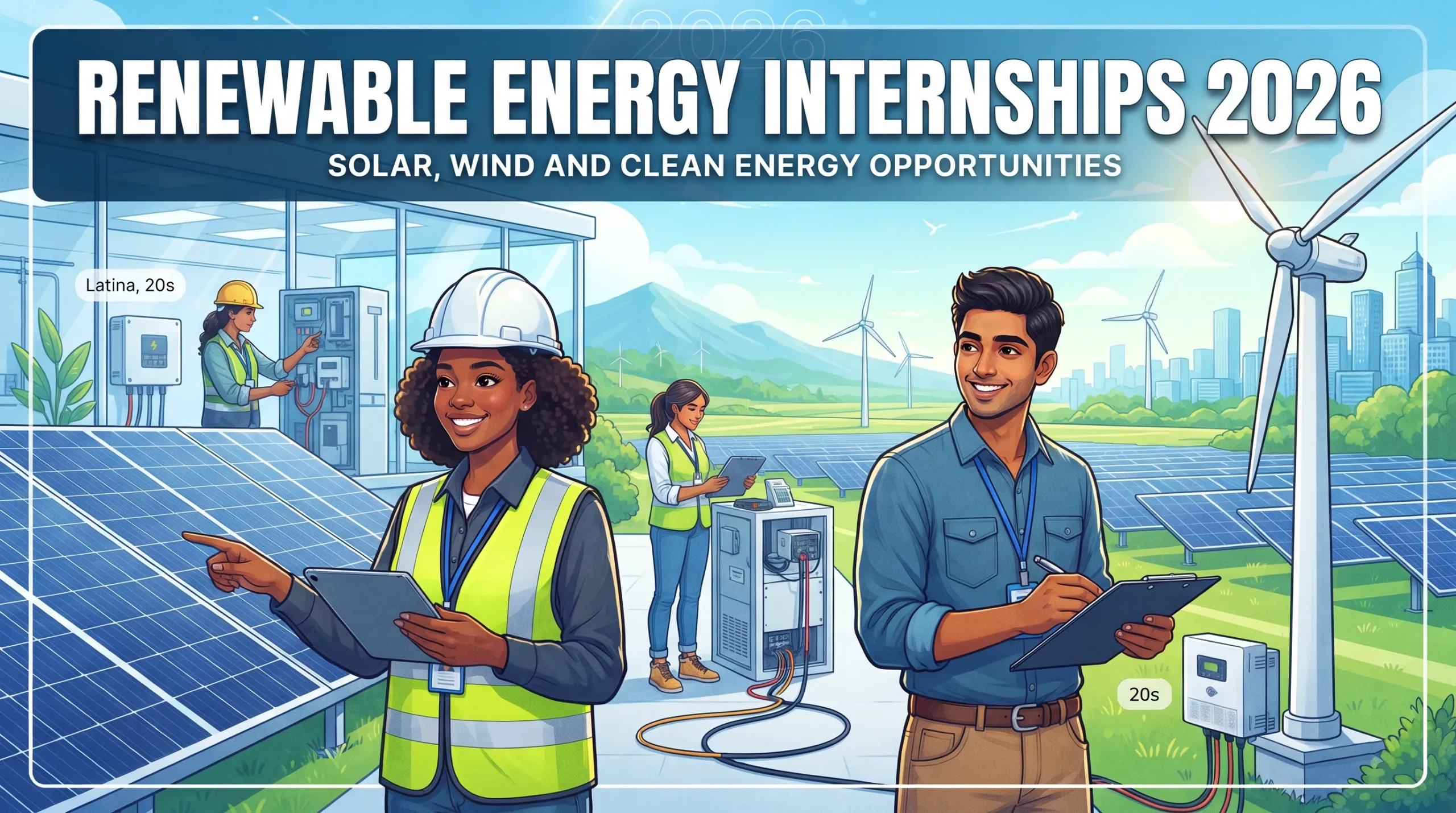
The global energy industry is undergoing a major transformation. Solar power, wind energy, battery storage, smart grids, energy efficiency and other clean-energy technologies are creating new opportunities for students and recent graduates.
For anyone interested in engineering, environmental science, sustainability, climate policy, data, finance or technology, a renewable energy internship in 2026 can provide valuable experience before entering the clean-energy workforce.
Renewable energy internships are much broader than installing solar panels or working at a wind farm. Depending on the organization, an intern may help design photovoltaic systems, analyze electricity data, research energy markets, work on battery-storage projects, conduct environmental assessments, support energy-policy research or develop software for clean-energy projects.
The sector is also generating employment across developing markets. The International Renewable Energy Agency’s latest annual review estimates that Pakistan’s solar PV sector alone supported around 180,000 jobs in 2024, while hydropower supported approximately 111,400 jobs.
There are already examples of renewable-energy internships in Pakistan. NUST’s U.S.-Pakistan Center for Advanced Studies in Energy offered 2026 programs covering renewable energy and grid integration, including solar and wind systems.
A paid 2026 internship at LUMS and Open Energy Transition focused on energy data, grid mapping, rooftop solar estimates and AI-assisted data processing.
This guide explains the different types of renewable energy internships available in 2026, salary expectations, eligibility, skills, responsibilities, international opportunities, visa considerations and practical application strategies.
Renewable Energy Internship Overview
| Category | Details |
|---|---|
| Industry | Renewable Energy / Clean Energy |
| Common Roles | Solar Intern, Wind Energy Intern, Energy Analyst Intern, Sustainability Intern |
| Major Technologies | Solar PV, Wind, Hydropower, Batteries, Smart Grids |
| Related Fields | Engineering, Environmental Science, Energy, Data, Finance and Policy |
| Education | Engineering, Science, Business, IT or related fields |
| Experience Level | Students, final-year students and recent graduates |
| Typical Duration | 1–6 months, depending on the program |
| Work Settings | Office, laboratory, project site, field and hybrid/remote |
| Technical Skills | Excel, MATLAB, Python, GIS, PVsyst or engineering software |
| Potential Employers | Energy companies, utilities, startups, consultancies, NGOs and research institutions |
| Career Paths | Renewable Energy Engineer, Energy Analyst, Solar Engineer, Sustainability Specialist |
Why Renewable Energy Internships Are in Demand
The transition toward cleaner energy is creating demand for people who understand energy systems and emerging technologies.
Solar photovoltaic systems, wind farms, energy storage and modern electricity grids require professionals across engineering, finance, project management, data analysis, environmental assessment and policy.
Solar is particularly important in markets where distributed electricity generation is expanding.
In Pakistan, IRENA reports that solar PV has expanded faster than other renewable technologies in recent years, with distributed rooftop, captive and off-grid systems driving much of the growth.
Wind energy is also creating opportunities. In England, applications for onshore wind farms reached a ten-year high during the year to March 2026, demonstrating renewed development activity in at least part of the European market.
However, the clean-energy industry is not limited to solar and wind.
It also includes:
- Battery storage
- Hydropower
- Biomass
- Biogas
- Geothermal energy
- Green hydrogen
- Smart grids
- Energy efficiency
- Electric vehicles
- Energy management
- Carbon reduction
- Climate technology
This makes renewable energy a multidisciplinary career field.
Solar Energy Internships
Solar energy is one of the most accessible areas for students entering renewable energy.
A solar internship can involve either technical engineering work or commercial and business activities.
Solar Engineering Intern
Technical interns may assist with:
- Solar PV system design
- Energy-yield calculations
- Site assessments
- Electrical drawings
- Equipment selection
- Inverter analysis
- System sizing
- Performance monitoring
- Installation planning
- Technical documentation
A basic understanding of electrical systems is usually helpful.
Solar Sales and Business Internships
Not every renewable-energy internship requires an engineering degree.
Solar companies also need interns for:
- Sales
- Business development
- Market research
- Customer support
- Marketing
- Project coordination
- Procurement
- Finance
A 2026 solar internship listing in Islamabad, for example, involved customer requirements, solar-system knowledge, presentations, lead generation and renewable-energy market research.
This demonstrates that renewable-energy companies can offer opportunities outside purely technical engineering roles.
Wind Energy Internships
Wind energy internships can be especially useful for students studying mechanical, electrical or energy engineering.
Possible responsibilities include:
- Wind-resource assessment
- Turbine technology research
- Power-generation analysis
- Turbine maintenance planning
- Electrical systems
- Mechanical systems
- Data analysis
- Environmental assessment
- Project development
- Wind-farm operations
Skills for Wind Energy Internships
Useful technical knowledge includes:
- Electrical engineering
- Mechanical engineering
- Fluid mechanics
- Power systems
- Statistics
- Data analysis
- Geographic information systems
- Engineering simulation
Interns may also need to understand how wind conditions affect energy production.
Clean Energy and Sustainability Internships
Clean-energy internships can extend beyond specific technologies.
Sustainability interns may work on:
- Carbon reduction
- Energy efficiency
- Sustainability reporting
- Environmental research
- Climate policy
- Corporate sustainability
- Green-building projects
- Energy audits
- Environmental impact assessments
These positions may be suitable for students studying environmental science, sustainability, public policy, economics or business.
A 2026 green-workforce program in Pakistan, for example, offers structured training and placements covering climate action, sustainable development, environmental research, energy transition and resilience.
Renewable Energy Engineering Internships
Engineering remains one of the strongest pathways into the renewable-energy sector.
Electrical Engineering
Electrical engineering interns can work on:
- Solar PV systems
- Grid integration
- Power electronics
- Inverters
- Transformers
- Transmission
- Distribution
- Smart grids
- Battery systems
Mechanical Engineering
Mechanical engineers can pursue:
- Wind turbines
- Hydropower
- Energy systems
- Thermal systems
- Equipment design
- Maintenance
- Manufacturing
Civil Engineering
Civil engineering can be relevant to:
- Renewable-energy project construction
- Foundations
- Solar farms
- Wind farms
- Hydropower infrastructure
- Site development
Environmental Engineering
Environmental engineers can work on:
- Environmental assessments
- Sustainability
- Waste management
- Water impacts
- Emissions
- Environmental compliance
Renewable Energy Data and Technology Internships
Modern energy systems generate huge amounts of data.
This creates opportunities for students with backgrounds in:
- Computer science
- Data science
- Artificial intelligence
- Statistics
- GIS
- Software engineering
Interns can work on:
- Electricity-demand forecasting
- Solar-energy forecasting
- Wind forecasting
- Grid mapping
- Energy dashboards
- Data visualization
- Geographic analysis
- Energy-market analysis
The 2026 LUMS/Open Energy Transition internship is a good example of this intersection. Its projects included mapping Pakistan’s electrical grid, identifying gaps in grid datasets, estimating rooftop solar and utility-scale solar capacity, and using AI-assisted techniques to clean and visualize energy data.
Renewable Energy Internship Salary Range
There is no single worldwide salary for renewable-energy interns.
Compensation depends on the country, employer, academic program, location and whether the position is a professional internship or an educational training program.
In Pakistan, internships can range from unpaid academic placements to paid positions.
For example, a 2026 solar-industry internship advertised through the Career Development Center at COMSATS University Wah describes the position as paid and includes accommodation for out-of-station interns.
Other programs may have no salary. An AICTE-listed renewable-energy internship in India, for example, shows a zero monthly stipend while offering academic credits and renewable-energy training.
Therefore, applicants should always distinguish between salary, stipend, academic credit and training programs.
| Location | Typical Structure |
|---|---|
| United States | Often hourly paid internships |
| Canada | Paid placements are available through companies and universities |
| United Kingdom | Paid internships vary by employer |
| Germany | Compensation varies according to employer and internship arrangement |
| Australia | Paid industry placements are available |
| Pakistan | Paid, stipend-based and unpaid internships all exist |
| India | Both paid and unpaid academic internships are available |
Do not assume that an internship is paid simply because it appears on a job or internship website.
Employee Benefits
Renewable-energy internships can offer benefits beyond direct compensation.
Depending on the program, interns may receive:
- Monthly stipend
- Hourly pay
- Accommodation
- Professional training
- Technical experience
- Mentorship
- Industry networking
- Internship certificate
- Academic credit
- Field experience
- Research experience
- Potential full-time employment
The practical experience can be particularly valuable.
For example, NUST’s 2026 renewable-energy and grid-integration program offered exposure to solar and wind systems and renewable-energy integration, along with hands-on learning and certificates.
Renewable Energy Internship Responsibilities
Responsibilities depend on the specialization.
Technical Responsibilities
Engineering interns may:
- Assist with system design
- Perform calculations
- Prepare technical reports
- Analyze equipment
- Review engineering drawings
- Monitor project performance
- Assist with testing
- Conduct site assessments
Research Responsibilities
Research interns may:
- Collect energy data
- Review scientific literature
- Analyze datasets
- Prepare reports
- Conduct simulations
- Build models
- Document findings
Commercial Responsibilities
Business interns may:
- Research renewable-energy markets
- Identify potential customers
- Support sales teams
- Prepare presentations
- Analyze competitors
- Assist with project proposals
Sustainability Responsibilities
Sustainability interns may:
- Track energy consumption
- Calculate emissions
- Research climate policy
- Prepare sustainability reports
- Support environmental projects
- Analyze energy-efficiency opportunities
Required Skills
Renewable Energy Fundamentals
Start by understanding:
- Solar PV
- Wind turbines
- Electricity generation
- Grid integration
- Energy storage
- Energy efficiency
You do not need to know everything before your first internship, but strong fundamentals make learning easier.
Excel
Excel is useful for:
- Energy calculations
- Financial models
- Project tracking
- Data analysis
- Charts
- Reporting
Python
Python can be valuable for:
- Data analysis
- Energy forecasting
- Automation
- Modeling
- Visualization
MATLAB
MATLAB is widely useful in engineering and energy-system analysis.
It can help with:
- Power-system simulations
- Mathematical modeling
- Renewable-energy calculations
- Data analysis
GIS
GIS is useful for:
- Solar-site analysis
- Wind-resource mapping
- Grid mapping
- Land-use analysis
- Infrastructure planning
PVsyst and Other Solar Software
Students interested in solar engineering can benefit from learning photovoltaic-system design and simulation software such as PVsyst.
Communication
Technical knowledge alone is not enough.
Renewable-energy professionals work with:
- Engineers
- Investors
- Government officials
- Customers
- Contractors
- Communities
- Researchers
The ability to explain technical information clearly is extremely valuable.
Education and Experience Requirements
Renewable-energy internships are open to students from many disciplines.
Common degrees include:
- Electrical Engineering
- Mechanical Engineering
- Civil Engineering
- Environmental Engineering
- Energy Engineering
- Environmental Science
- Computer Science
- Data Science
- Physics
- Mathematics
- Economics
- Business
- Public Policy
Some internships do not require previous renewable-energy experience.
For example, the 2026 PARWAZ green-workforce program states that prior climate expertise is not required and is designed for final-year students and recent graduates.
Other technical positions may expect a stronger background in electrical or energy engineering.
Can Fresh Graduates Apply?
Yes, depending on the employer.
Some programs are specifically designed for students, while others accept recent graduates.
A good strategy is to search both:
- Internship
- Graduate trainee
- Junior renewable-energy analyst
- Graduate engineer
- Energy trainee
This can significantly increase the number of relevant opportunities you find.
Renewable Energy Internships in Pakistan
Pakistan is an increasingly interesting market for students interested in solar and other renewable technologies.
IRENA’s latest employment review identifies solar PV and hydropower as major contributors to renewable-energy employment in the country.
Islamabad
Islamabad offers opportunities through:
- Universities
- Energy research institutions
- Solar companies
- Government organizations
- Climate organizations
- Energy consultancies
NUST’s energy center has offered internships covering renewable-energy systems and grid integration.
Lahore
Lahore has a growing ecosystem of:
- Solar companies
- Engineering firms
- Energy consultancies
- Universities
- Sustainability organizations
Karachi
Karachi is an important commercial center with opportunities involving:
- Solar projects
- Energy finance
- Engineering
- Power companies
- Sustainability
- Renewable-energy investment
Other Pakistani Cities
Students should not limit their search to the largest cities.
Renewable-energy projects can operate in:
- Faisalabad
- Multan
- Peshawar
- Quetta
- Hyderabad
- Rawalpindi
- Smaller regional locations
Online and hybrid opportunities can also reduce geographical limitations.
International Renewable Energy Internships
International clean-energy internships are available across major energy markets.
Potential destinations include:
- United States
- Canada
- United Kingdom
- Germany
- Netherlands
- Denmark
- Australia
- New Zealand
- Singapore
- United Arab Emirates
- India
Opportunities can exist at:
- Renewable-energy developers
- Utilities
- Engineering companies
- Universities
- Research laboratories
- Government agencies
- Climate organizations
- Energy consultancies
- Technology companies
What Should International Students Look For?
When searching abroad, check:
- Whether international students are eligible.
- Whether the employer accepts applicants without local work authorization.
- Whether visa sponsorship is available.
- Whether university enrollment is required.
- Whether the internship must be related to your degree.
- Whether relocation assistance is provided.
Visa Sponsorship Information
A renewable-energy internship advertised internationally does not automatically include visa sponsorship.
Possible immigration routes may include:
- Student work authorization
- University-approved internships
- Temporary training visas
- Internship-specific permits
- Research visas
- Graduate work authorization
- Post-study work routes
The correct route depends on the country and your circumstances.
For students hoping to remain abroad after graduation, it is useful to investigate whether the destination offers a pathway from study or internship experience to graduate employment.
Never pay a third party simply because they claim to guarantee a renewable-energy internship visa.
Verify immigration requirements through the destination country’s official government resources.
How to Apply for Renewable Energy Internships in 2026
1. Select Your Specialization
Decide whether you want to pursue:
- Solar
- Wind
- Energy storage
- Power systems
- Sustainability
- Energy data
- Energy finance
- Climate policy
- Green technology
A focused application is generally stronger than a generic one.
2. Create a Renewable-Energy Resume
Highlight:
- Degree
- Relevant coursework
- Engineering projects
- Software skills
- Research
- Academic achievements
- Certifications
- Energy-related projects
For technical roles, place technical skills prominently.
3. Build a Small Project
A portfolio can make a major difference.
For example, create a solar-energy analysis project showing:
- Location
- Solar resource
- Estimated system size
- Energy generation
- Monthly production
- Basic financial analysis
Or create a Python project analyzing public electricity-generation data.
4. Search Beyond “Renewable Energy Intern”
Use related search terms:
- Solar Energy Intern
- Solar Engineering Intern
- Wind Energy Intern
- Energy Analyst Intern
- Sustainability Intern
- Clean Energy Intern
- Energy Data Intern
- Power Systems Intern
- Energy Research Intern
- Climate Intern
- Green Technology Intern
- Energy Finance Intern
5. Apply Through Official Channels
Universities, energy companies and government institutions frequently advertise programs through their own websites.
The KP Internship Portal, for example, provides an official platform for searching active internship opportunities in Khyber Pakhtunkhwa and warns applicants about fake internship notifications.
Always verify the employer and application destination before submitting personal documents.
Tips to Increase Hiring Chances
Learn One Technical Tool Well
You do not need ten certifications.
It can be more valuable to demonstrate practical competence in one tool such as:
- Python
- MATLAB
- Excel
- PVsyst
- HOMER
- AutoCAD
- GIS
Choose the tool most relevant to your desired role.
Understand Solar Basics
Even if you want a business role, understand:
- Solar panels
- Inverters
- Batteries
- Net metering
- Grid connection
- System sizing
- Energy generation
This can make interviews easier.
Follow the Energy Industry
Read about:
- Renewable-energy policies
- Electricity markets
- Solar prices
- Battery storage
- Grid modernization
- Energy security
- Climate policy
Employers appreciate candidates who understand the broader industry.
Prepare a Project Portfolio
Include two or three projects rather than a long list of courses.
For each project explain:
- Problem
- Method
- Tools
- Result
- What you learned
Apply Early
Some summer internships close applications months before the placement starts.
Do not wait until the last week.
Students seeking renewable-energy internships abroad may encounter different immigration routes depending on their destination.
Potential options include:
- Student internship authorization
- University placement authorization
- Temporary work permits
- Training visas
- Research visas
- Graduate work programs
- Post-study work permits
- Employer-sponsored employment
A short internship and a full-time renewable-energy job can have completely different immigration requirements.
If your ultimate objective is international employment, investigate the country’s graduate and skilled-worker pathways before choosing an internship destination.
Cost of Living for International Interns
Clean-energy projects can be located in major cities or remote project areas.
Before accepting an international internship, calculate:
- Rent
- Food
- Transportation
- Flights
- Visa fees
- Insurance
- Local travel
- Phone and internet
- Emergency expenses
Also ask whether the employer provides:
- Housing
- Transportation
- Meals
- Relocation assistance
- Travel reimbursement
- Stipend
A higher internship salary does not necessarily mean a better financial outcome if the city has a very high cost of living.
Frequently Asked Questions
1. What is a renewable energy internship?
A renewable energy internship is a temporary educational or professional placement where students gain practical experience in areas such as solar, wind, energy storage, power systems, sustainability or clean-energy research.
2. Who can apply for renewable energy internships?
Students and recent graduates from engineering, environmental science, energy, computer science, data science, economics, business and related disciplines can apply, depending on the position.
3. Are renewable energy internships paid in 2026?
Some are paid and others are unpaid or provide academic credit. Compensation varies significantly by employer, country and internship structure. A 2026 solar internship listed through COMSATS University Wah, for example, is described as paid and includes accommodation for out-of-station interns.
4. What skills are required for solar internships?
Useful skills include basic electrical knowledge, solar PV fundamentals, Excel, technical calculations and software such as PVsyst. Communication and problem-solving are also important.
5. Can mechanical engineering students work in renewable energy?
Yes. Mechanical engineers can pursue internships involving wind turbines, energy systems, hydropower, equipment design, manufacturing and maintenance.
6. Can computer science students get renewable energy internships?
Yes. Energy companies increasingly need software, data, GIS, AI and analytics skills. A 2026 energy-data internship at LUMS/Open Energy Transition, for example, specifically sought programming and GIS-related capabilities.
7. Are wind energy internships available?
Yes. Wind internships can involve turbine technology, wind-resource analysis, power generation, maintenance, environmental assessment and project development.
8. Can international students get renewable energy internships abroad?
Yes, but eligibility depends on the employer, country and work authorization. Some internships require students to already have permission to work in the destination country.
9. Can a renewable energy internship lead to a full-time job?
Yes. Internships can provide practical experience and professional connections that may improve your chances of securing a graduate or entry-level position, although employment is not guaranteed.
10. Where can I find renewable energy internships in 2026?
Look at official company career pages, university energy centers, government internship portals, research institutions, renewable-energy organizations and reputable job platforms. Always verify the original employer before applying.
Final Thoughts
Renewable energy internships in 2026 can provide an excellent starting point for students who want to build careers in solar, wind, energy storage, power systems, sustainability or clean technology.
The sector needs much more than engineers.
Solar and wind projects require business professionals, financial analysts, environmental specialists, software developers, data scientists, researchers, project managers and policy experts.
For engineering students, learning solar PV systems, power electronics, electrical design or wind technology can provide a strong technical foundation.
For computer science and data students, energy forecasting, GIS, AI and grid-data analysis can create another route into the industry.
For business and economics students, renewable-energy finance, project development, market research and energy policy can be attractive options.
The current internship landscape reflects this diversity. In Pakistan, 2026 programs have covered renewable-energy grid integration, energy data, solar systems, climate action and green-workforce development.
The best approach is to choose a specialization, develop practical skills and build at least one project that demonstrates your interest.
Do not focus only on the highest-paying internship. Look for an opportunity where you can work with experienced professionals, learn industry tools and contribute to real projects.
As the global energy system continues to evolve, practical experience in solar energy, wind power, energy storage, smart grids and clean-energy technology can give students a valuable foundation for future careers.