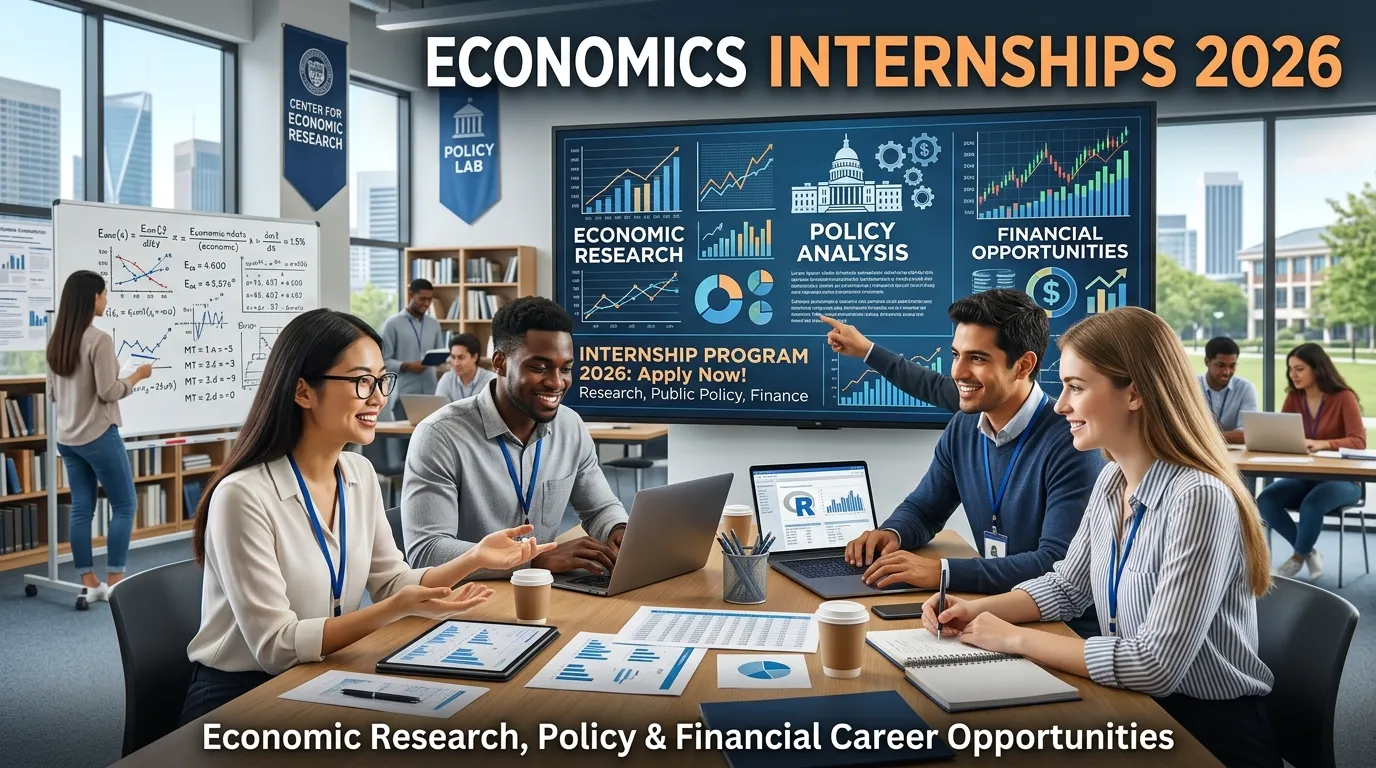
Economics is one of the most versatile academic fields for students interested in research, finance, government, business, international development, and data-driven decision-making. In 2026, economics students can find internship opportunities ranging from economic research and public policy to banking, financial analysis, consulting, development economics, and business analytics.
Economics Internships 2026 give students an opportunity to move beyond textbooks and apply economic theory to real-world problems. Depending on the organization, an intern might analyze economic data, support policy research, build forecasts, study markets, evaluate development programs, conduct literature reviews, or assist economists with research projects.
The field also overlaps strongly with statistics, mathematics, data science, finance, and public policy. This means economics students can apply for many positions that do not necessarily have “economics” in the job title.
Current 2026 programs illustrate this range. The State Bank of Pakistan’s six-week Summer Internship Program included Economics among its eligible disciplines, while the Pakistan Institute of Development Economics offered an eight-week research and policy internship covering economics, public policy, public finance, data science, and statistics.
Internationally, the Federal Reserve Board’s internship program offers undergraduate and graduate opportunities related to economics, public policy, finance, accounting, and data analysis, while Brookings offers paid internships across research programs including Economic Studies and Global Economy and Development.
This guide explains the major types of economics internships available in 2026, the skills employers look for, research and policy opportunities, financial careers, international options, salaries, visa considerations, and application strategies.
Economics Internships 2026 at a Glance
| Category | Details |
|---|---|
| Main field | Economics and Economic Research |
| Common applicants | Economics, Econometrics, Finance, Mathematics and Statistics students |
| Education levels | Undergraduate, Master’s and PhD |
| Research areas | Macroeconomics, microeconomics, development, labor and international economics |
| Policy areas | Public finance, monetary policy, trade and development |
| Financial areas | Banking, investment, risk and financial analysis |
| Technical skills | Excel, R, Python, Stata, SQL, MATLAB |
| Research skills | Econometrics, data analysis, literature review and report writing |
| Typical duration | 6–12 weeks or several months |
| Work formats | On-site, hybrid and selected remote |
| Possible employers | Banks, universities, think tanks, governments and companies |
What Are Economics Internships?
Economics internships are practical learning experiences where students use economic concepts and analytical methods to solve real-world problems.
An internship at a research institute may involve studying poverty, inflation, employment, trade, economic growth, or public policy.
An internship at a bank could involve financial analysis, economic forecasting, market research, or risk-related work.
A business internship might focus on pricing, consumer behavior, market demand, revenue, or operational performance.
The exact work depends on the organization, but the central objective is the same: turn economic knowledge into practical analytical experience.
Why Economics Internships Matter in 2026
Studying economics develops an understanding of markets, incentives, policy, statistics, and decision-making. However, employers often want candidates who can demonstrate that they can apply these concepts to actual problems.
An internship can help students learn how to:
- Analyze economic datasets
- Conduct literature reviews
- Interpret economic indicators
- Build forecasts
- Perform econometric analysis
- Research public policies
- Prepare professional reports
- Present economic findings
- Work with economists and analysts
- Use statistical software
- Understand financial markets
- Communicate complex ideas clearly
The experience can also help students decide which area of economics they want to pursue after graduation.
Types of Economics Internships in 2026
1. Economic Research Internships
Economic research internships are ideal for students interested in academic research, think tanks, central banks, universities, and international organizations.
Interns may work on:
- Literature reviews
- Economic datasets
- Econometric models
- Research papers
- Policy analysis
- Forecasting
- Data visualization
- Research presentations
The Institute for Fiscal Studies, for example, describes its summer placements as research-oriented opportunities involving literature review, data preparation and analysis, and writing research results. Its placements are aimed primarily at undergraduate and master’s students with strong economics backgrounds.
2. Development Economics Internships
Development economics examines economic and social issues affecting developing and emerging economies.
Possible topics include:
- Poverty
- Education
- Employment
- Healthcare
- Agriculture
- Infrastructure
- Gender and inequality
- Human capital
- Economic growth
- Financial inclusion
These internships can be particularly useful for students interested in international development and public policy.
The World Bank’s 2026 Development Impact internship opportunities included students from economics, public policy, data science, computer science, and related fields, with projects involving development research, data, and policy-related work.
3. Public Policy Internships
Public policy internships allow economics students to study how government decisions affect individuals, businesses, and economies.
Interns may research:
- Taxation
- Government spending
- Employment
- Inflation
- Education
- Healthcare
- Trade
- Energy
- Social protection
Students can find these opportunities at think tanks, government agencies, policy organizations, research institutes, and international development organizations.
4. Banking Internships
Banks employ economics students for many analytical roles.
Possible internship areas include:
- Economic research
- Credit analysis
- Risk
- Financial markets
- Treasury
- Corporate banking
- Data analytics
- Strategy
Central banks can be particularly valuable for students interested in monetary economics and financial stability.
The State Bank of Pakistan’s 2026 Summer Internship Program, for example, included Economics among its eligible disciplines and ran for six weeks at SBP Karachi.
5. Financial Economics Internships
Financial economics combines economic theory with financial markets.
Interns may study:
- Interest rates
- Investment
- Financial markets
- Risk
- Asset pricing
- Corporate finance
- Economic indicators
Students interested in this area should develop strong quantitative and financial-analysis skills.
6. Business Economics Internships
Businesses use economic analysis to make decisions about markets, pricing, customers, investment, and expansion.
Possible projects include:
- Market analysis
- Pricing analysis
- Demand forecasting
- Competitor research
- Revenue analysis
- Customer behavior
- Business strategy
This is a useful option for students who want a private-sector career.
7. Econometrics Internships
Econometrics applies statistical methods to economic questions.
Students may work with:
- Regression models
- Panel data
- Time-series data
- Causal inference
- Forecasting
- Experimental data
- Survey data
Econometrics can be particularly valuable for students considering research, policy analysis, finance, or data science.
What Do Economics Interns Do?
The responsibilities vary considerably.
A research intern might spend several weeks collecting data and reproducing economic analysis.
A policy intern may research legislation and prepare briefing documents.
A financial intern could analyze markets or company performance.
Typical tasks include:
- Collecting economic data
- Cleaning datasets
- Conducting literature reviews
- Running econometric models
- Creating charts
- Preparing presentations
- Monitoring economic indicators
- Writing research summaries
- Conducting market research
- Building spreadsheets
- Supporting senior economists
- Preparing reports
Strong interns learn how to move from data → analysis → interpretation → recommendation.
Essential Skills for Economics Internships
Economic Theory
Students should have a solid understanding of:
- Microeconomics
- Macroeconomics
- International economics
- Public economics
- Development economics
- Monetary economics
The required knowledge depends on the internship.
Econometrics
Econometrics is particularly valuable for research-oriented positions.
Important topics include:
- Regression
- Statistical inference
- Causal inference
- Panel data
- Time-series analysis
- Experimental methods
- Forecasting
Data Analysis
Economists increasingly work with large datasets.
Students should learn how to:
- Clean data
- Identify patterns
- Test hypotheses
- Create visualizations
- Interpret statistical output
- Communicate results
Programming
Programming is becoming increasingly useful for economics careers.
Useful tools include:
- Python
- R
- Stata
- MATLAB
- SQL
Stata remains especially relevant for econometrics and academic research, while Python and R are useful for data science and more advanced analytics.
Economics Internships for Undergraduate Students
Undergraduate students can apply for research, banking, consulting, government, and business internships.
Eligibility varies considerably.
For example, the 2026 SBP Summer Internship required students to have completed at least two years of a four-year bachelor’s degree or to be enrolled in a master’s program. Economics was one of the eligible disciplines, with academic performance requirements also specified.
Students should begin preparing well before internship deadlines.
A strong undergraduate profile can include:
- Good economics grades
- Econometrics coursework
- Research projects
- Data-analysis skills
- Programming
- Student societies
- Academic competitions
- Relevant volunteer or professional experience
Economics Internships for Master’s Students
Master’s students can target more advanced research and analytical positions.
Potential areas include:
- Econometrics
- Monetary economics
- Financial economics
- Development economics
- International economics
- Public finance
- Economic forecasting
- Data science
Master’s students can also pursue research assistant positions that may provide experience directly relevant to future PhD applications.
Economics Research Internships
Research internships can be especially valuable for students considering graduate school.
A typical economic research project may involve:
- Selecting a research question.
- Reviewing existing literature.
- Collecting data.
- Cleaning the dataset.
- Developing an empirical strategy.
- Running statistical or econometric models.
- Interpreting the results.
- Preparing tables and charts.
- Writing research findings.
- Presenting the results.
Students should become comfortable reading academic papers and explaining research methodology.
Harvard Economics’ Fall 2026 Research Assistant Program, for example, pairs undergraduate students with research projects and lists work related to economic questions such as inequality and redistribution.
Economics Internships in Pakistan
Pakistan has several relevant pathways for economics students.
State Bank of Pakistan
The State Bank of Pakistan is one of the most relevant institutions for students interested in economics, monetary policy, banking, and financial research.
Its 2026 Summer Internship Program ran from June 29 through August 7, 2026. Economics was among the eligible disciplines, and applicants needed to meet academic and educational requirements.
SBP also has a dedicated research function covering areas such as monetary policy transmission, structural economic issues, forecasting, scenario analysis, climate change, and digitalization.
Pakistan Institute of Development Economics
PIDE is another major option for students interested in economics and public policy.
Its 2026 internship program was an eight-week, full-time, on-site opportunity in Islamabad covering research centers, policy projects, and technical wings. Eligible fields included economics, public policy, public finance, data science, statistics, and related disciplines.
PIDE’s internship portal also describes its program as a research-focused experience involving mentorship from economists and work across specialized research centers.
The 2026 cohort ultimately included 140 interns selected from 62 universities across Pakistan and abroad, highlighting the competitive and research-oriented nature of the program.
International Economics Internship Opportunities
International opportunities can provide exposure to different economic systems and research environments.
Federal Reserve Board
The U.S. Federal Reserve Board offers internships for undergraduate and graduate students considering careers in economics, public policy, finance, accounting, and data analysis.
Its internships generally run for 10–12 weeks, are paid, and are based in Washington, D.C.
Brookings
Brookings offers internships across research programs including Economic Studies and Global Economy and Development. Its 2026 schedule includes spring, summer, and fall internship cohorts.
Reserve Bank of Australia
The Reserve Bank of Australia’s Economic and Policy Summer Intern Program is designed for third-year students studying economics or econometrics who intend to continue into honours or similar research programs.
The 2026 program is an eight-week full-time placement, although its eligibility requires Australian citizenship or permanent residency.
This illustrates an important point for international applicants: a high-quality economics internship is not necessarily open to international students.
Always check nationality and work-authorization requirements before applying.
Economics Internships and Visa Sponsorship
International students should not assume that an economics internship includes visa sponsorship.
Programs may have different rules regarding:
- Citizenship
- Permanent residency
- Student visas
- Work authorization
- Academic enrollment
- Sponsorship
- Relocation
- Accommodation
Some programs are explicitly restricted to citizens or permanent residents.
For example, the Reserve Bank of Australia’s 2026 Economic and Policy Summer Intern Program requires Australian citizenship or permanent residency.
Similarly, some U.S. economic policy positions can have citizenship restrictions.
Therefore, always read the official eligibility section before investing significant time in an application.
Economics Internship Stipends and Salaries
Compensation varies significantly between countries, organizations, and internship types.
Some internships offer:
- Monthly stipends
- Hourly wages
- Research fellowships
- Housing support
- Travel assistance
- Academic credit
- No financial compensation
For example, the Federal Reserve Board describes its internships as paid positions with salaries linked to the student’s level of higher education.
On the other hand, the World Bank Group’s 2026 Pioneers development-impact internships were listed as unpaid and required academic support or financial support from the student’s institution.
This is why applicants should verify compensation directly from each program instead of relying on generic internship salary estimates.
How to Build an Economics Internship Portfolio
A portfolio can help demonstrate analytical ability before you have professional experience.
Project 1: Inflation Analysis
Analyze inflation data for a country over several years.
Include:
- Inflation trends
- Major changes
- Possible causes
- Charts
- Economic interpretation
Project 2: Unemployment Analysis
Compare unemployment rates across different regions or demographic groups.
Discuss:
- Trends
- Correlations
- Economic factors
- Limitations
Project 3: Econometric Analysis
Build a regression model using a publicly available dataset.
Explain:
- Research question
- Variables
- Methodology
- Results
- Limitations
Project 4: Economic Forecast
Create a basic forecast for:
- Inflation
- GDP
- Unemployment
- Exchange rates
- Interest rates
Use appropriate statistical methods and clearly explain the assumptions.
Project 5: Policy Brief
Choose an economic issue and write a short policy brief.
Possible subjects include:
- Youth unemployment
- Inflation
- Energy prices
- Trade
- Public debt
- Education
- Housing
This can demonstrate both analytical and communication skills.
How to Write an Economics Internship CV
Your CV should show evidence of quantitative and analytical ability.
Education
Include:
- Degree
- University
- Expected graduation
- Relevant courses
Useful coursework may include:
- Econometrics
- Statistics
- Microeconomics
- Macroeconomics
- Financial economics
- Mathematical economics
Technical Skills
Mention relevant software such as:
- Stata
- R
- Python
- Excel
- SQL
- MATLAB
Research Projects
Describe the question, method, and outcome.
Instead of:
“Completed economics research.”
Use a specific description such as:
“Analyzed inflation and unemployment data using regression techniques in Stata and presented findings through statistical tables and visualizations.”
How to Find Economics Internships in 2026
Do not search only for “Economics Intern.”
Use related job titles.
Useful Search Terms
- Economics Intern 2026
- Economic Research Intern
- Research Assistant Economics
- Policy Research Intern
- Economic Analyst Intern
- Econometrics Intern
- Development Economics Intern
- Financial Economics Intern
- Public Policy Intern
- Economic Data Analyst
- Quantitative Economics Intern
- Market Research Intern
- Banking Intern
Also search university research centers, central banks, think tanks, government agencies, financial institutions, consulting firms, and international organizations.
Economics Internship Interview Questions
Prepare for technical and behavioral questions.
Common questions include:
- Why did you choose economics?
- Which area of economics interests you most?
- Explain supply and demand.
- What causes inflation?
- What is the difference between correlation and causation?
- Explain regression analysis.
- What is an opportunity cost?
- How would you analyze an economic dataset?
- Which statistical software do you know?
- Describe an economics research project you completed.
- What economic issue are you currently interested in?
- How would you explain an economic concept to a non-economist?
For finance-related internships, also prepare for questions about financial markets, interest rates, valuation, risk, and accounting fundamentals.
Benefits of Economics Internships
Real-World Experience
Students can see how economic concepts are used outside the classroom.
Research Skills
Research internships teach students how economists develop and test ideas.
Data Skills
Students gain experience working with real economic datasets.
Professional Networking
Interns can build relationships with economists, researchers, analysts, policymakers, and business professionals.
Stronger Graduate Applications
Research experience can strengthen applications for Master’s and PhD programs.
Career Discovery
An internship can help you determine whether you prefer:
- Research
- Banking
- Finance
- Public policy
- Consulting
- Development
- Data analytics
- Academia
Career Opportunities After an Economics Internship
Economics graduates can work across public and private sectors.
Potential career paths include:
- Economist
- Economic Analyst
- Research Analyst
- Policy Analyst
- Financial Analyst
- Data Analyst
- Business Analyst
- Market Research Analyst
- Risk Analyst
- Investment Analyst
- Economic Consultant
- Quantitative Analyst
- Development Economist
- Public Policy Analyst
- Research Assistant
Some economist and research positions require a Master’s or PhD, particularly at advanced levels.
Emerging Economics Career Areas in 2026
AI and the Digital Economy
Economists are increasingly studying how artificial intelligence and automation affect productivity, labor markets, competition, and economic growth.
Climate Economics
Climate change creates demand for economic research into carbon pricing, energy transitions, environmental policy, and climate-related financial risks.
Behavioral Economics
Behavioral economics examines how real human behavior differs from traditional economic assumptions.
Development Economics
Development research remains important for understanding poverty, inequality, education, health, and economic growth.
Digital Finance
Fintech, digital payments, cryptocurrencies, and financial technology are creating new economic research questions.
Economic Data Science
Economists increasingly use large datasets, programming, machine learning, and computational methods to answer research questions.
Policy Evaluation
Governments and organizations increasingly need evidence showing whether programs and policies actually produce the intended results.
Tips for Getting an Economics Internship
1. Strengthen your econometrics.
Econometrics is one of the most valuable technical skills for research-oriented economics positions.
2. Learn statistical software.
Start with Stata, R, or Python.
3. Build economic projects.
Analyze real datasets and publish your work in a portfolio.
4. Read economic research.
Follow working papers, research institutions, and economic journals.
5. Improve Excel skills.
Excel remains useful in banking, finance, consulting, and business.
6. Develop writing skills.
Economists often need to communicate complex results clearly.
7. Apply to related positions.
Do not limit yourself to jobs titled “Economics Intern.”
8. Research the organization.
Understand its economic research, products, or policy priorities before an interview.
9. Apply early.
Many competitive international internships recruit months before the placement begins.
10. Build relationships with professors.
Academic research opportunities can sometimes begin through faculty connections.
Frequently Asked Questions
Are economics internships available for undergraduate students?
Yes. Many programs accept undergraduate economics students, although eligibility varies by academic year, grades, citizenship, and technical requirements.
What can I do with an economics internship?
An economics internship can provide experience in economic research, banking, finance, public policy, development, consulting, data analysis, and business strategy.
Do economics internships require econometrics?
Not every internship does, but econometrics is particularly useful for research, policy, forecasting, and quantitative economics positions.
Which software should economics students learn?
Stata, R, Python, Excel, SQL, and MATLAB can all be useful. Stata and R are especially relevant for econometrics and research, while Python is increasingly useful for data science and computational economics.
Can economics students apply for finance internships?
Yes. Economics students with quantitative, financial, accounting, and analytical skills can apply for many banking and finance internships.
Can economics students apply for data science internships?
Yes. Students with statistics, econometrics, Python, SQL, and machine-learning skills can compete for data-oriented roles.
Are economics internships paid?
Some are paid while others provide stipends, academic credit, housing, or no compensation. Compensation depends on the program and location.
Can international students get economics internships?
Some programs accept international students, but others require citizenship or permanent residency. Applicants should always verify work authorization and visa requirements.
Are economics research internships useful for PhD applications?
Yes. Research experience can demonstrate that you understand academic research methods, data analysis, econometrics, technical writing, and independent problem-solving.
What is the difference between an economics internship and a finance internship?
Economics internships generally focus on markets, policy, economic research, data, and economic theory. Finance internships often focus more on investments, corporate finance, financial markets, valuation, and risk.
Final Thoughts
Economics Internships 2026 can provide a strong foundation for careers in economic research, public policy, banking, finance, consulting, development, data analysis, and business.
The strongest applicants increasingly combine traditional economic knowledge with econometrics, statistics, programming, data analysis, and communication skills.
Students should also think beyond the job title. A background in economics can lead to opportunities labeled research analyst, policy analyst, data analyst, financial analyst, business analyst, quantitative analyst, or economic researcher.
If your long-term goal is graduate school, prioritize research-focused opportunities. If you want a corporate career, look for banking, consulting, financial analysis, business analytics, and market research roles. If public service interests you, explore central banks, government agencies, think tanks, and development organizations.
The most valuable internship is not necessarily the one with the biggest brand name. It is the one where you can do meaningful analytical work, learn from experienced professionals, build evidence of your skills, and move closer to your desired career.