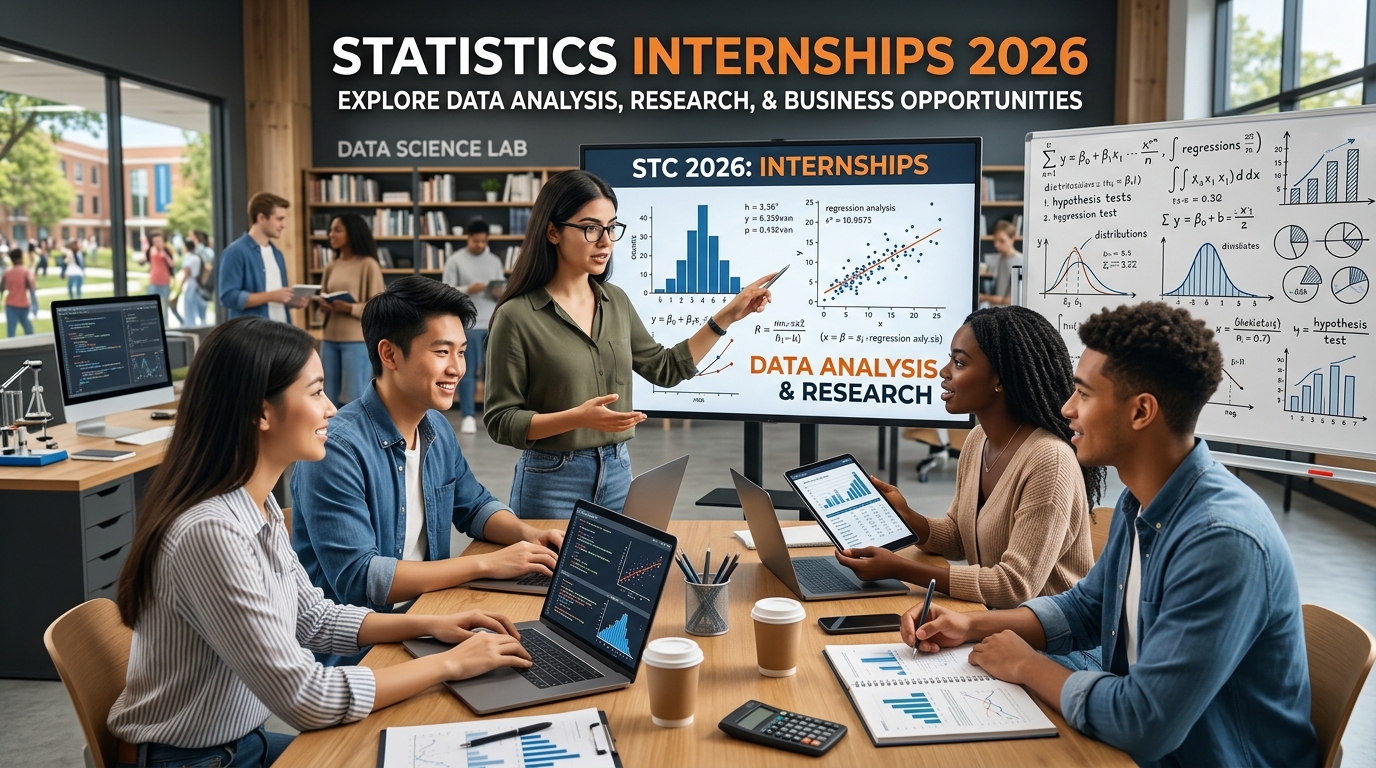
Statistics has become one of the most valuable analytical disciplines in today’s data-driven economy. Businesses, governments, research institutions, banks, healthcare organizations, technology companies, and universities all rely on statistics to understand information and make better decisions.
For students studying statistics, mathematics, data science, economics, computer science, or related subjects, Statistics Internships 2026 can provide an important bridge between academic learning and professional experience.
A statistics internship may involve analyzing datasets, building statistical models, creating reports, conducting surveys, performing research, forecasting trends, developing dashboards, or supporting business decisions.
The field is also much broader than traditional statistical analysis. Modern statistics internships increasingly overlap with data science, business analytics, artificial intelligence, machine learning, market research, financial analysis, healthcare research, and operations research.
Current 2026 opportunities demonstrate this diversity. The State Bank of Pakistan’s Summer Internship Program included Mathematics and Statistics among eligible disciplines and offered a six-week placement for qualifying students. In Lahore, current internship listings also show statistics graduates being recruited for data science and web-scraping roles requiring mathematics, statistics, Python, and data visualization skills.
This guide explains the major types of statistics internships available in 2026, required skills, eligibility, application strategies, research opportunities, business careers, salaries, and international opportunities.
Statistics Internships 2026 at a Glance
| Category | Details |
|---|---|
| Main field | Statistics, Data Analysis and Research |
| Common applicants | Statistics, Mathematics, Data Science and related students |
| Education level | Undergraduate, Master’s and PhD |
| Popular areas | Data analysis, business analytics, research, biostatistics, finance |
| Programming | R, Python, SQL, MATLAB |
| Visualization | Power BI, Tableau, Excel |
| Research tools | R, Python, SPSS, Stata, SAS and statistical packages |
| Typical duration | 4–12 weeks or several months |
| Work settings | On-site, hybrid and selected remote positions |
| Employers | Banks, technology companies, universities, healthcare, consulting and government |
| Career paths | Statistician, Data Analyst, Data Scientist, Research Analyst, Business Analyst |
What Are Statistics Internships?
Statistics internships are practical training opportunities where students apply statistical methods to real-world problems.
Rather than working exclusively with theoretical examples, interns may receive actual business, scientific, economic, medical, financial, or social datasets.
Depending on the organization, an intern could be asked to:
- Clean datasets
- Analyze trends
- Build statistical models
- Prepare reports
- Create dashboards
- Perform hypothesis testing
- Conduct surveys
- Develop forecasts
- Interpret research findings
- Present data-driven recommendations
The experience can be particularly valuable because employers often want graduates who understand both statistics and its practical application.
Why Statistics Internships Matter in 2026
Organizations generate enormous amounts of data, but raw data has little value without proper analysis.
Statistics helps organizations answer questions such as:
- What is happening?
- Why is it happening?
- What is likely to happen next?
- How confident are we in the result?
- Which factors are influencing an outcome?
- Is a difference statistically meaningful?
- Which decision produces the best expected result?
An internship allows students to practice answering these questions.
The Virtual University of Pakistan, for example, describes its BS Statistics internship as a structured course designed to give students firsthand experience applying statistical knowledge in real-world workplace settings.
This practical exposure can make the transition from university to employment easier.
Types of Statistics Internships in 2026
1. Data Analysis Internships
Data analysis is one of the most accessible areas for statistics students.
Interns may work with:
- Customer data
- Sales information
- Financial records
- Website analytics
- Survey results
- Operational data
- Marketing data
- Public datasets
Typical responsibilities include cleaning data, identifying patterns, calculating statistical measures, preparing visualizations, and communicating findings.
2. Statistical Research Internships
Research-focused internships are ideal for students considering graduate school or academic careers.
Possible research areas include:
- Probability
- Statistical inference
- Experimental design
- Bayesian statistics
- Regression
- Multivariate statistics
- Time-series analysis
- Computational statistics
Students may work with faculty members, research scientists, or professional statisticians.
Columbia University’s 2026 Department of Statistics Summer Internship Program, for example, places undergraduate students with faculty mentors on research projects and provides a competitive stipend with a summer housing allowance.
3. Business Analytics Internships
Business analytics combines statistics with business decision-making.
Interns may analyze:
- Sales
- Customers
- Marketing campaigns
- Revenue
- Pricing
- Inventory
- Product performance
- Operational efficiency
This field is particularly useful for students who want careers in consulting, technology, finance, retail, or corporate strategy.
4. Data Science Internships
Statistics is one of the foundations of modern data science.
Statistics students may qualify for internships involving:
- Predictive modeling
- Machine learning
- Data preprocessing
- Feature engineering
- Statistical learning
- Data visualization
- Forecasting
Current Lahore opportunities demonstrate this overlap: a 2026 Big Byte Insights internship sought candidates from Statistics, Data Science, Engineering, and related disciplines with mathematics, statistics, Python, and visualization skills.
5. Biostatistics Internships
Biostatistics applies statistical methods to healthcare and biological research.
Interns may work with:
- Clinical trial data
- Public health datasets
- Epidemiological research
- Medical studies
- Survival analysis
- Experimental design
- Health outcomes
This area can be an excellent option for students interested in healthcare and research.
6. Financial Statistics Internships
Banks and financial organizations use statistics for:
- Risk assessment
- Credit analysis
- Forecasting
- Fraud detection
- Customer analytics
- Portfolio analysis
- Market research
Statistics students with knowledge of probability, Python, SQL, and financial concepts can target quantitative and financial analytics roles.
7. Market Research Internships
Market research uses statistics to understand consumers and markets.
Interns may work on:
- Customer surveys
- Consumer behavior
- Market segmentation
- Product research
- Polling
- Competitive analysis
- Survey design
This can be a good path for students who enjoy both statistics and business.
8. Government Statistics Internships
Government agencies collect and analyze data related to:
- Population
- Employment
- Inflation
- Education
- Health
- Agriculture
- Trade
- Economic development
These internships can provide exposure to large datasets and public-sector research.
What Do Statistics Interns Do?
Responsibilities depend on the organization.
A research intern might analyze experimental data and help prepare an academic report.
A business analytics intern may create dashboards and identify trends in customer behavior.
A data science intern could build predictive models using Python.
Common tasks include:
- Data collection
- Data cleaning
- Exploratory data analysis
- Statistical testing
- Regression analysis
- Forecasting
- Visualization
- Survey analysis
- Report writing
- Dashboard development
- Research support
- Presentations
Strong interns learn not only how to calculate results but also how to interpret and communicate them correctly.
Essential Skills for Statistics Internships
Statistical Knowledge
Students should build a strong foundation in:
- Descriptive statistics
- Probability
- Statistical inference
- Regression
- Hypothesis testing
- Sampling
- Experimental design
- Correlation
- Time-series analysis
Advanced internships may require additional knowledge of Bayesian methods, multivariate analysis, survival analysis, or statistical learning.
Programming Skills
Programming can dramatically increase the number of internships available to statistics students.
R
R is widely used for statistical analysis, visualization, and research.
Python
Python is valuable for:
- Data analysis
- Machine learning
- Automation
- Visualization
- Statistical modeling
Common libraries include pandas, NumPy, SciPy, matplotlib, and scikit-learn.
SQL
SQL is particularly useful for retrieving and analyzing information stored in databases.
MATLAB
MATLAB can be useful for numerical and statistical computing, especially in engineering and research.
Statistical Software to Learn
Students can benefit from learning at least one statistical programming environment and one business visualization tool.
Useful tools include:
- R
- Python
- SPSS
- SAS
- Stata
- MATLAB
- Excel
- Power BI
- Tableau
You do not need to master every tool.
A stronger strategy is to become highly comfortable with a few tools and demonstrate their use through projects.
Statistics Internships for Undergraduate Students
Undergraduate students can find opportunities in both research and industry.
Some programs accept students after their second year, while others require students to be closer to graduation.
For example, the State Bank of Pakistan’s 2026 Summer Internship Program accepted students who had completed at least two years of a four-year bachelor’s degree or were enrolled in a master’s program. Statistics and Mathematics were among the listed eligible disciplines.
Undergraduate students can improve their chances by developing:
- Statistical programming skills
- Research experience
- Data-analysis projects
- Strong academic performance
- Communication skills
- A well-structured CV
Statistics Internships for Master’s Students
Master’s students can generally target more specialized positions.
Possible areas include:
- Advanced statistics
- Biostatistics
- Econometrics
- Data science
- Quantitative finance
- Statistical computing
- Machine learning
- Research methodology
Master’s students may also have more opportunities to work as research assistants or contribute to academic publications.
Statistics Research Internships
Research internships are particularly useful for students planning postgraduate study.
A research internship can teach students how to:
- Define a research question.
- Review previous research.
- Collect or obtain data.
- Select an appropriate methodology.
- Perform statistical analysis.
- Interpret results.
- Identify limitations.
- Write research findings.
- Present conclusions.
The 2026 Summer Research Week organized by PASTIC in Islamabad included practical exposure to research planning, data collection, quantitative and qualitative data analysis, programming, scholarly writing, and research ethics.
Statistics Internships in Pakistan
Pakistan offers opportunities for statistics students across banking, research, government, consulting, technology, education, and business.
State Bank of Pakistan
The State Bank’s 2026 Summer Internship Program provided a six-week placement in Karachi and listed Statistics and Mathematics among eligible disciplines. The program required qualifying students to meet academic and educational criteria.
Research and Policy Organizations
Statistics students can also consider research institutes and think tanks.
PIDE’s 2026 internship program included Statistics and Data Science among relevant fields and focused on research, economics, public policy, technical work, and data analysis.
Technology and Data Companies
Statistics graduates can also apply for positions that are not explicitly labeled “Statistics Intern.”
Search for:
- Data Analyst Intern
- Data Science Intern
- Business Analyst Intern
- Research Analyst Intern
- BI Intern
- Quantitative Intern
- Market Research Intern
- Data Quality Intern
Current Lahore listings show statistics graduates being considered for data science internships involving Python, mathematics, statistics, visualization, and real-world data projects.
Statistics Internships and Business Careers
One of the biggest advantages of studying statistics is the variety of industries that need analytical skills.
Banking
Statistics can support:
- Credit analysis
- Risk management
- Customer analytics
- Fraud detection
- Financial forecasting
Consulting
Consulting firms use data to help clients solve business problems.
Interns may analyze datasets, build reports, and support client projects.
Retail and E-Commerce
Statistics can be used to understand:
- Customer behavior
- Product demand
- Pricing
- Conversion rates
- Inventory
Technology
Technology companies use statistics for:
- Product analytics
- User behavior
- A/B testing
- Machine learning
- Forecasting
Healthcare
Healthcare organizations use statistics for research, clinical studies, health outcomes, and operational planning.
How to Build a Statistics Internship Portfolio
A portfolio can be especially valuable for students who lack professional experience.
Project 1: Customer Data Analysis
Use a public dataset to investigate customer behavior.
Include:
- Data cleaning
- Exploratory analysis
- Statistical testing
- Visualization
- Business recommendations
Project 2: Time-Series Forecasting
Analyze historical data and create a forecast.
Possible topics include:
- Sales
- Stock prices
- Weather
- Energy consumption
- Website traffic
Project 3: A/B Testing
Create a simulated or public experiment and explain:
- Hypothesis
- Sample
- Statistical test
- Confidence interval
- Result
- Business interpretation
Project 4: Regression Analysis
Choose a dataset and develop a regression model.
Explain:
- Variables
- Model selection
- Assumptions
- Results
- Limitations
A GitHub repository or portfolio website can provide employers with evidence of your practical skills.
How to Write a Statistics Internship CV
Keep the CV focused on evidence rather than generic claims.
Education
Include:
- Degree
- University
- Graduation date
- Relevant coursework
Technical Skills
Mention tools you genuinely know.
For example:
R, Python, SQL, Excel, Power BI, SPSS, Tableau
Projects
Describe what you actually accomplished.
Instead of:
“Made a statistics project.”
Use a more specific description such as:
“Analyzed a public customer dataset using Python and developed regression models to identify factors associated with customer retention.”
Research Experience
Include:
- Research assistantships
- Academic projects
- Publications
- Presentations
- Faculty research
- Thesis work
How to Find Statistics Internships in 2026
Students should avoid searching only for the exact phrase “Statistics Internship.”
Use multiple search terms.
Useful Search Queries
- Statistics Intern 2026
- Statistics Research Intern
- Data Analyst Intern
- Statistical Analyst Intern
- Data Science Intern
- Business Analytics Intern
- Biostatistics Intern
- Quantitative Research Intern
- Research Analyst Intern
- Statistical Modeling Intern
- Market Research Intern
Search university career portals, research institutes, company career pages, professional networks, and internship platforms.
Statistics Internships and Visa Sponsorship
International students should carefully examine immigration requirements.
A statistics internship advertised by an international organization does not automatically mean visa sponsorship is available.
Before applying, check:
- International student eligibility
- Visa requirements
- Work authorization
- Sponsorship availability
- Accommodation
- Travel support
- Insurance
- Application deadlines
Some research programs may provide housing or logistical support, while others are restricted to students from particular universities or countries.
Never assume that a paid internship automatically provides visa sponsorship.
Statistics Internship Stipends and Salaries
Compensation varies widely.
Some internships are unpaid academic placements. Others offer:
- Monthly stipends
- Hourly wages
- Housing
- Travel support
- Meal allowances
- Research fellowships
For example, Columbia University’s 2026 Statistics Summer Internship Program offered a competitive stipend including a summer housing allowance.
Other programs have completely different funding structures.
Therefore, applicants should always check the official internship announcement instead of relying on a general salary figure.
Statistics Internship Interview Questions
Prepare for a combination of technical and behavioral questions.
Common questions include:
- Why did you choose statistics?
- What statistical software do you know?
- Explain the difference between correlation and causation.
- What is a confidence interval?
- How do you handle missing data?
- Explain hypothesis testing.
- What is regression analysis?
- How would you approach a new dataset?
- Describe a statistical project you completed.
- How do you communicate statistical findings to non-technical people?
For data science positions, prepare for Python, SQL, probability, statistics, and basic machine-learning questions.
Benefits of Statistics Internships
Practical Experience
Internships demonstrate that you can apply classroom knowledge.
Research Exposure
Research placements can help students understand how academic studies are conducted.
Programming Experience
Many modern statistics roles require statistical programming.
Professional Networking
Interns can meet researchers, analysts, managers, and industry professionals.
Stronger Graduate Applications
Research experience can strengthen applications for Master’s and PhD programs.
Career Exploration
An internship can help you decide whether you prefer:
- Statistics
- Data science
- Research
- Finance
- Business analytics
- Healthcare
- Consulting
- Government
Career Opportunities After a Statistics Internship
Statistics graduates can pursue many careers.
Potential positions include:
- Statistician
- Data Analyst
- Data Scientist
- Business Analyst
- Research Analyst
- Quantitative Analyst
- Biostatistician
- Market Research Analyst
- Risk Analyst
- Financial Analyst
- Operations Research Analyst
- Business Intelligence Analyst
- Statistical Programmer
- Data Quality Analyst
- Research Scientist
Advanced research and specialized positions may require postgraduate education.
Emerging Areas for Statistics Careers in 2026
Artificial Intelligence and Machine Learning
Statistics provides the theoretical foundation for many machine-learning methods.
Big Data Analytics
Organizations need statistical methods to extract meaningful information from large datasets.
Healthcare Analytics
Statistical analysis supports clinical research and healthcare decision-making.
Financial Risk
Banks and financial institutions use statistical models to understand uncertainty and risk.
Business Intelligence
Companies increasingly rely on dashboards and analytical systems for decision-making.
Causal Inference
Organizations increasingly want to understand not just whether variables are associated, but whether interventions actually produce changes.
Experimental Design
A well-designed experiment can help organizations make better decisions while minimizing wasted resources.
Tips for Getting a Statistics Internship
1. Master the fundamentals.
Build a strong understanding of probability, inference, regression, and statistical modeling.
2. Learn programming.
Start with R or Python and add SQL.
3. Build projects.
Use real datasets instead of only classroom exercises.
4. Learn visualization.
Practice creating clear charts and dashboards.
5. Improve communication.
Learn to explain statistical results in simple language.
6. Customize your CV.
Match your skills to the internship description.
7. Apply beyond “statistics” jobs.
Data, analytics, research, finance, and business roles can all be relevant.
8. Start early.
Competitive summer research programs may have deadlines months before the internship begins.
9. Contact researchers.
For academic internships, a focused email to a relevant professor can be worthwhile.
10. Keep applying.
Statistics internships can be competitive, so apply to multiple suitable programs.
Frequently Asked Questions
Are statistics internships available for undergraduate students?
Yes. Many statistics internships are designed for undergraduate students. Eligibility can depend on academic year, grades, university enrollment, nationality, and specific technical skills.
What can I do with a statistics internship?
You can gain experience in data analysis, research, business analytics, data science, finance, healthcare, market research, or other analytical fields.
Do statistics internships require Python?
Not always. Some research positions primarily use R, SAS, SPSS, or other tools. However, Python can significantly expand opportunities in data science and analytics.
Is R useful for statistics internships?
Yes. R is widely used for statistical analysis, visualization, research, and data science.
Can statistics students apply for data science internships?
Yes. Statistics is highly relevant to data science, especially when students also have programming, machine learning, and data visualization skills.
Are statistics internships paid?
Some are paid, some provide academic stipends or fellowships, and some are unpaid. Compensation depends on the employer and program.
Can international students get statistics internships?
Yes, some programs accept international students. However, others have nationality, residency, or university restrictions. Visa and work authorization requirements should always be checked.
Are statistics internships useful for PhD applications?
Yes. Research-focused internships can provide valuable experience with statistical methodology, academic research, technical writing, presentations, and research collaboration.
What software should statistics students learn?
Useful options include R, Python, SQL, Excel, SPSS, SAS, Stata, MATLAB, Power BI, and Tableau. The best combination depends on your intended career.
What is the difference between a statistics internship and a data science internship?
Statistics internships tend to emphasize statistical analysis, inference, probability, research, and modeling. Data science internships often combine statistics with programming, machine learning, databases, and large-scale data processing.
Final Thoughts
Statistics Internships 2026 can open doors to careers in data analysis, research, finance, healthcare, business, technology, government, and consulting.
The most competitive candidates are increasingly combining traditional statistical knowledge with Python or R, SQL, data visualization, research skills, and business communication.
Students should also look beyond job titles containing the word “statistics.” A strong statistics background can qualify you for data analyst, research analyst, business intelligence, quantitative, market research, and data science internships.
Whether your goal is a corporate career, a research position, graduate school, or a data-focused profession, practical experience can make your academic knowledge much more valuable.
Start with the fundamentals, build a portfolio of real projects, learn modern analytical tools, and apply broadly to opportunities that match your interests.