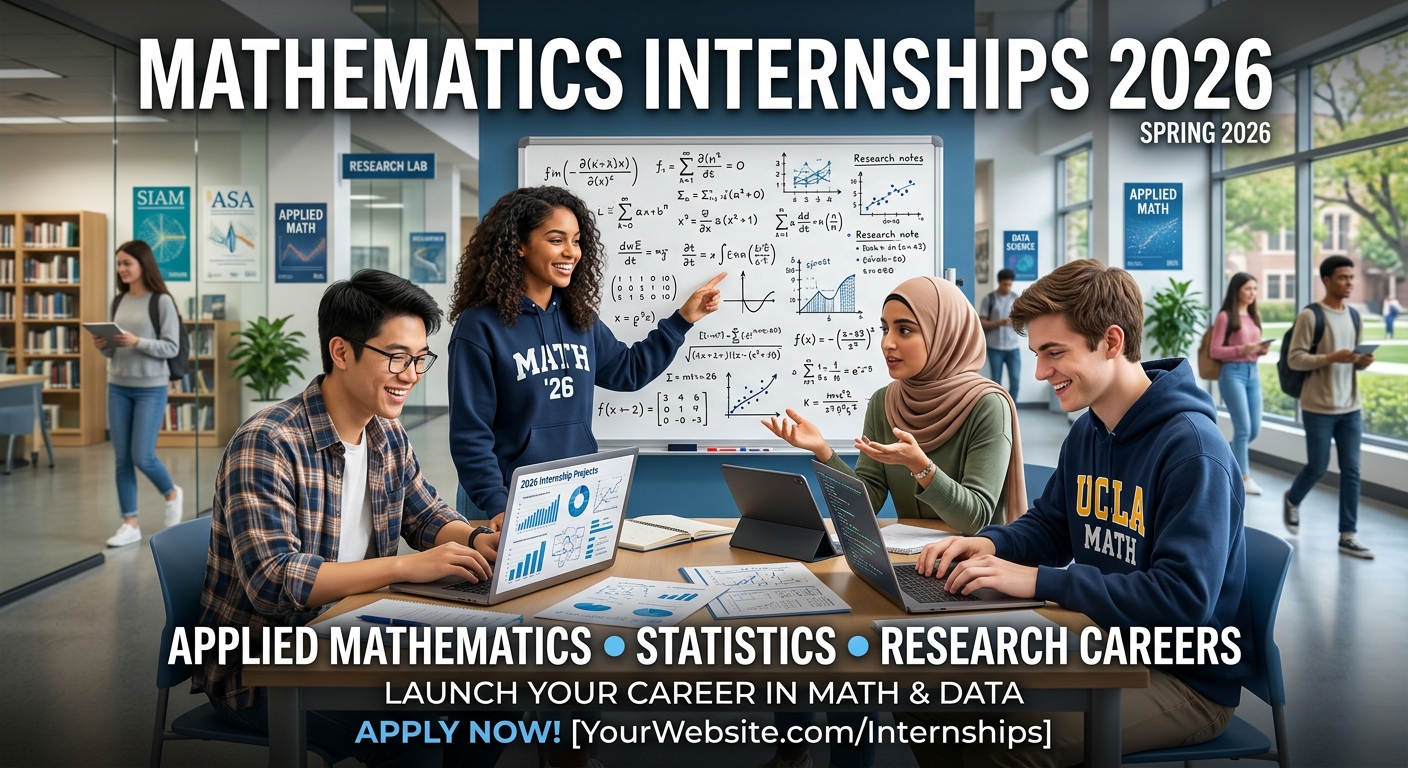
Mathematics is no longer limited to classrooms, textbooks, and academic research. In 2026, mathematical skills are being applied across data science, artificial intelligence, finance, engineering, healthcare, climate science, technology, economics, cybersecurity, and scientific research.
Mathematics internships in 2026 can help undergraduate and graduate students turn theoretical knowledge into practical experience. Depending on the program, interns may work on mathematical modeling, probability, statistics, optimization, numerical methods, machine learning, data analysis, computational mathematics, or pure mathematics research.
For students considering careers in research or industry, an internship can also provide experience working with professional researchers, faculty members, analysts, engineers, and data specialists.
Current programs demonstrate how broad the field has become. For example, Carnegie Mellon University’s 2026 Summer Undergraduate Applied Mathematics Institute included research areas such as graph theory, liquid crystals, interacting particle systems, and low-dimensional topology. NC State’s 2026 DRUMS program combines mathematics and statistics with applications including climate change, atmospheric science, materials science, cardiovascular disease, and precision medicine.
Mathematics Internships 2026 at a Glance
| Category | Details |
|---|---|
| Internship field | Mathematics, Applied Mathematics, Statistics |
| Common levels | Undergraduate, Master’s, PhD |
| Research areas | Modeling, statistics, optimization, probability, computational mathematics |
| Industry areas | Finance, technology, healthcare, engineering, analytics |
| Programming skills | Python, R, MATLAB, Julia, SQL |
| Research tools | LaTeX, numerical methods, statistical software |
| Typical duration | 4–12 weeks, with some longer placements |
| Work formats | On-site, hybrid, remote, university-based |
| Main outcomes | Research experience, projects, networking, references and career preparation |
What Are Mathematics Internships?
Mathematics internships are structured learning or work experiences where students apply mathematical concepts to real-world problems.
Some internships are heavily research-oriented. Students may work with professors or researchers to investigate an open mathematical problem, develop a model, analyze data, or write a research report.
Other internships are industry-focused. In these positions, mathematics may be used for forecasting, business analytics, statistical modeling, optimization, quality control, financial analysis, machine learning, or operations research.
This makes mathematics one of the most flexible academic backgrounds for students who want careers outside traditional mathematics departments.
Why Mathematics Internships Matter in 2026
A mathematics degree can provide strong analytical and problem-solving skills, but employers often want evidence that students can apply those skills.
An internship can provide that practical evidence.
Students may learn how to:
- Analyze real datasets
- Build mathematical models
- Perform statistical analysis
- Use programming languages
- Present technical results
- Write research reports
- Work with professional teams
- Solve open-ended problems
- Interpret uncertainty
- Create simulations
- Communicate mathematical ideas to non-specialists
For research students, an internship can also help determine whether graduate school or a research career is the right path.
Stanford’s SURIM program, for example, emphasizes mathematical research, presentations, LaTeX, software tools, and interaction with mathematics faculty and graduate students.
Types of Mathematics Internships in 2026
1. Applied Mathematics Internships
Applied mathematics focuses on using mathematical techniques to solve problems in science, engineering, economics, technology, and other disciplines.
Possible projects include:
- Differential equations
- Numerical analysis
- Mathematical modeling
- Optimization
- Dynamical systems
- Simulation
- Computational mathematics
- Fluid dynamics
- Network analysis
Applied mathematics is particularly useful for students who enjoy mathematics but want to work on practical problems.
2. Statistics Internships
Statistics internships are ideal for students interested in data, probability, forecasting, and evidence-based decision-making.
Interns may work with:
- Statistical modeling
- Regression
- Probability
- Experimental design
- Data visualization
- Survey analysis
- Time-series analysis
- Predictive modeling
- Statistical computing
The Indian Statistical Institute’s 2026 Chennai Winter Internship, for example, lists statistical modeling, probability, data analysis, and computational statistics among its research areas.
3. Mathematical Research Internships
Research internships allow students to work directly with mathematicians and academic researchers.
Projects may involve:
- Number theory
- Algebra
- Geometry
- Topology
- Combinatorics
- Graph theory
- Analysis
- Probability
- Mathematical physics
- Differential equations
Research internships can be particularly valuable for students planning Master’s or PhD study.
TIFR Centre for Applicable Mathematics offers research internships where undergraduate and graduate students work with faculty on mathematical research projects and finish with a presentation and report.
4. Computational Mathematics Internships
Computational mathematics combines mathematical theory with computer-based calculations.
Interns can work on:
- Numerical simulations
- Algorithm development
- Scientific computing
- Numerical optimization
- High-performance computing
- Computational modeling
- Mathematical software
Python, MATLAB, Julia, C++, and other programming languages can be useful in this area.
5. Data Science and Mathematics Internships
Mathematics and statistics are important foundations for data science.
Students may work with:
- Large datasets
- Machine learning
- Predictive analytics
- Probability models
- Classification
- Clustering
- Feature engineering
- Statistical learning
- Data visualization
A mathematics student with programming and statistics experience can therefore compete for internships that are not explicitly labeled “mathematics.”
6. Financial Mathematics Internships
Financial mathematics applies mathematical and statistical techniques to financial problems.
Possible areas include:
- Risk analysis
- Quantitative finance
- Financial modeling
- Portfolio optimization
- Derivatives
- Forecasting
- Credit risk
- Market analysis
Students interested in this field should consider learning probability, statistics, optimization, Python, and financial modeling.
7. Operations Research Internships
Operations research uses mathematical methods to improve decision-making.
Internship projects can involve:
- Optimization
- Linear programming
- Integer programming
- Scheduling
- Logistics
- Supply chain analysis
- Resource allocation
- Simulation
- Decision models
These skills can be useful in manufacturing, transportation, technology, healthcare, and business.
What Do Mathematics Interns Do?
The exact responsibilities depend on the organization and specialization.
A research intern might spend several weeks studying literature, understanding an existing mathematical method, developing an approach, testing results, and presenting findings.
An industry intern may instead analyze datasets, build spreadsheets, develop statistical models, automate calculations, or create reports.
Common responsibilities include:
- Conducting literature reviews
- Cleaning and analyzing data
- Developing mathematical models
- Writing Python or R code
- Running simulations
- Creating charts and visualizations
- Performing statistical tests
- Testing algorithms
- Documenting results
- Preparing presentations
- Writing technical reports
- Attending research meetings
The ability to explain the reasoning behind a result is often just as important as obtaining the result.
Skills to Develop Before a Mathematics Internship
Mathematical Skills
Strong candidates may benefit from understanding:
- Calculus
- Linear algebra
- Probability
- Statistics
- Differential equations
- Discrete mathematics
- Optimization
- Numerical methods
The exact requirements depend on the internship.
A statistics position may emphasize probability and statistical inference, while an applied mathematics project could require differential equations and numerical methods.
Programming Skills
Programming can significantly expand the number of opportunities available to mathematics students.
Useful languages and tools include:
- Python
- R
- MATLAB
- Julia
- SQL
- C++
- Mathematica
- Excel
Python is particularly useful because it can be applied to mathematical computing, data analysis, machine learning, visualization, and automation.
Communication Skills
Mathematics students sometimes underestimate the importance of communication.
Interns may have to explain technical results to people who are not mathematicians.
Important skills include:
- Technical writing
- Presentation
- Documentation
- Research communication
- Team collaboration
- Visualizing results
LaTeX can also be useful for academic mathematics and research papers.
Mathematics Internships for Undergraduate Students
Undergraduate students are among the main participants in mathematics research programs.
Some programs accept students after their second or third year, while others have more specific requirements.
For example, the ISI Chennai Winter Internship 2026 accepts eligible undergraduate students who have completed at least their second year, along with eligible postgraduate students.
Undergraduates should consider building experience through:
- University research projects
- Mathematics competitions
- Data-analysis projects
- Programming courses
- Independent research
- Academic societies
- Research assistant opportunities
You do not necessarily need to have published research before applying.
Mathematics Internships for Master’s Students
Master’s students can target more specialized opportunities.
Possible areas include:
- Applied mathematics
- Statistics
- Mathematical finance
- Data science
- Computational mathematics
- Mathematical physics
- Optimization
- Machine learning
- Operations research
Master’s students may also be able to apply for research assistantships and university research placements that require more advanced mathematical knowledge.
Mathematics Research Internships for PhD Students
PhD students typically pursue highly specialized research opportunities.
Potential areas include:
- Advanced statistical modeling
- Mathematical optimization
- Computational science
- Mathematical physics
- Probability theory
- Numerical analysis
- Scientific computing
- Machine learning theory
These positions may be offered through universities, research laboratories, technology companies, financial institutions, and scientific organizations.
Mathematics Internships in Pakistan
Students in Pakistan can explore opportunities in universities, banks, technology companies, research organizations, consulting firms, manufacturing companies, and data-driven businesses.
The State Bank of Pakistan’s 2026 Summer Internship Program specifically included Mathematics and Statistics among its eligible disciplines. The six-week program ran from June 29 to August 7, 2026, and required eligible students to have completed at least two years of a four-year bachelor’s program or be enrolled in a master’s program.
There are also private-sector opportunities. For example, a 2026 Karachi listing advertised a Mathematics/Statistics internship involving full-time work and data-driven responsibilities, while another Lahore listing sought BS Mathematics and Statistics graduates for quality and production exposure.
Students should search beyond the exact phrase “mathematics internship.” Useful alternatives include:
- Data analyst intern
- Statistical analyst intern
- Research intern
- Business analyst intern
- Quantitative intern
- Operations research intern
- Data science intern
- Risk analyst intern
- Research assistant
- Mathematical modeling intern
International Mathematics Research Opportunities
International programs can provide valuable exposure to different research environments.
KAUST’s 2026 Applied Mathematics School, for example, is designed for senior undergraduates, recent graduates, and master’s students in mathematics, statistics, physics, and related disciplines. The program includes advanced research topics in applied mathematics, computational science, and statistics and provides benefits including accommodation and visa/logistics support for selected participants.
KAUST’s Saudi Summer Internship also connects students with research in applied mathematics, computational sciences, and statistics, although eligibility for that particular program is targeted to Saudi university students and recent graduates.
These examples demonstrate why applicants should always check the nationality, university, academic-level, and residency requirements before applying.
Mathematics Internships and Visa Sponsorship
International students should be careful when interpreting internship advertisements that mention travel assistance, accommodation, or visa support.
An internship does not automatically include visa sponsorship.
Some university programs may provide immigration or logistical support, while others are restricted to citizens, permanent residents, or students from specific institutions.
Before applying internationally, check:
- Whether international students are eligible.
- Whether a visa is required.
- Whether the organization provides visa support.
- Whether accommodation is included.
- Whether travel expenses are covered.
- Whether health insurance is required.
- Whether the internship is paid or unpaid.
- Whether proof of enrollment is required.
Do not assume that an internship advertised as “international” automatically provides a work visa.
Mathematics Internship Stipends and Salaries
Compensation varies substantially by country, organization, duration, academic level, and funding.
Some university research programs offer fixed stipends. Others provide hourly pay, monthly compensation, housing, meals, travel assistance, or no financial compensation.
For example, the ISI Chennai 2026 Winter Internship lists a consolidated ₹8,000 fellowship for the one-month program, subject to successful participation and completion.
Private-sector opportunities can have different compensation structures. A Karachi Mathematics/Statistics internship listing in 2026 advertised PKR 30,000 per month.
These figures should not be treated as standard salaries for all mathematics internships. Compensation can change considerably between programs.
How to Find Mathematics Internships in 2026
A strong internship search should use several channels.
University Websites
Search mathematics, statistics, computer science, economics, engineering, and research department websites.
Many research opportunities are advertised by individual faculty members rather than general employment websites.
Research Institutes
Look for:
- Mathematical research institutes
- Statistical institutes
- National laboratories
- Universities
- Scientific research centers
- Technology research organizations
LinkedIn and Job Platforms
Use combinations such as:
“Mathematics Intern 2026”
“Applied Mathematics Intern”
“Statistics Research Intern”
“Mathematical Modeling Intern”
“Quantitative Research Intern”
“Data Science Intern Mathematics”
Faculty Members
For research internships, contacting professors can sometimes be more effective than relying exclusively on job boards.
Read the professor’s research interests first and explain why your background matches their work.
How to Prepare a Mathematics Internship CV
Your CV should demonstrate mathematical ability and practical skills.
Include:
Education
List your degree, university, expected graduation date, and relevant coursework.
Technical Skills
Mention tools such as:
- Python
- R
- MATLAB
- SQL
- LaTeX
- Excel
- Mathematica
Research Projects
Describe projects using measurable and specific language.
Instead of writing:
“Worked on statistics project.”
Write something closer to:
“Analyzed a public dataset using regression and statistical testing in Python and presented findings through visualizations.”
Academic Achievements
Include:
- Scholarships
- Mathematics competitions
- Research awards
- Relevant certifications
- Conference presentations
- Academic projects
Mathematics Internship Portfolio Ideas
A portfolio can make your application stronger, particularly for applied mathematics and data-oriented roles.
Consider creating projects such as:
Project 1: Statistical Analysis
Analyze a public dataset and explain:
- Research question
- Data preparation
- Statistical method
- Results
- Limitations
Project 2: Mathematical Modeling
Create a model for:
- Population growth
- Disease spread
- Traffic flow
- Renewable energy
- Inventory management
Project 3: Optimization
Develop an optimization model for:
- Delivery routes
- Scheduling
- Resource allocation
- Production planning
Project 4: Numerical Simulation
Use Python or MATLAB to simulate a mathematical system and visualize its behavior.
A GitHub repository can also help demonstrate programming and documentation skills.
Mathematics Internship Interview Questions
Candidates may encounter both technical and behavioral questions.
Examples include:
- Why did you choose mathematics?
- What area of mathematics interests you most?
- Explain a mathematical project you have completed.
- What programming languages do you know?
- How would you approach an unfamiliar mathematical problem?
- Explain regression in simple terms.
- What is the difference between correlation and causation?
- How do you validate a mathematical model?
- Tell us about a difficult problem you solved.
- Why are you interested in this research area?
For research positions, interviewers may be more interested in how you think than whether you immediately know every answer.
Benefits of Mathematics Internships
A good internship can provide several long-term advantages.
Practical Experience
You learn how mathematical concepts are used outside textbooks.
Research Experience
Research internships can strengthen applications for graduate school.
Programming Skills
Many mathematics roles now require computational skills.
Professional Network
You may develop relationships with professors, researchers, analysts, and industry professionals.
Stronger CV
Relevant internship experience can help demonstrate practical ability to employers.
Career Discovery
An internship can help you decide whether you prefer:
- Research
- Data science
- Finance
- Teaching
- Technology
- Engineering
- Statistics
- Academia
- Business analytics
Mathematics Careers After an Internship
Mathematics graduates can pursue careers across many industries.
Potential career paths include:
- Mathematician
- Statistician
- Data Scientist
- Data Analyst
- Quantitative Analyst
- Operations Research Analyst
- Risk Analyst
- Actuary
- Research Scientist
- Machine Learning Specialist
- Financial Analyst
- Business Analyst
- Cryptography Specialist
- Mathematical Modeler
- Research Assistant
- University Lecturer
Advanced research positions may require a Master’s or PhD.
Emerging Mathematics Fields in 2026
Several areas are creating new opportunities for mathematically trained graduates.
Mathematical Foundations of AI
Machine learning relies heavily on linear algebra, probability, optimization, statistics, and numerical methods.
Computational Science
Scientists increasingly use mathematical models and simulations to investigate complex systems.
Climate Mathematics
Mathematical models are used to study weather, climate systems, environmental risks, and energy systems.
Healthcare Modeling
Mathematics and statistics support disease modeling, medical research, clinical studies, and health analytics.
Quantum Computing
Quantum information combines mathematics, physics, computer science, and algorithms.
Financial Mathematics
Quantitative methods remain important in financial modeling, risk management, and optimization.
Mathematical Biology
Mathematical models can be used to understand biological systems, population dynamics, epidemiology, and medical processes.
Tips for Getting a Mathematics Internship
Start your preparation early.
1. Build mathematical fundamentals.
Focus on probability, statistics, calculus, linear algebra, and relevant advanced subjects.
2. Learn programming.
Python is a particularly useful starting point.
3. Create practical projects.
Do not rely only on coursework.
4. Customize your CV.
Highlight skills that match the internship description.
5. Write a focused statement of purpose.
Explain why the specific research area interests you.
6. Contact researchers professionally.
Show that you have actually read about their work.
7. Apply to multiple programs.
Research internships can be competitive.
8. Check eligibility carefully.
Nationality and university restrictions are common.
9. Prepare for technical interviews.
Review relevant mathematics rather than trying to memorize everything.
10. Keep improving after rejection.
An unsuccessful application can still show you which skills need development.
Frequently Asked Questions
Are mathematics internships available for undergraduate students in 2026?
Yes. Many university and research programs are designed specifically for undergraduate students. Eligibility varies by year of study, academic performance, nationality, and research area.
Can mathematics students apply for data science internships?
Yes. Mathematics and statistics students can be strong candidates for data science internships, particularly when they have programming and data-analysis skills.
Do mathematics internships require programming?
Not all of them. Pure mathematics research may require little programming, while computational mathematics, statistics, data science, and mathematical modeling often involve programming.
Which programming language is best for mathematics internships?
Python is a strong general-purpose option. R is particularly useful for statistics, while MATLAB and Julia can be valuable for numerical and scientific computing.
Can international students apply for mathematics internships?
Some programs accept international students, while others are restricted to citizens, permanent residents, or students from specific institutions. Always check the official eligibility requirements.
Are mathematics internships paid?
Some are paid, some provide stipends, and others are unpaid. Compensation varies significantly between organizations and countries.
Can a mathematics internship lead to a full-time job?
It can. Industry internships may sometimes lead to graduate roles, although employment is never guaranteed.
Are mathematics internships useful for PhD applications?
Research-focused internships can be valuable because they provide experience with research methods, academic communication, technical projects, and potential academic references.
What should I put on my mathematics internship CV?
Include your education, relevant mathematics courses, programming skills, research or academic projects, competitions, publications if applicable, certifications, and other relevant achievements.
What is the difference between applied mathematics and statistics internships?
Applied mathematics internships often focus on mathematical models, equations, simulations, optimization, and numerical methods. Statistics internships generally focus more on data, probability, statistical inference, experiments, and statistical modeling.
Final Thoughts
Mathematics Internships 2026 offer opportunities far beyond traditional mathematics careers. Students can use mathematical knowledge in statistics, data science, finance, engineering, artificial intelligence, healthcare, climate research, technology, and academic research.
The strongest candidates are not necessarily those who know the most advanced mathematics. They are often students who can combine mathematical thinking with programming, research ability, communication, and practical problem-solving.
Whether you are studying BS Mathematics, Statistics, Applied Mathematics, Mathematical Physics, Data Science, or a related discipline, start building practical experience early. A well-chosen internship can become a valuable bridge between university study and a research or professional career.