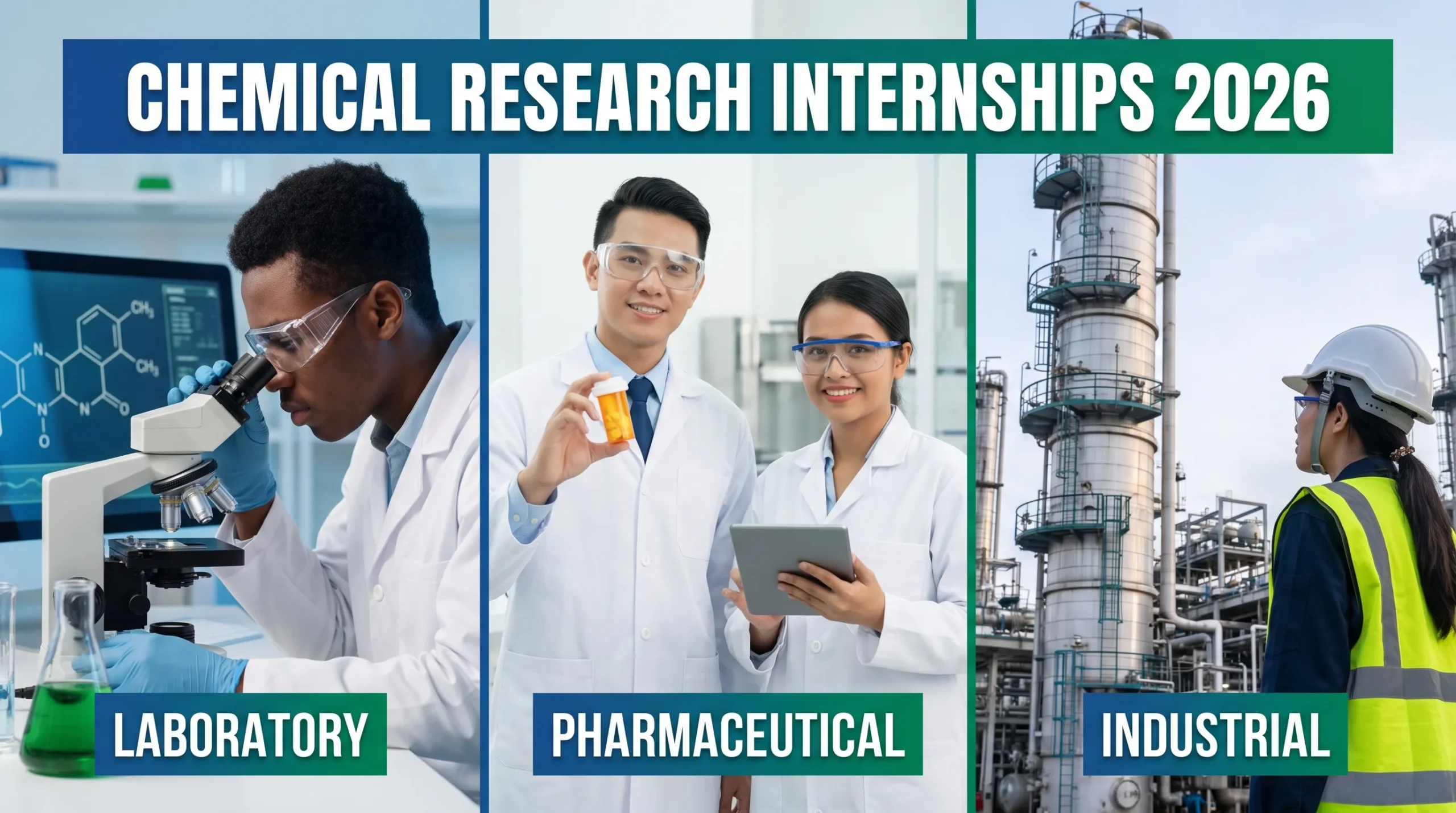
Chemical research plays an important role in pharmaceuticals, healthcare, manufacturing, materials science, food production, environmental technology and industrial development. For students who want practical scientific experience, a research internship can provide an opportunity to move from classroom chemistry into real laboratory and industrial environments.
Chemical Research Internships 2026 are available across several areas, including organic chemistry, analytical chemistry, medicinal chemistry, pharmaceutical research, polymers, materials, formulation, process development and chemical manufacturing.
These internships can involve laboratory experiments, instrumental analysis, synthesis, formulation, quality testing, data analysis and research documentation. Some opportunities are based at universities and research institutes, while others are offered by pharmaceutical, chemical, consumer-product and manufacturing companies.
Current 2026 programs demonstrate the diversity of the field. For example, the Department of Chemistry at Government College Women University Faisalabad offered practical training in advanced chemistry laboratories, UV-Visible spectroscopy, FTIR, GC-MS, laboratory safety and good laboratory practices.
Chemical Research Internships 2026 at a Glance
| Category | Details |
|---|---|
| Main Fields | Organic, Analytical, Medicinal, Industrial & Physical Chemistry |
| Research Areas | Pharmaceuticals, Materials, Polymers, Formulation & Process Development |
| Common Techniques | FTIR, UV-Vis, GC-MS, chromatography, spectroscopy |
| Laboratory Work | Synthesis, testing, characterization and experimentation |
| Common Degrees | Chemistry, Applied Chemistry, Chemical Engineering, Biochemistry |
| Pharmaceutical Areas | R&D, formulation, QC, QA, analytical testing |
| Industrial Areas | Manufacturing, materials, polymers, chemicals and process development |
| Typical Candidates | Undergraduate, Master’s and recent graduates |
| Career Paths | Chemist, Research Scientist, R&D Chemist, Analytical Chemist |
What Is a Chemical Research Internship?
A chemical research internship provides practical exposure to scientific investigation and laboratory-based problem solving.
Rather than simply studying chemical reactions theoretically, interns may work directly with laboratory equipment, chemical samples, research protocols and experimental data.
Depending on the organization, responsibilities can include:
- Preparing chemical samples
- Conducting laboratory experiments
- Performing chemical synthesis
- Analyzing materials
- Operating laboratory instruments
- Recording experimental observations
- Processing research data
- Reviewing scientific literature
- Supporting research scientists
- Preparing technical reports
- Following laboratory safety procedures
- Maintaining laboratory records
The experience can vary significantly between academic research laboratories and commercial R&D departments.
Why Chemical Research Internships Matter in 2026
Modern chemistry is increasingly connected with pharmaceutical development, advanced materials, environmental technology, biotechnology and industrial manufacturing.
Students therefore need more than textbook knowledge.
A research internship can help develop practical abilities such as:
- Experimental planning
- Laboratory discipline
- Scientific writing
- Data interpretation
- Instrument handling
- Chemical safety
- Problem-solving
- Research methodology
For example, LUMS’s 2026 RISE program included chemistry research projects involving X-ray diffraction, functional nanomaterials and synthetic chemistry, including new methodologies for medicinally active organic molecules.
Types of Chemical Research Internships
1. Organic Chemistry Research Internships
Organic chemistry research focuses on carbon-containing molecules and their reactions.
Interns may work on:
- Organic synthesis
- Reaction optimization
- Purification
- Characterization
- Reaction mechanisms
- Synthetic methodology
- Small-molecule development
This area is particularly relevant to pharmaceutical and materials research.
2. Analytical Chemistry Internships
Analytical chemistry focuses on determining what a sample contains and how much of each component is present.
Interns may gain exposure to:
- UV-Visible spectroscopy
- FTIR
- GC-MS
- HPLC
- Chromatography
- Titration
- Sample preparation
- Instrument calibration
- Quantitative analysis
Analytical chemistry is important in pharmaceuticals, food, environmental testing, chemicals and manufacturing.
3. Pharmaceutical Research Internships
Pharmaceutical research is one of the most attractive areas for chemistry graduates.
Possible projects include:
- Drug formulation
- Drug development
- Stability testing
- Analytical testing
- Active pharmaceutical ingredients
- Process development
- Quality control
- Research and development
A 2026 pharmaceutical research internship at AbbVie involves formulation development, laboratory characterization, experimental data analysis and technical reporting, with candidates studying areas such as Chemistry, Chemical Engineering or Pharmaceutical Sciences.
4. Medicinal Chemistry Internships
Medicinal chemistry combines chemistry with drug discovery.
Interns may learn about:
- Small-molecule synthesis
- Molecular structures
- Drug candidates
- Structure-activity relationships
- Compound characterization
- Chemical optimization
This path can be particularly useful for students considering pharmaceutical R&D or graduate research.
5. Industrial Chemistry Internships
Industrial chemistry connects laboratory science with commercial production.
Interns may work with:
- Chemical raw materials
- Production processes
- Quality testing
- Process optimization
- Industrial formulations
- Manufacturing standards
- Product testing
Industrial research can provide an understanding of how chemistry is translated into scalable manufacturing.
6. Polymer Research Internships
Polymers are used extensively in packaging, automotive products, electronics, construction and consumer goods.
Research may involve:
- Polymer synthesis
- Polymer characterization
- Composite materials
- Plastic additives
- Recycling
- Sustainable polymers
- Material testing
7. Materials Chemistry Internships
Materials chemistry focuses on developing and understanding materials with specific properties.
Potential research areas include:
- Nanomaterials
- Functional materials
- Catalysts
- Energy materials
- Coatings
- Ceramics
- Advanced composites
8. Chemical Engineering Research Internships
Chemical engineering students can also participate in chemical research.
Their projects may involve:
- Process design
- Reaction engineering
- Heat transfer
- Mass transfer
- Process simulation
- Separation systems
- Process optimization
Chemical engineering research is particularly useful for students interested in industrial-scale production.
Laboratory Skills for Chemical Research Internships
A strong laboratory foundation can significantly improve your internship applications.
Sample Preparation
Learn how to correctly:
- Measure chemicals
- Prepare solutions
- Dilute samples
- Label samples
- Store materials
- Prevent contamination
Laboratory Safety
Safety is essential when working with chemicals.
Students should understand:
- PPE requirements
- Chemical labeling
- Safety Data Sheets
- Waste disposal
- Spill response
- Fume-hood practices
- Safe chemical handling
Analytical Techniques
Depending on the internship, useful techniques include:
- UV-Vis
- FTIR
- GC-MS
- HPLC
- NMR
- XRD
- TGA
- DSC
- Chromatography
The exact instruments available depend on the laboratory.
Documentation
Research depends on accurate records.
Interns may maintain:
- Laboratory notebooks
- Experimental procedures
- Sample records
- Instrument results
- Research reports
- Data files
Pharmaceutical Chemical Research Careers
Pharmaceutical research provides several career directions for chemistry graduates.
Drug Discovery
Scientists investigate new chemical compounds that may eventually become medicines.
Formulation Development
Researchers develop formulations that deliver active ingredients effectively and consistently.
Analytical Development
Chemists develop analytical methods for identifying and measuring pharmaceutical compounds.
Quality Control
QC laboratories test raw materials, intermediates and finished products.
Quality Assurance
QA focuses on systems, procedures, documentation and compliance.
Process Development
Scientists and engineers develop scalable manufacturing processes.
Stability Research
Researchers investigate how products behave under different storage conditions.
Current pharmaceutical internship programs in Pakistan demonstrate how students can gain exposure to manufacturing, quality control, R&D and other functions. Maxitech Pharma’s 2026 program, for example, offered students and recent graduates exposure to pharmaceutical operations, manufacturing, quality control and research and development.
What Do Chemical Research Interns Do?
Responsibilities depend on the research group, but common activities include:
- Conducting experiments
- Preparing reagents
- Synthesizing compounds
- Testing materials
- Operating analytical equipment
- Recording experimental data
- Reviewing scientific literature
- Performing calculations
- Analyzing results
- Supporting senior researchers
- Preparing presentations
- Writing technical reports
In pharmaceutical research, interns may also work with formulation experiments, stability testing or analytical characterization.
Chemical Research Internships in Pakistan
Pakistan offers chemical research opportunities through universities, research institutes, pharmaceutical companies, manufacturing organizations and industrial laboratories.
Important locations include:
- Lahore
- Karachi
- Islamabad
- Rawalpindi
- Faisalabad
- Jamshoro
- Peshawar
- Taxila
Lahore
Lahore has a strong concentration of universities, pharmaceutical companies, chemical manufacturers and research laboratories.
The University of the Punjab’s School of Chemistry, for example, has research projects connected with industrial applications. One 2026 project focused on commercial production of benzalkonium chloride and offered a research-assistant position requiring chemistry research and laboratory skills.
Karachi
Karachi is particularly relevant for pharmaceutical and chemical research because of its large industrial and academic ecosystem.
The International Center for Chemical and Biological Sciences at the University of Karachi offered a 2026 summer internship for recent graduates in chemical and biological sciences, with research areas spanning synthetic chemistry, medicinal chemistry, analytical science, materials, polymers and related fields.
Faisalabad
Faisalabad also provides opportunities connected with industrial chemistry and laboratory science.
GCWUF’s 2026 Chemistry Summer Internship included advanced laboratory training and instrumental analysis using techniques such as UV-Visible spectroscopy, FTIR and GC-MS.
Jamshoro
The National Centre of Excellence in Analytical Chemistry at the University of Sindh advertised a 2026 summer internship offering laboratory training and exposure to advanced analytical techniques.
Chemical Research Internships in the Pharmaceutical Industry
Pharmaceutical companies employ chemistry graduates across several departments.
Research & Development
R&D teams develop new formulations, products and processes.
Quality Control
QC laboratories test whether materials and products meet established specifications.
Quality Assurance
QA teams ensure that manufacturing and laboratory processes follow required procedures.
Production
Chemistry graduates can also work alongside manufacturing teams to understand chemical processes at production scale.
Regulatory Affairs
Scientific knowledge can support careers involving technical documentation and regulatory requirements.
Process Development
Researchers investigate how laboratory processes can be translated into efficient commercial manufacturing.
For example, a 2026 GSK engineering internship in Karachi involved pharmaceutical manufacturing operations, equipment, laboratory and utility systems, process optimization and GMP-related practices.
Chemical Research vs Pharmaceutical Research
| Chemical Research | Pharmaceutical Research |
|---|---|
| Broad range of chemistry fields | Focused on medicines and healthcare |
| Materials and industrial chemistry | Drug discovery and formulation |
| Organic and analytical research | Pharmaceutical analysis |
| Polymers and catalysts | Stability and quality testing |
| Environmental chemistry | Regulatory and GMP environment |
| Academic or industrial | Primarily pharmaceutical/biomedical |
The two areas overlap significantly.
A chemistry student with laboratory and analytical experience can potentially move between several industries.
Skills That Can Make Your Application Stronger
Scientific Writing
Research teams need people who can document experiments clearly.
Data Analysis
Learn to interpret experimental data instead of simply recording it.
Instrumentation
Hands-on experience with analytical instruments can strengthen your CV.
Chemistry Software
Depending on your field, computational tools can support molecular modeling, data analysis and research.
Excel and Data Handling
Spreadsheet skills remain useful for laboratory calculations and experimental data.
Communication
Researchers need to explain results to supervisors and colleagues.
Attention to Detail
Small errors in chemical measurements or experimental procedures can significantly affect results.
Education Requirements
Chemical research internships may accept students from several academic backgrounds.
Common degrees include:
- BS Chemistry
- BSc Chemistry
- MSc Chemistry
- Applied Chemistry
- Organic Chemistry
- Analytical Chemistry
- Biochemistry
- Chemical Engineering
- Pharmaceutical Sciences
- Biotechnology
- Materials Science
Some programs are specifically designed for undergraduate students, while advanced research internships may require a Master’s or PhD.
For example, the 2026 ICCBS program targeted recent BS, MSc, PharmD, MS and MPhil graduates in chemical and biological sciences.
Chemical Research Internships for Undergraduate Students
Undergraduate students can use internships to discover which branch of chemistry interests them most.
A first research internship might expose you to:
- Basic synthesis
- Analytical testing
- Laboratory safety
- Spectroscopy
- Sample preparation
- Research documentation
You do not need to have a publication before applying to most undergraduate opportunities.
Strong academic fundamentals and genuine interest can be enough to get started.
Research Internships for Master’s Students
Master’s students can generally target more specialized projects.
Potential areas include:
- Medicinal chemistry
- Advanced organic synthesis
- Nanomaterials
- Catalysis
- Pharmaceutical formulation
- Analytical method development
- Polymer chemistry
- Computational chemistry
At this stage, previous laboratory or research experience can make applications stronger.
Research Internships for PhD Students
PhD-level research internships are typically highly specialized.
Companies and laboratories may expect experience in:
- Advanced laboratory methods
- Scientific publications
- Experimental design
- Data interpretation
- Specialized analytical equipment
- Research presentations
A current 2026 AbbVie internship, for example, specifically targets PhD students in Chemistry, Chemical Engineering, Pharmaceutical Sciences and related fields for biologic drug-product research.
How to Find Chemical Research Internships in 2026
University Departments
Check chemistry, chemical engineering, pharmaceutical sciences and materials departments.
Faculty research pages can be especially useful.
Pharmaceutical Companies
Search pharmaceutical companies for:
- R&D Intern
- Research Intern
- QC Intern
- Analytical Chemistry Intern
- Formulation Intern
- Laboratory Intern
Chemical Manufacturers
Industrial chemical companies can offer experience in laboratory testing, production and process development.
Research Institutes
Research institutes can provide more academic and experimental exposure.
Job Platforms
Use searches such as:
- Chemical Research Intern
- Chemistry Research Intern
- Laboratory Intern Chemistry
- Pharmaceutical R&D Intern
- Analytical Chemistry Intern
- Organic Chemistry Intern
- Industrial Chemistry Intern
- Chemical Laboratory Intern
- Materials Chemistry Intern
How to Prepare for a Chemical Research Internship
1. Choose Your Research Area
Start by selecting an area that matches your interests.
For example:
Organic chemistry: synthesis and reaction development.
Analytical chemistry: instruments and chemical analysis.
Pharmaceutical chemistry: drug development and formulation.
Materials chemistry: polymers, nanomaterials and advanced materials.
Industrial chemistry: manufacturing and process development.
2. Improve Laboratory Skills
Practice fundamental techniques whenever possible.
3. Learn Instrumentation
If your university provides access, become familiar with analytical equipment.
4. Build a Research Project
Your final-year or semester project can become the foundation of your research portfolio.
5. Read Research Papers
Choose papers connected with the laboratory or company you want to join.
6. Prepare a Technical CV
Include:
- Degree
- Relevant courses
- Laboratory skills
- Research projects
- Instruments
- Software
- Publications
- Academic achievements
Chemical Research Portfolio Ideas
A portfolio does not need to contain dozens of projects.
One or two well-documented projects can be useful.
Organic Synthesis Project
Explain the reaction, procedure, purification and characterization.
Analytical Chemistry Project
Demonstrate how you analyzed a sample using an appropriate analytical technique.
Pharmaceutical Formulation Project
Describe formulation development, testing and stability considerations.
Polymer Project
Investigate polymer properties and compare different materials.
Environmental Chemistry Project
Analyze water, soil or another environmental sample.
Computational Chemistry Project
Use computational tools to investigate molecular properties or chemical behavior.
Chemical Research Internship Interview Questions
Why are you interested in chemical research?
Explain a specific research area rather than giving a generic answer.
Which laboratory techniques have you used?
Only mention techniques you have actually practiced.
What analytical instruments have you worked with?
Discuss the instrument, purpose and type of data it generates.
How do you maintain laboratory safety?
Explain PPE, chemical handling, labeling, waste disposal and laboratory procedures.
Tell us about your final-year project.
Describe the research question, methodology, results and what you learned.
What would you do if an experiment produced unexpected results?
A strong answer should emphasize checking procedures, controls, calculations, equipment and possible sources of error before repeating the experiment.
How do you document experiments?
Discuss laboratory notebooks, sample identification, dates, procedures, observations and results.
Benefits of Chemical Research Internships
Practical Laboratory Experience
You learn how research laboratories operate in real situations.
Instrumentation Skills
Exposure to analytical instruments can strengthen your technical profile.
Research Experience
You learn how scientific questions are converted into experiments.
Industry Exposure
Pharmaceutical and industrial internships can show how chemistry supports commercial products.
Professional Networking
You can develop relationships with researchers, professors and industry professionals.
Graduate Study Preparation
Research experience can strengthen applications for Master’s and PhD programs.
Career Exploration
An internship can help you determine whether you prefer academia, pharmaceuticals, manufacturing, analytical science or R&D.
Chemical Research Internship Salary and Stipends
There is no universal salary for chemical research internships.
Compensation depends on:
- Country
- Organization
- Degree level
- Research area
- Internship duration
- Funding
- Industry
Some academic programs may be unpaid or charge participation fees, while company internships may provide monthly stipends or salaries.
For example, the National Centre of Excellence in Analytical Chemistry at the University of Sindh listed participation fees for its 2026 summer internship rather than presenting it as a conventional paid employment position.
In contrast, some research roles are paid positions. The University of the Punjab’s 2026 research-assistant position under an HEC-funded chemistry project listed a fixed monthly pay of Rs. 100,000 for a qualified MS/MPhil candidate. This is a research position rather than a typical undergraduate internship, so it should not be treated as a standard internship salary benchmark.
Always check the specific program for its stipend, fees, accommodation, transport and other conditions.
Chemical Research Internship vs Laboratory Internship
| Research Internship | Laboratory Internship |
|---|---|
| Focuses on scientific investigation | Focuses heavily on practical lab work |
| Experimental design may be included | Established procedures may dominate |
| Literature review is common | Routine testing may be common |
| Data interpretation is important | Accurate measurements are important |
| May lead toward academic research | Can lead toward QC and laboratory careers |
| Often project-based | Can be testing or operations-based |
There can be significant overlap between the two.
A good laboratory internship can also provide meaningful research skills.
Career Opportunities After a Chemical Research Internship
Research Chemist
Conducts experiments and develops new chemical solutions.
Analytical Chemist
Analyzes materials and develops testing methods.
Organic Chemist
Works on organic synthesis and molecular development.
Medicinal Chemist
Develops and optimizes chemical compounds for pharmaceutical research.
Formulation Scientist
Develops stable and effective formulations.
Quality Control Chemist
Tests materials and finished products against specifications.
Quality Assurance Specialist
Works with quality systems and documentation.
Process Development Chemist
Helps transform laboratory processes into scalable production methods.
Materials Scientist
Researches and develops advanced materials.
R&D Scientist
Works on new products, technologies and scientific solutions.
Emerging Chemical Research Areas in 2026
Several research directions are becoming increasingly important.
Sustainable Chemistry
Researchers are developing processes that reduce waste, energy use and hazardous materials.
Green Chemistry
The focus is on safer chemicals and more efficient processes.
Advanced Materials
New materials are being developed for electronics, energy, healthcare and manufacturing.
Pharmaceutical Innovation
Drug discovery and advanced formulation remain important research areas.
Nanotechnology
Nanomaterials can provide unique chemical, optical, electrical and biological properties.
Battery and Energy Materials
Chemists contribute to batteries, catalysts, fuel cells and energy-storage technologies.
Computational Chemistry
Computational methods can help researchers predict molecular behavior and accelerate experimentation.
Industrial Process Optimization
Chemical researchers and engineers continue to improve efficiency, quality and sustainability in manufacturing.
Frequently Asked Questions
What are Chemical Research Internships?
Chemical research internships provide students or graduates with practical experience in chemical experiments, laboratory research, analysis, synthesis, materials development or industrial R&D.
Who can apply for chemical research internships?
Eligibility varies. Programs may accept undergraduate chemistry students, Master’s students, recent graduates, chemical engineering students, pharmaceutical science students and related disciplines.
Do I need previous research experience?
Not always. Undergraduate programs often accept students who have laboratory coursework and demonstrate strong interest in research.
Which laboratory skills are useful?
Sample preparation, chemical handling, spectroscopy, chromatography, laboratory safety, data recording and basic analytical techniques are useful.
Are pharmaceutical research internships suitable for chemistry students?
Yes. Chemistry graduates can work in pharmaceutical R&D, analytical chemistry, formulation, quality control and related scientific departments.
Can chemical engineering students apply for chemistry research internships?
Yes, where the eligibility criteria include chemical engineering or related disciplines. Many research areas overlap between chemistry and chemical engineering.
Are chemical research internships paid?
Some are paid, some are funded through academic programs and others may be unpaid or fee-based. Candidates should check each program individually.
Can international students apply?
Some research internships accept international students, but eligibility, visa requirements and work authorization vary by country and institution.
Can research internships help with a PhD application?
Yes. Research experience can demonstrate laboratory ability, scientific writing, data analysis and genuine interest in a research field.
What is the difference between chemistry and chemical engineering research?
Chemistry research often focuses on molecules, reactions, materials and chemical properties, while chemical engineering research frequently focuses on processes, scale-up, systems, manufacturing and process optimization. The two fields overlap in many industrial and research projects.
Final Thoughts
Chemical Research Internships 2026 can provide an important bridge between academic chemistry and professional scientific work.
Students can choose from a wide range of directions, including laboratory research, analytical chemistry, organic synthesis, pharmaceutical R&D, formulation, materials science, polymers and industrial process development.
The best internship is not necessarily the one with the most impressive title. Look for an opportunity where you can use real laboratory equipment, work under experienced researchers, analyze experimental data and contribute to a meaningful project.
If your long-term goal is pharmaceutical research, focus on synthesis, analytical chemistry, formulation and drug-development opportunities. If you prefer industrial careers, look for process development, quality, materials or manufacturing-related research.
Build strong laboratory fundamentals, document your projects carefully and continue developing analytical and scientific communication skills. These experiences can become valuable foundations for future employment, graduate study and long-term careers in chemical research.