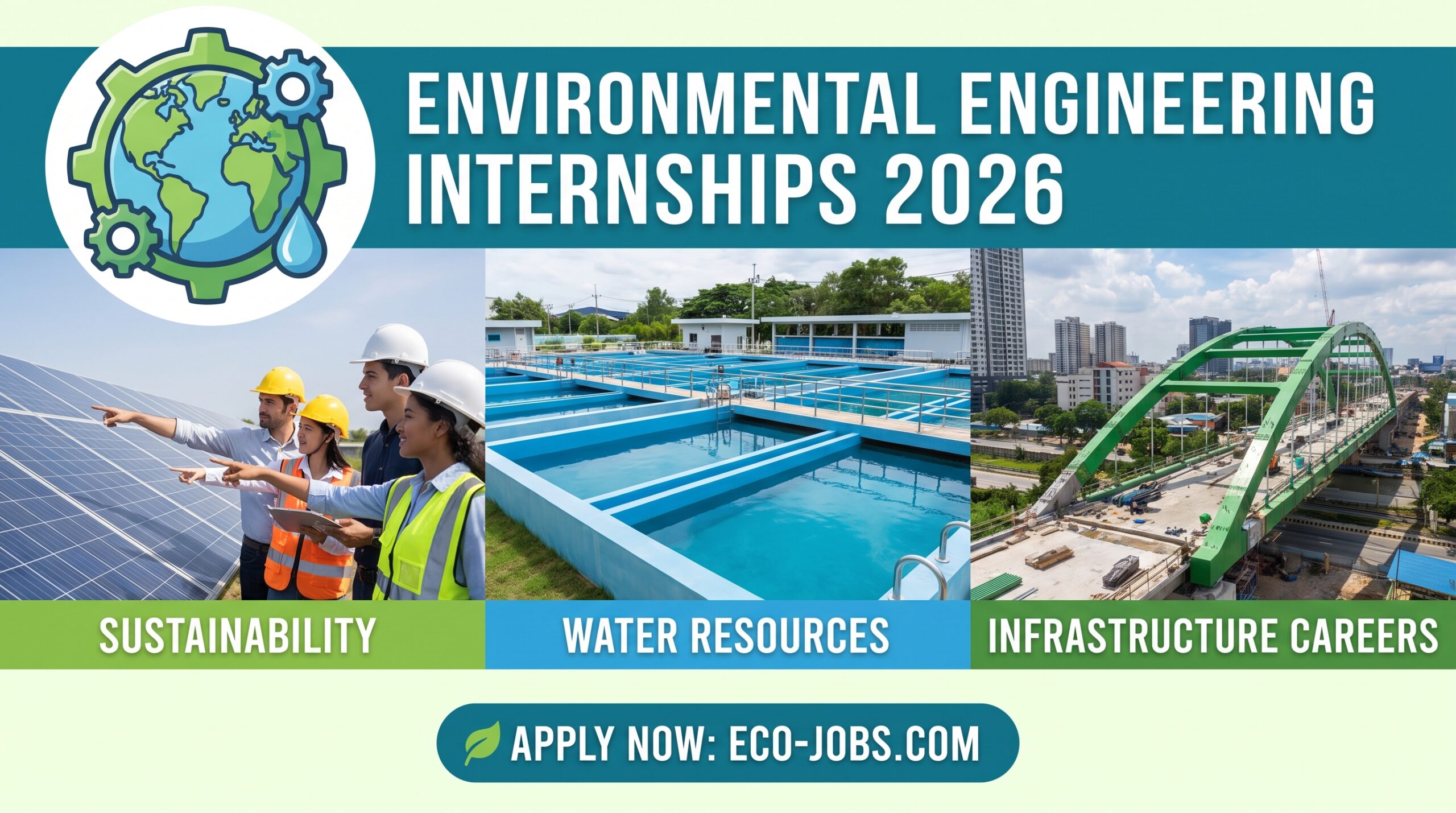
Environmental engineering is becoming increasingly important as cities, industries, governments and communities work to manage water resources, reduce pollution, improve infrastructure and respond to environmental and climate challenges.
For students and recent graduates, Environmental Engineering Internships 2026 provide an opportunity to move beyond classroom theory and gain practical experience in areas such as water treatment, environmental monitoring, sustainability, waste management, climate resilience, environmental consulting and infrastructure planning.
An internship can also help students understand which part of environmental engineering best matches their interests. Some may prefer laboratory work and water quality, while others may enjoy field inspections, GIS, environmental impact assessments, sustainability programs or engineering design.
Current 2026 opportunities demonstrate this range. Environmental internship programs and engineering employers are offering exposure to environmental consulting, sustainability, research, GIS, water projects, climate work and practical field activities.
Environmental Engineering Internships 2026 at a Glance
| Category | Details |
|---|---|
| Field | Environmental Engineering |
| Main Areas | Sustainability, water, waste, climate, environmental consulting and infrastructure |
| Typical Candidates | Engineering students, final-year students and recent graduates |
| Degree | Environmental Engineering or related discipline |
| Experience | Often suitable for entry-level candidates |
| Work Settings | Offices, laboratories, construction sites, treatment plants and field locations |
| Common Skills | Research, data analysis, GIS, environmental assessment and technical reporting |
| Internship Types | Summer, semester, graduate training and project-based |
| International Opportunities | USA, Canada, UK, Australia, Europe, Middle East and Asia |
Why Environmental Engineering Internships Matter in 2026
Environmental challenges are increasingly connected to engineering.
Clean drinking water, wastewater treatment, stormwater management, air quality, waste reduction, sustainable construction and climate-resilient infrastructure all require technical professionals.
An internship gives students an opportunity to observe how these challenges are addressed in real projects.
For example, an environmental engineering intern might participate in environmental sampling one week and help organize technical data or prepare reports the next. Another intern may work on water infrastructure, environmental assessments or sustainability projects.
The experience can make academic subjects more understandable because students see how engineering calculations, environmental regulations, scientific data and project planning are applied in practice.
Major Areas of Environmental Engineering Internships
Environmental engineering is a diverse career field. Internship responsibilities depend heavily on the organization and specialization.
1. Water and Wastewater Engineering Internships
Water is one of the most important areas of environmental engineering.
Interns may gain exposure to:
- Drinking water systems
- Wastewater treatment
- Water quality monitoring
- Stormwater management
- Sewer systems
- Hydraulic analysis
- Water sampling
- Treatment processes
- Water infrastructure planning
- Technical documentation
Water engineering internships can be particularly useful for students interested in municipal infrastructure and environmental consulting.
A 2026 Mott MacDonald water engineering internship, for example, included engineering design, site inspections, technical documentation, project meetings, digital tools and sustainable outcomes.
2. Environmental Consulting Internships
Environmental consulting companies work with businesses, governments and infrastructure developers on environmental issues.
Interns may assist with:
- Environmental assessments
- Environmental Impact Assessments
- Initial Environmental Examinations
- Compliance documentation
- Environmental monitoring
- Research
- Sustainability studies
- Technical reports
- Field investigations
This area can provide broad exposure because consultants may work across several industries and project types.
3. Sustainability Internships
Sustainability has become an important part of engineering and business planning.
Environmental engineering interns may contribute to:
- Resource efficiency
- Waste reduction
- Energy efficiency
- Sustainable infrastructure
- Environmental performance
- Carbon reduction initiatives
- Sustainability reporting
- Circular economy projects
These skills can be useful beyond traditional environmental engineering roles.
4. Climate and Resilience Internships
Climate-related engineering work can involve preparing communities and infrastructure for environmental risks.
Possible projects include:
- Flood risk
- Climate adaptation
- Heat resilience
- Disaster preparedness
- Watershed management
- Climate data
- Resilient infrastructure
- Environmental planning
For example, Pakistan’s 2026 CM Punjab Climate Leadership Development Internship Program includes environmental sciences and engineering among its core disciplines and emphasizes supervised fieldwork, environmental data analysis and climate-related practical assignments.
5. Environmental Monitoring Internships
Monitoring helps organizations understand environmental conditions and identify potential problems.
Interns can potentially work with:
- Water samples
- Air-quality data
- Soil samples
- Environmental sensors
- Laboratory results
- Field measurements
- Environmental databases
A 2026 water-quality internship example included river sampling, laboratory testing, data collection, cleaning and visualization.
6. GIS and Remote Sensing Internships
Geographic Information Systems are increasingly useful in environmental engineering.
GIS can be used for:
- Flood mapping
- Watershed analysis
- Land-use mapping
- Environmental monitoring
- Infrastructure planning
- Disaster risk analysis
- Water-resource management
Students who combine environmental engineering with GIS can develop a particularly useful technical profile.
7. Waste Management Internships
Waste management involves engineering solutions for the collection, treatment, recycling and disposal of waste.
Interns may learn about:
- Solid waste management
- Recycling systems
- Waste audits
- Landfill operations
- Wastewater sludge
- Hazardous waste
- Resource recovery
- Circular economy principles
What Does an Environmental Engineering Intern Do?
The exact responsibilities depend on the organization.
Typical tasks may include:
- Conducting environmental research
- Supporting field inspections
- Collecting environmental samples
- Entering and analyzing data
- Preparing technical reports
- Assisting with environmental assessments
- Supporting laboratory activities
- Creating maps using GIS
- Reviewing environmental regulations
- Monitoring project compliance
- Participating in sustainability projects
- Assisting senior engineers
- Preparing presentations and documentation
Interns generally work under supervision rather than independently taking responsibility for regulated engineering decisions.
Skills to Develop During an Environmental Engineering Internship
Technical Skills
Useful technical areas include:
- Environmental sampling
- Water-quality analysis
- Wastewater treatment
- Environmental impact assessment
- GIS
- Remote sensing
- Data analysis
- Environmental regulations
- Sustainability assessment
- Technical report writing
- Engineering calculations
Depending on the position, students may also encounter software such as ArcGIS, QGIS, AutoCAD, Excel, Python or specialized environmental modeling tools.
Professional Skills
Employers also value:
- Communication
- Teamwork
- Critical thinking
- Problem-solving
- Organization
- Attention to detail
- Time management
- Research
- Report writing
- Presentation skills
A strong environmental engineer needs both technical knowledge and the ability to explain technical information clearly.
Environmental Engineering Internship Salary and Stipend
Internship compensation varies considerably according to country, employer, location, duration and responsibilities.
Some programs are paid hourly, others provide a monthly stipend, and some academic or research internships may offer different forms of support.
For example, a 2026 environmental sampling and data-analysis internship in the United States listed compensation of $22–$25 per hour for a part-time placement.
In Pakistan, compensation can be substantially different. Current 2026 listings include environmental and civil/environmental internship opportunities with monthly compensation around PKR 10,000–15,000, while other technical research and engineering positions can offer more depending on responsibilities.
These figures should be treated as examples rather than universal salary ranges. Always verify compensation directly in the individual internship advertisement.
Benefits of Environmental Engineering Internships
Practical Experience
You can see how environmental engineering works outside the university environment.
Technical Development
Internships can help you develop practical knowledge in water, GIS, environmental monitoring, sustainability and data analysis.
Professional Networking
You may work alongside:
- Environmental engineers
- Civil engineers
- Scientists
- Consultants
- Project managers
- GIS specialists
- Government officials
- Laboratory professionals
Stronger CV
Relevant internship experience can help demonstrate that you can apply your education to practical problems.
Career Exploration
An internship can help you decide whether you prefer:
- Water engineering
- Environmental consulting
- Sustainability
- Climate work
- GIS
- Waste management
- Environmental monitoring
- Infrastructure
Environmental Engineering Internships for International Students
International students can find environmental engineering opportunities in several countries, although eligibility varies by employer.
Common destinations include:
- United States
- Canada
- United Kingdom
- Australia
- Germany
- Netherlands
- Ireland
- New Zealand
- United Arab Emirates
- Saudi Arabia
- Qatar
- Singapore
International internships may involve environmental consulting, water infrastructure, sustainability, climate resilience, environmental monitoring or engineering research.
However, international applicants should check work authorization requirements before applying.
Do Environmental Engineering Internships Offer Visa Sponsorship?
Not automatically.
Some internships are specifically designed for students who already have permission to work in the country. Others may have student-visa arrangements or other pathways depending on the employer and location.
Before applying internationally, check:
- Whether international students are eligible.
- Whether the employer accepts candidates requiring work authorization.
- Whether visa sponsorship is available.
- Whether enrollment at a local university is required.
- Whether the internship is restricted to citizens or residents.
- Whether the placement has specific visa conditions.
A job advertisement that says “environmental engineering internship” should not automatically be interpreted as an offer of visa sponsorship.
Eligibility Requirements
Requirements vary, but common criteria include:
- Studying environmental engineering
- Studying civil engineering or a related discipline
- Being in the final years of a degree
- Recent graduation
- Good academic performance
- Interest in sustainability
- Basic technical knowledge
- Communication skills
- Analytical ability
- Willingness to work in the field
Some programs accept students from related disciplines such as environmental science, geography, GIS, hydrology, natural resources or climate studies.
For example, a 2026 environmental internship in Islamabad listed Environmental Science, Environmental Engineering, GIS, Geography, Ecology, Forestry, Natural Resource Management, Climate Change and Sustainability among relevant backgrounds.
Education Required
Common degrees include:
- BS Environmental Engineering
- BE Environmental Engineering
- BS Environmental Sciences
- Civil Engineering
- Water Resources Engineering
- Chemical Engineering
- Geographical Sciences
- Hydrology
- Natural Resource Management
Requirements depend on the specific internship.
Research-focused positions may require stronger data-analysis or programming skills, while field-based roles may prioritize environmental sampling and practical work.
How to Find Environmental Engineering Internships in 2026
Students should search multiple sources rather than relying on one job website.
Company Career Pages
Engineering consultancies, environmental firms, water companies and infrastructure organizations often advertise directly on their websites.
University Career Centers
Universities frequently receive internship announcements from employers.
Government Departments
Environmental protection agencies and public-sector organizations can provide valuable practical exposure.
For example, Pakistan’s Environmental Protection Agency promotes internships for students in environmental science, biology, engineering, public policy and related fields, with opportunities involving environmental policy, research and management.
Professional Networks
LinkedIn and engineering associations can also be useful for discovering opportunities.
Research Institutes
Universities and research centers can offer internships involving water resources, climate, environmental data and sustainability research.
How to Apply for Environmental Engineering Internships
Step 1: Prepare Your CV
Include:
- Degree
- University
- Relevant coursework
- Technical skills
- Software
- Academic projects
- Research
- Certifications
- Previous experience
Step 2: Highlight Relevant Projects
If you have no professional experience, university projects can demonstrate your abilities.
Examples include:
- Wastewater treatment design
- Water-quality analysis
- Environmental impact assessment
- Flood-risk mapping
- GIS projects
- Waste-management studies
- Air-quality research
- Sustainability assessments
Step 3: Build Your Technical Skills
Focus on tools relevant to your desired specialization.
For example:
Water: hydraulic modeling and water-quality analysis
GIS: ArcGIS or QGIS
Data: Excel, Python and statistical tools
Environmental consulting: EIA/IEE documentation and environmental regulations
Step 4: Apply Through the Correct Channel
Follow the employer’s application instructions carefully.
Some organizations request a CV and cover letter, while others use online application systems.
Step 5: Prepare for Interviews
You may be asked about:
- Your environmental engineering degree
- Academic projects
- Water treatment
- Sustainability
- Environmental regulations
- GIS
- Data analysis
- Teamwork
- Problem-solving
- Why you chose environmental engineering
How to Improve Your Chances of Selection
Gain Practical Experience
Even small university or volunteer projects can demonstrate initiative.
Learn GIS
GIS is particularly useful in water, environmental planning, climate and infrastructure work.
Improve Data Skills
Environmental engineering increasingly involves collecting, cleaning, analyzing and visualizing data.
Understand Environmental Regulations
Learn the basic environmental regulations and assessment processes relevant to your target country.
Develop Report-Writing Skills
Environmental engineers frequently need to communicate findings through technical reports.
Apply to Several Opportunities
Do not depend on a single application.
A broader application strategy can increase your chances of finding a suitable placement.
Environmental Engineering Careers After an Internship
An internship can introduce you to several long-term career paths.
Environmental Engineer
Works on pollution control, environmental systems, compliance and sustainable engineering.
Water Resources Engineer
Focuses on water supply, drainage, hydrology and water management.
Wastewater Engineer
Works with wastewater treatment systems and related infrastructure.
Environmental Consultant
Provides technical and regulatory advice for projects and organizations.
Sustainability Specialist
Helps organizations improve environmental performance and resource efficiency.
GIS Analyst
Uses geographic data to support environmental and infrastructure decisions.
Environmental Scientist
Conducts environmental research, monitoring and assessments.
Climate Resilience Specialist
Works on strategies to prepare infrastructure and communities for environmental risks.
Environmental Engineering Internships in Pakistan
Pakistan offers opportunities through government agencies, universities, engineering consultancies, water organizations and environmental companies.
Current examples show opportunities spanning environmental consulting, climate leadership, water resources and environmental research.
The Centre of Excellence in Water Resources Engineering at UET Lahore, for example, announced a 2026 professional internship covering areas such as hydrology, climate change, watershed analysis, urban drainage, GIS, remote sensing, integrated water resources management and dam engineering.
This demonstrates how environmental engineering students can build skills that overlap with civil engineering, water resources, GIS and climate resilience.
Environmental Engineering Internship vs Graduate Program
| Feature | Internship | Graduate Program |
|---|---|---|
| Target Candidates | Students | Recent graduates |
| Duration | Usually shorter | Often longer |
| Main Purpose | Learning and exposure | Professional development |
| Responsibility | Limited/supervised | Greater responsibility |
| Experience Level | Beginner | Entry-level professional |
| Full-Time Potential | Possible | Often stronger pathway |
| Academic Credit | Sometimes | Usually not |
Students should consider both options when planning their transition into professional environmental engineering.
Frequently Asked Questions
1. Who can apply for Environmental Engineering Internships 2026?
Environmental engineering students, final-year students and recent graduates can apply for many opportunities. Some employers also accept students from environmental science, civil engineering, GIS, hydrology and related disciplines.
2. Do environmental engineering internships require previous experience?
Usually not. Internships are designed for students and early-career candidates, although academic projects and technical skills can strengthen an application.
3. Are environmental engineering internships paid?
Some are paid while others may be unpaid or provide academic credit. Compensation depends on the employer and country.
4. Can international students apply?
Some employers accept international students, while others require existing work authorization. Applicants should check the specific internship requirements.
5. What skills are useful for environmental engineering internships?
Useful skills include environmental assessment, water-quality analysis, GIS, data analysis, technical reporting, research and sustainability knowledge.
6. Is GIS useful for environmental engineers?
Yes. GIS can be useful for environmental monitoring, flood mapping, watershed analysis, infrastructure planning and natural-resource management.
7. Can fresh graduates apply for environmental internships?
Yes. Some internships and graduate-training programs accept recent graduates, although each employer has its own eligibility requirements.
8. Can environmental engineering internships lead to permanent jobs?
They can provide useful experience and professional connections, and some employers recruit successful interns for future roles. However, an internship does not guarantee permanent employment.
9. Can environmental engineering interns work in water infrastructure?
Yes. Water supply, wastewater, drainage, water quality and water-resource management are important areas of environmental engineering.
10. Are there environmental engineering internships abroad?
Yes. Opportunities exist in countries including the United States, Canada, the UK, Australia and various European and Middle Eastern countries. International applicants must verify eligibility and work authorization.
Final Thoughts
Environmental Engineering Internships 2026 offer students an opportunity to gain practical experience in one of the engineering disciplines most closely connected to sustainability, water management and resilient infrastructure.
The field extends well beyond traditional environmental work. Students can explore water and wastewater engineering, environmental consulting, climate resilience, GIS, sustainability, waste management, environmental monitoring and infrastructure planning.
The best strategy is to identify a specialization early, develop practical technical skills and apply to internships that provide meaningful project exposure.
If you are studying environmental engineering, do not focus only on grades. Build projects, learn relevant software, improve your analytical abilities and develop strong technical writing skills. These experiences can help you transition from university into a professional environmental engineering career.