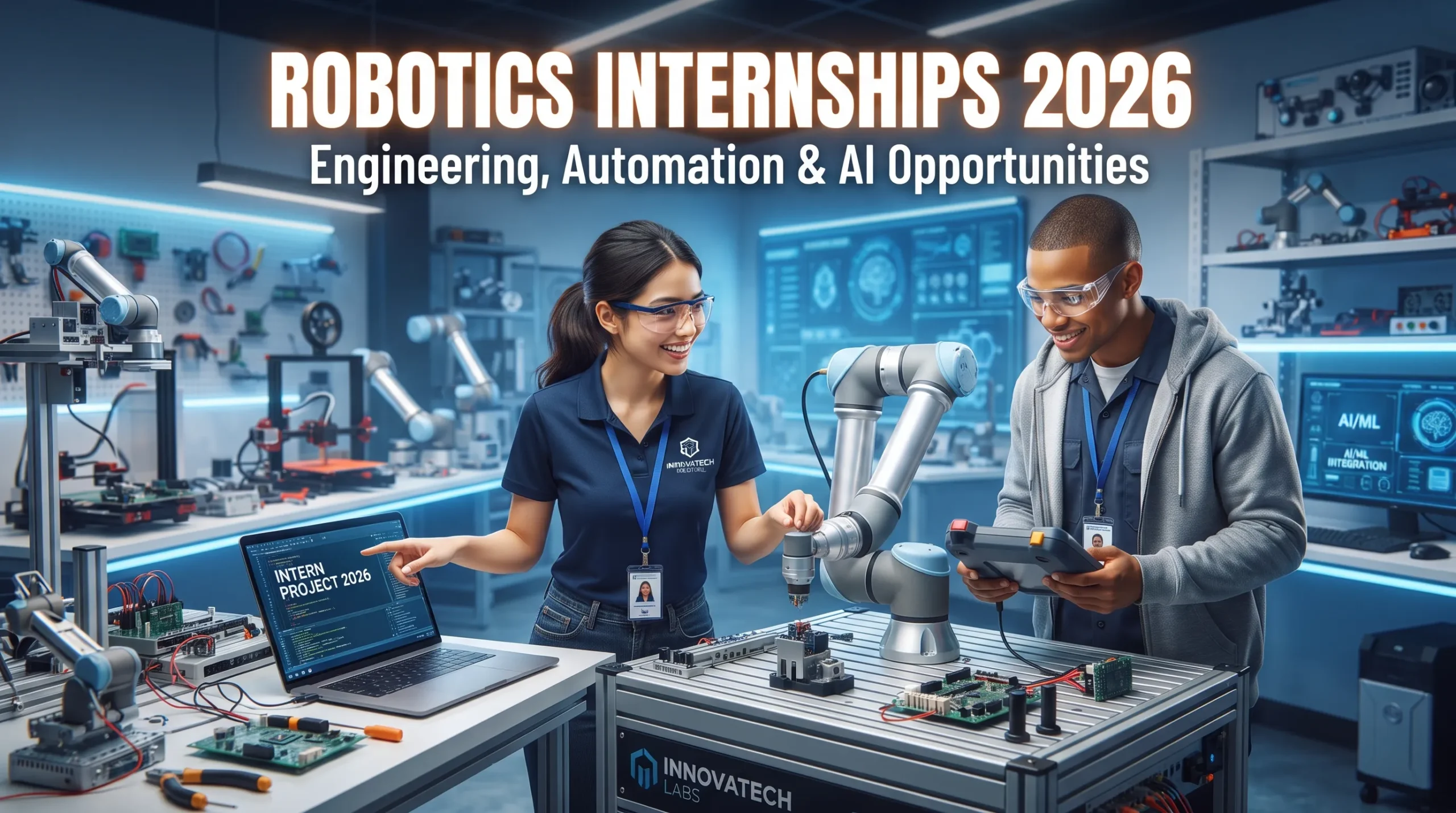
Robotics is becoming one of the most interdisciplinary areas of modern technology. A single robotic system can combine mechanical engineering, electronics, computer programming, artificial intelligence, sensors, control systems and automation.
That is why robotics internships in 2026 are attracting students from a wide range of academic backgrounds. Mechanical, electrical, mechatronics, computer science, software engineering, artificial intelligence and industrial engineering students can all find potential entry points into the field.
A robotics intern may help build a robotic arm, program an autonomous mobile robot, develop computer-vision software, test sensors, design mechanical components or improve an industrial automation process. Others may work on drones, autonomous vehicles, medical robots or AI-powered robotic systems.
The current internship market demonstrates how broad the sector has become. Robotics internship listings for 2026 include positions involving computer vision, manipulation, autonomous systems, reinforcement learning, SLAM, embedded systems, motion control, industrial robotics and machine learning.
Opportunities are also available in Pakistan. A 2026 robotics internship advertised in Karachi, for example, included hands-on work in robotics design, programming, automation and AI integration, with a listed stipend of Rs. 15,000–20,000 per month. UET Taxila’s 2026 internship activities have also included robotics-arm integration, IoT, embedded systems, machine learning, Python and MATLAB.
For students interested in the future of engineering and intelligent technology, an internship can provide practical experience that is difficult to obtain through classroom study alone.
This guide explains the major types of robotics internships available in 2026, expected responsibilities, salary considerations, required skills, education, international opportunities, visa issues and strategies for building a competitive application.
Robotics Internship Overview
| Category | Details |
|---|---|
| Industry | Robotics, Automation, Engineering and Artificial Intelligence |
| Common Roles | Robotics Intern, Robotics Engineering Intern, Automation Intern, AI Robotics Intern |
| Major Areas | Industrial robots, autonomous systems, AI, computer vision, drones and embedded systems |
| Education | Engineering, Computer Science, Robotics, Mechatronics and related fields |
| Experience Level | Undergraduate students, postgraduate students and recent graduates |
| Typical Duration | 2–12 months depending on employer or academic program |
| Work Settings | Laboratories, factories, offices, research centers and testing facilities |
| Programming | Python, C, C++, MATLAB and related languages |
| Robotics Tools | ROS/ROS 2, simulation platforms, CAD and computer-vision libraries |
| Potential Employers | Robotics companies, manufacturers, research institutions, startups and technology firms |
| Career Paths | Robotics Engineer, Automation Engineer, Controls Engineer, AI Engineer |
Why Robotics Internships Are in Demand
Robotics is increasingly being used to automate repetitive, dangerous or highly precise tasks.
Manufacturing is one of the best-known examples, but robotics is expanding into many other areas, including:
- Warehousing
- Logistics
- Healthcare
- Agriculture
- Construction
- Defense
- Aerospace
- Consumer products
- Mining
- Inspection
- Transportation
- Research
The technology itself is also changing.
Traditional industrial robots typically perform carefully programmed repetitive movements. Modern robotic systems increasingly combine sensors, computer vision, machine learning and autonomous decision-making.
That creates demand for students who understand more than one technical discipline.
A robotics engineer might need to understand mechanical components while also working with sensors and programming. An AI robotics researcher may need computer vision and machine learning skills alongside knowledge of robotic motion and simulation.
Current 2026 listings demonstrate this combination. Available roles include robotics planning and controls, autonomous systems, computer vision, sensor fusion, machine learning, industrial robotics and embedded systems.
The growth of automation is also creating demand for technicians and engineers who can maintain and troubleshoot robotic equipment. A new engineering technology program at Galveston College, for example, is preparing students to work with robots, drones and programmable logic controllers used in automated environments.
Robotics Engineering Internships
Robotics engineering is one of the broadest internship categories.
A robotics engineering intern may participate in the complete development process:
- Define the problem.
- Design the robotic system.
- Select hardware.
- Develop software.
- Integrate sensors and actuators.
- Test the prototype.
- Analyze performance.
- Improve the system.
Responsibilities vary according to the company.
Mechanical Robotics Engineering
Mechanical-focused interns can work on:
- Robotic arms
- End effectors
- Gear systems
- Frames
- Chassis
- Mechanical assemblies
- Actuator mounting
- CAD models
- Prototypes
- Mechanical testing
Knowledge of CAD software such as SolidWorks, CATIA, Creo or Autodesk tools can be valuable.
Electrical Robotics Engineering
Electrical interns may work on:
- Motors
- Motor controllers
- Sensors
- Circuit boards
- Power supplies
- Wiring
- Embedded electronics
- Communication systems
- Control hardware
A good understanding of circuits, electronics and control systems can help candidates compete for these roles.
Robotics Automation Internships
Automation is closely connected to robotics.
Automation internships are particularly relevant to manufacturing and industrial environments.
Interns may work with:
- Programmable Logic Controllers
- Industrial robots
- Sensors
- Actuators
- Human-machine interfaces
- Automated production lines
- Machine vision
- Industrial communication networks
- Process monitoring
Common industrial robotics platforms include ABB, FANUC and KUKA systems.
A current 2026 robotics and automation internship listing, for example, includes PLC programming, sensors and instrumentation, industrial robotics, motion control and programming among its technical areas.
What Does an Automation Intern Do?
An automation intern may help engineers:
- Program equipment
- Test automated systems
- Troubleshoot faults
- Monitor production processes
- Improve machine efficiency
- Document procedures
- Configure sensors
- Analyze production data
This can be an excellent route for students interested in industrial engineering and manufacturing.
Artificial Intelligence and Robotics Internships
AI is becoming an increasingly important component of modern robotics.
AI allows robots to interpret their environment, recognize objects, make predictions and perform tasks that are difficult to handle with fixed programming alone.
AI robotics internships can involve:
- Machine learning
- Deep learning
- Computer vision
- Reinforcement learning
- Object detection
- Image classification
- Robot perception
- Natural-language interfaces
- Autonomous navigation
- Imitation learning
Some current 2026 internships combine robotics with vision-language models, reinforcement learning and sim-to-real transfer.
Computer Vision Internships
Computer vision allows robots to interpret visual information.
Interns may work with:
- Cameras
- Object detection
- Object tracking
- Image segmentation
- Depth cameras
- 3D perception
- Visual inspection
Python and OpenCV are useful starting points.
Students can also learn frameworks such as PyTorch or TensorFlow for machine-learning applications.
Reinforcement Learning
Reinforcement learning is another emerging area.
Instead of explicitly programming every action, an algorithm learns through interaction with an environment.
Robotics research internships may use reinforcement learning for:
- Robotic manipulation
- Navigation
- Locomotion
- Grasping
- Autonomous decision-making
This area is particularly suitable for students with strong mathematics, programming and machine-learning backgrounds.
Autonomous Robotics Internships
Autonomous robots are designed to perform tasks with limited human intervention.
Examples include:
- Autonomous mobile robots
- Delivery robots
- Warehouse robots
- Drones
- Self-driving systems
- Agricultural robots
- Inspection robots
Internships can involve:
- Path planning
- Localization
- Mapping
- Navigation
- Sensor fusion
- Motion planning
- Obstacle avoidance
SLAM
SLAM stands for Simultaneous Localization and Mapping.
It enables a robot to estimate its location while creating a map of an unfamiliar environment.
Students interested in autonomous robotics can benefit from learning:
- Robotics mathematics
- Probability
- Sensors
- LiDAR
- Computer vision
- ROS 2
- C++
- Python
These skills frequently appear in autonomous-robotics internship listings.
Embedded Systems and Robotics Internships
Robots need computers to control their hardware.
Embedded robotics internships can involve:
- Microcontrollers
- Firmware
- Real-time systems
- Sensors
- Motor control
- Communication protocols
- Embedded Linux
Useful technologies include:
- Arduino
- ESP32
- Raspberry Pi
- STM32
- C
- C++
- Python
A robotics internship in Lahore, for example, has included hardware/software integration involving Arduino, Raspberry Pi and Jetson Nano, along with sensors, motors, computer vision and AI-related work.
Robotics Research Internships
Research internships are suitable for students interested in advanced robotics and potentially graduate study.
Research projects may involve:
- Robot perception
- Autonomous systems
- Human-robot interaction
- Robot learning
- Manipulation
- Motion planning
- Simulation
- AI
- Control systems
Research internships may be offered by:
- Universities
- Research laboratories
- Technology companies
- Government institutions
- Robotics startups
Some opportunities are specifically designed for postgraduate students, while others accept strong undergraduate applicants.
Robotics Internship Salary Range
Robotics internship compensation varies significantly by country, company, technical specialization and academic level.
Current 2026 listings demonstrate a wide range.
Some U.S. robotics internships advertise hourly compensation in the $20–$50+ range, while specialized positions can be higher. One current robotics internship listing shows $25–$35 per hour, while other technical positions advertise $38–$94 per hour.
In Pakistan, compensation can be considerably different. A Karachi robotics and technology internship currently listed on Indeed advertises Rs. 15,000–20,000 per month.
International programs may also provide monthly stipends rather than hourly salaries.
For example, a robotics internship listed through India’s AICTE portal offers a ₹75,000 monthly stipend for a 75-day robotics and automation program, while another robotics engineering internship lists no stipend.
| Market | Possible Compensation |
|---|---|
| United States | Often hourly paid |
| Canada | Paid internships and co-op placements |
| United Kingdom | Compensation varies by employer |
| Germany | Paid and academic internship arrangements |
| Australia | Paid placements available |
| Pakistan | Paid and unpaid internships |
| India | Paid, unpaid and stipend-based programs |
These figures should be treated as examples rather than guaranteed industry averages.
Always check whether an advertised amount is a salary, stipend, allowance or educational benefit.
Employee Benefits
Robotics internships can provide benefits beyond compensation.
Depending on the employer, interns may receive:
- Monthly stipend
- Hourly salary
- Accommodation
- Transportation
- Technical training
- Mentorship
- Internship certificate
- Academic credit
- Laboratory access
- Factory experience
- Professional networking
- Portfolio projects
- Potential full-time employment
A strong internship can also help students understand which robotics specialization suits them.
For example, someone entering a general robotics internship may discover that they prefer computer vision over mechanical design or controls over AI.
Robotics Internship Responsibilities
The actual work depends heavily on the role.
Engineering Responsibilities
Engineering interns may:
- Design components
- Create CAD models
- Build prototypes
- Test robotic systems
- Analyze engineering data
- Prepare technical documentation
Programming Responsibilities
Software-focused interns may:
- Write code
- Debug software
- Develop control algorithms
- Process sensor data
- Build computer-vision systems
- Test autonomous behaviors
Research Responsibilities
Research interns may:
- Review technical literature
- Develop experiments
- Collect data
- Train models
- Run simulations
- Analyze results
- Prepare research reports
Automation Responsibilities
Automation interns may:
- Configure PLCs
- Test sensors
- Program industrial robots
- Troubleshoot equipment
- Monitor automated processes
- Improve production efficiency
Required Skills for Robotics Internships
Programming
Programming is one of the most valuable skills in modern robotics.
Students should consider learning:
- Python
- C++
- C
- MATLAB
Python is particularly useful for AI, data analysis and rapid prototyping.
C and C++ are widely relevant to embedded systems and robotics software.
ROS and ROS 2
The Robot Operating System ecosystem is highly useful for robotics development.
Students can learn:
- Nodes
- Topics
- Services
- Actions
- Robot simulation
- Sensor integration
- Navigation
ROS 2 is particularly useful for students interested in modern autonomous robotics.
Mathematics
Robotics requires mathematics in areas such as:
- Linear algebra
- Calculus
- Probability
- Statistics
- Geometry
These concepts are useful for computer vision, control, localization and machine learning.
Electronics
Understanding:
- Sensors
- Motors
- Microcontrollers
- Circuits
- Communication protocols
can make it easier to integrate physical hardware with software.
CAD
Mechanical robotics positions may require:
- SolidWorks
- CATIA
- Creo
- Fusion 360
- AutoCAD
AI and Computer Vision
Students targeting intelligent robotics should consider:
- OpenCV
- PyTorch
- TensorFlow
- NumPy
- Pandas
- Scikit-learn
Current internship listings frequently mention Python, OpenCV, PyTorch and machine-learning frameworks for robotics roles.
Education and Experience Requirements
Robotics internships are available to students from several disciplines.
Common degrees include:
- Robotics Engineering
- Mechatronics Engineering
- Mechanical Engineering
- Electrical Engineering
- Electronics Engineering
- Computer Engineering
- Computer Science
- Software Engineering
- Artificial Intelligence
- Industrial Engineering
- Aerospace Engineering
- Control Engineering
Some internships also accept physics, mathematics and related technical disciplines.
For example, an AICTE-listed robotics and automation program is aimed at undergraduate and postgraduate students in mechanical, electrical, electronics, mechatronics, robotics and computer science.
Can Fresh Graduates Apply?
Yes.
Some robotics internships specifically accept recent graduates.
A robotics engineering internship advertised in Lahore, for example, lists fresh graduates among its target applicants and considers computer vision, programming, Arduino, Raspberry Pi and Jetson Nano experience relevant.
However, candidates should check each employer’s eligibility criteria because some internships are restricted to currently enrolled students.
Robotics Internships in Pakistan
Pakistan’s robotics ecosystem includes opportunities across education, research, automation and technology.
Islamabad and Rawalpindi
Students can explore:
- Universities
- Research centers
- Engineering organizations
- AI laboratories
- Robotics startups
- Automation companies
The National Center of Artificial Intelligence at NUST has also promoted programs combining AI, machine learning, deep learning and robotics project experience for students.
Lahore
Lahore has opportunities involving:
- Computer vision
- Robotics
- Automation
- AI
- Software development
- Industrial engineering
A robotics engineering internship advertised in Lahore has involved computer vision, Arduino, Raspberry Pi, Jetson Nano, sensors, motors and software development.
Karachi
Karachi also offers robotics and automation opportunities.
A current 2026 listing for a paid robotics and technology internship describes hands-on work in robotic-system development, programming, automation and AI integration, with a Rs. 15,000–20,000 monthly stipend.
Other Locations
Students should also search in:
- Taxila
- Peshawar
- Faisalabad
- Sialkot
- Multan
University engineering departments can be especially useful sources because many internships are connected to research projects and industry collaborations.
International Robotics Internships
International robotics internships are available in major technology and engineering markets.
Potential destinations include:
- United States
- Canada
- Germany
- United Kingdom
- Switzerland
- Singapore
- Japan
- South Korea
- Australia
- India
Current 2026 listings show opportunities in cities including San Francisco, Singapore, Munich-area locations, Stuttgart, Tokyo, Geneva and other technology centers.
Some positions focus on research while others are directly connected to commercial products.
What Should International Students Check?
Before applying, determine:
- Whether international students are eligible.
- Whether existing work authorization is required.
- Whether the company sponsors internships.
- Whether enrollment at a university is mandatory.
- Whether the internship must be related to your degree.
- Whether relocation assistance is provided.
- Whether housing is included.
Do not assume that an internship advertisement includes visa sponsorship.
Visa Sponsorship Information
International robotics internships can involve different immigration requirements depending on the destination.
Potential routes can include:
- Student internship authorization
- University-sponsored work authorization
- Temporary training visas
- Research visas
- Co-op work permits
- Graduate work authorization
The appropriate route depends on the country, your citizenship, university status and internship structure.
Candidates should check official government immigration information before making travel arrangements.
Be particularly cautious of agencies that demand large upfront payments in exchange for a supposed guaranteed robotics internship or visa.
A legitimate employer should provide clear information about the organization, position, compensation and application process.
How to Apply for Robotics Internships in 2026
1. Choose a Specialization
Instead of applying randomly, decide whether you are most interested in:
- Robotics engineering
- Industrial automation
- AI robotics
- Computer vision
- Embedded systems
- Robot controls
- Autonomous systems
- Drones
- Medical robotics
2. Build a Technical Resume
Include:
- Degree
- University
- Relevant coursework
- Programming languages
- Engineering software
- Robotics projects
- Research
- Competitions
- Certifications
Keep your most relevant skills near the top.
3. Create a Robotics Portfolio
A portfolio can significantly strengthen an application.
Good project ideas include:
Robot arm: Build and program a simple robotic arm.
Autonomous car: Create a small vehicle that follows a route or avoids obstacles.
Computer vision: Develop an object-detection application.
ROS project: Build a simulated mobile robot using ROS 2.
Arduino project: Create a sensor-controlled robotic system.
AI project: Train a model to recognize objects for robotic applications.
4. Use GitHub
For programming-focused roles, GitHub can provide evidence of your practical skills.
Include:
- Source code
- Project documentation
- Installation instructions
- Demonstration videos
- Results
- Technical explanations
5. Search With Different Keywords
Do not search only for Robotics Internship.
Try:
- Robotics Engineering Intern
- Automation Engineering Intern
- AI Robotics Intern
- Robotics Software Intern
- Computer Vision Intern
- Controls Engineering Intern
- Embedded Systems Intern
- Autonomous Systems Intern
- Machine Learning Robotics Intern
- Industrial Automation Intern
- Mechatronics Intern
- Robot Programming Intern
Tips to Increase Hiring Chances
Build One Strong Project
One complete project is often more useful than a resume containing dozens of unrelated online courses.
Explain:
- What you built
- Why you built it
- Which tools you used
- What problems occurred
- How you solved them
- What the final result was
Learn ROS 2
ROS 2 can be particularly useful for students targeting robotics software and autonomous systems.
Build at least one small project rather than simply listing ROS on your resume.
Improve Your C++ and Python
Python is useful for AI, computer vision and experimentation.
C++ is valuable for performance-sensitive robotics software and many robotics frameworks.
Having both can give students greater flexibility.
Learn About Sensors
Understand the basic purpose of:
- Cameras
- LiDAR
- Ultrasonic sensors
- IMUs
- Encoders
- GPS
Then learn how robots combine information from multiple sensors.
Join Robotics Competitions
University robotics competitions can provide practical experience with:
- Mechanical design
- Programming
- Electronics
- Sensors
- Control
- Teamwork
- Project management
This experience can be particularly useful during interviews.
Students applying internationally may encounter several possible immigration routes.
Depending on the country, these may include:
- Student internship authorization
- University placement programs
- Co-op work permits
- Temporary training visas
- Research visas
- Graduate work programs
- Post-study employment routes
An internship visa and a full-time skilled-worker visa are not necessarily the same.
If your long-term goal is to work abroad as a robotics engineer, investigate both the internship requirements and the country’s graduate employment pathway.
Cost of Living for International Interns
International candidates should calculate the complete cost of an internship.
Consider:
- Rent
- Food
- Transportation
- Flights
- Visa expenses
- Insurance
- Local travel
- Internet
- Emergency funds
Also check whether the employer provides:
- Housing
- Relocation assistance
- Transport
- Meals
- Travel reimbursement
A high internship salary may not necessarily result in higher savings if accommodation and living costs are expensive.
Frequently Asked Questions
1. What is a robotics internship?
A robotics internship is a temporary educational or professional placement where students gain practical experience designing, programming, testing or researching robotic systems and automation technologies.
2. Who can apply for robotics internships?
Students and graduates from robotics, mechatronics, mechanical engineering, electrical engineering, electronics, computer science, software engineering, AI and related fields can apply depending on the employer.
3. Are robotics internships paid in 2026?
Yes, many are paid, although compensation varies significantly. Current listings show examples ranging from modest monthly stipends to highly paid technical internships in the United States.
4. What programming language is best for robotics internships?
Python and C++ are two of the most useful languages. Python is popular for AI, data analysis and prototyping, while C++ is widely used for robotics software, embedded systems and performance-sensitive applications.
5. Is ROS 2 important for robotics students?
ROS 2 is highly useful for students interested in robotics software, autonomous systems, sensors, navigation and robot simulation. It can be particularly valuable when combined with C++ or Python.
6. Can mechanical engineering students apply for robotics internships?
Yes. Mechanical engineering students can work on robotic mechanisms, CAD, actuators, chassis, robotic arms, manufacturing and mechanical testing.
7. Can computer science students get robotics internships?
Yes. Computer science students can work in computer vision, machine learning, autonomous navigation, robotics software, AI, simulation and perception.
8. Are robotics internships available in Pakistan?
Yes. Opportunities exist in cities including Karachi, Lahore, Islamabad and Taxila. Current 2026 examples include robotics, automation, AI, embedded systems and robotics-arm integration programs.
9. Can international students apply for robotics internships abroad?
Yes, but eligibility depends on the employer and immigration regulations. Some companies accept international students, while others require candidates to already have authorization to work in the country.
10. Can a robotics internship lead to a full-time job?
Yes. An internship can provide practical experience, professional connections and knowledge of company processes that may improve your chances of future employment. However, an internship does not guarantee a permanent position.
Final Thoughts
Robotics internships in 2026 offer students an opportunity to work at the intersection of engineering, automation and artificial intelligence.
The industry is much broader than traditional industrial robots.
Today’s robotics ecosystem includes autonomous vehicles, warehouse robots, drones, medical systems, robotic arms, smart manufacturing, computer vision, embedded systems and AI-powered machines.
That diversity means students from different academic backgrounds can find their own entry point.
Mechanical engineering students can focus on robot mechanisms and physical design. Electrical and electronics students can explore motors, sensors and control hardware. Mechatronics students can combine mechanical, electrical and programming skills. Computer science students can pursue robotics software, computer vision and AI. Industrial engineering students can explore manufacturing and automation.
Current 2026 opportunities demonstrate this range, from robotics engineering and autonomous systems to AI, machine learning, industrial automation and embedded technology.
Students in Pakistan also have growing opportunities to gain practical experience. Current examples include robotics internships in Karachi, robotics and automation activities through engineering institutions, and programs combining robotics with AI and embedded systems.
The most effective way to prepare is to combine academic knowledge with practical projects.
Learn Python and C++, experiment with Arduino or Raspberry Pi, explore ROS 2, build a small robot, document your work and create a portfolio that demonstrates what you can actually do.
Most importantly, do not limit your search to the exact phrase “Robotics Intern.” Automation engineering, computer vision, embedded systems, controls, autonomous systems, machine learning and mechatronics internships can all provide valuable experience for a future robotics career.