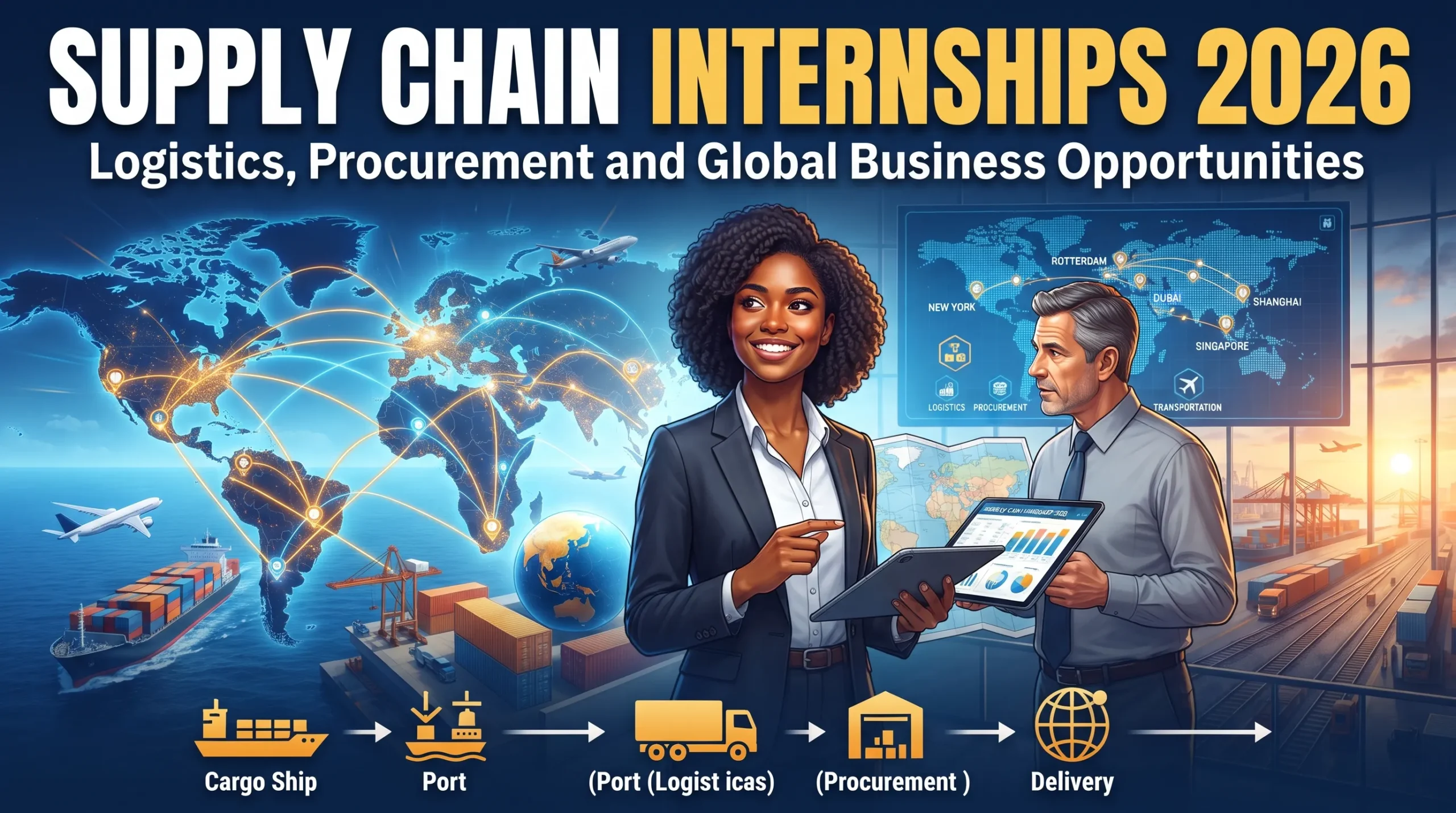
Supply chain internships in 2026 offer students and recent graduates an opportunity to gain practical experience in one of the most important functions behind modern businesses. Every product that reaches a customer depends on a network of suppliers, manufacturers, warehouses, transportation providers, technology systems and business teams.
A supply chain intern can gain exposure to how these interconnected activities are planned, monitored and improved. Depending on the employer, an internship may involve procurement, logistics, inventory management, demand planning, warehouse operations, supplier relationships, data analysis or supply chain strategy.
The field extends far beyond traditional shipping and transportation. Modern supply chains increasingly depend on digital systems, forecasting, data analytics, automation and international coordination. This means students with backgrounds in business, logistics, engineering, economics, data analytics and related disciplines can explore a wide range of career paths.
Supply chain internships are available across industries including manufacturing, retail, e-commerce, automotive, pharmaceuticals, food and beverage, technology, consumer goods and financial services.
For students interested in international business, operations or logistics, an internship can provide valuable insight into how organizations manage products, costs, suppliers and customer demand across multiple markets.
Supply Chain Internship Overview
| Category | Details |
|---|---|
| Field | Supply Chain, Logistics and Operations |
| Common Areas | Procurement, logistics, inventory, planning, sourcing and analytics |
| Typical Candidates | University students, recent graduates and early-career applicants |
| Experience Level | Entry-level / internship |
| Work Settings | Office, warehouse, manufacturing site, hybrid or other business locations |
| Common Industries | Manufacturing, retail, e-commerce, automotive, healthcare and consumer goods |
| Typical Work | Research, reporting, inventory analysis, procurement support and logistics coordination |
| Internship Duration | Varies by employer and program |
| Compensation | Depends on employer, location and internship structure |
| International Opportunities | Available through multinational businesses and global supply chain programs |
| Visa Requirement | Depends on destination country and work authorization |
Why Are Supply Chain Internships in Demand in 2026?
Supply chains connect businesses to suppliers and customers. When these networks operate efficiently, companies can control costs, maintain inventory and deliver products on time.
When disruptions occur, the consequences can affect production, prices and customer satisfaction.
As a result, organizations need professionals who can understand both operational processes and business data.
Global commerce creates supply chain careers
Companies increasingly purchase materials, manufacture products and sell goods across different countries.
This creates demand for professionals who understand:
- International sourcing
- Transportation
- Supplier management
- Inventory
- Warehousing
- Demand planning
- Procurement
- Supply chain analytics
Internships provide students with an introduction to these functions.
Businesses are investing in efficiency
Companies continually look for ways to reduce unnecessary costs and improve operations.
Supply chain teams may analyze:
- Supplier performance
- Transportation costs
- Inventory levels
- Delivery times
- Demand forecasts
- Warehouse efficiency
- Procurement spending
Interns can support these activities through research, reporting and data analysis.
Technology is changing supply chain management
Modern supply chains increasingly use digital tools for planning, tracking and forecasting.
Students may encounter:
- Enterprise resource planning systems
- Inventory management software
- Data dashboards
- Warehouse management systems
- Procurement platforms
- Forecasting tools
- Automation technologies
This makes supply chain management an increasingly analytical career.
Supply Chain Intern Responsibilities
The exact duties of an intern depend on the organization and department. Interns normally work under supervision and receive assignments appropriate to their level.
Logistics Support
Logistics interns may help coordinate the movement of goods.
Tasks can include:
- Tracking shipments
- Updating logistics records
- Preparing reports
- Monitoring delivery schedules
- Communicating with internal teams
- Reviewing transportation information
- Supporting logistics planning
The role can provide practical insight into transportation and distribution operations.
Procurement and Purchasing
Procurement internships focus on how organizations obtain products, materials and services.
Interns may assist with:
- Supplier research
- Purchase order information
- Vendor comparisons
- Procurement reports
- Cost analysis
- Supplier documentation
- Market research
Procurement can be particularly useful for students interested in negotiation, business and supplier management.
Inventory Management
Companies need enough inventory to meet demand without tying up excessive capital.
Interns may help analyze:
- Stock levels
- Inventory movement
- Product availability
- Reorder requirements
- Warehouse records
- Slow-moving inventory
This work requires attention to detail and an understanding of business data.
Demand Planning
Demand planning involves estimating how much of a product customers are likely to purchase.
Interns may support forecasting teams by organizing historical data, preparing reports and comparing actual sales against previous forecasts.
Supply Chain Analytics
Analytical internships can involve spreadsheets, dashboards and business intelligence tools.
Interns may analyze:
- Costs
- Lead times
- Supplier performance
- Inventory turnover
- Delivery performance
- Forecast accuracy
- Operational efficiency
These assignments can be an excellent starting point for students who enjoy working with numbers.
Supply Chain Internship Salary
Supply chain internship compensation varies significantly according to country, employer, industry, location, academic status and internship duration.
Companies may use hourly pay, monthly salaries or fixed stipends.
| Compensation Type | Description |
|---|---|
| Hourly compensation | Payment based on hours worked |
| Monthly salary | Fixed monthly internship compensation |
| Internship stipend | Fixed payment for the program |
| Annualized compensation | Yearly equivalent sometimes used for comparison |
| Academic placement | Compensation depends on employer and program |
Candidates should check the actual vacancy or offer rather than relying on generalized salary estimates.
The financial value of an internship also depends on benefits and expenses. A position that provides transportation, accommodation or relocation assistance may have a different overall value from one that does not.
Employee Benefits for Supply Chain Interns
Benefits vary between employers.
Depending on the organization, interns may receive:
- Paid compensation
- Professional training
- Mentorship
- Networking opportunities
- Access to company learning resources
- Transportation assistance
- Relocation support
- Housing assistance
- Employee discounts
- Flexible working arrangements
- Career development programs
Not every internship provides these benefits.
International students should also check whether health insurance, accommodation and travel expenses are included or must be paid independently.
Networking Opportunities
Supply chain interns can interact with professionals from multiple departments.
These may include:
- Procurement managers
- Logistics coordinators
- Operations managers
- Warehouse supervisors
- Financial analysts
- Sales teams
- Suppliers
- Manufacturing professionals
Because supply chain is cross-functional, internships can expose students to many parts of a business.
Visa Sponsorship for International Supply Chain Internships
International candidates should carefully investigate work authorization before applying for overseas internships.
An international company is not automatically required to sponsor an intern’s visa.
Some internship programs accept international students who already have appropriate work authorization. Others may offer immigration or relocation support under specific programs.
Candidates should look for vacancy information mentioning:
- International applicants
- Internship visa support
- Work authorization
- Sponsorship
- Relocation assistance
- Student eligibility
- Training programs
Immigration requirements differ by country and may depend on nationality, educational enrollment, internship duration and the type of work involved.
Before traveling or accepting an offer, candidates should confirm the applicable requirements with the employer and relevant immigration authority.
Eligibility Requirements
Supply chain internships commonly target students and recent graduates.
Typical requirements may include:
- Current university enrollment
- Recent graduation
- Interest in logistics or business operations
- Analytical ability
- Communication skills
- Organizational skills
- Basic computer knowledge
- Teamwork
- Availability during the internship period
Some employers prefer students studying supply chain management, logistics, business or engineering.
Others accept candidates from a broader range of disciplines.
Required Supply Chain Skills
A successful supply chain intern needs a combination of analytical, organizational and communication skills.
Excel and Data Analysis
Spreadsheet skills are particularly useful.
Candidates should ideally understand:
- Sorting and filtering
- Basic formulas
- Pivot tables
- Charts
- Data organization
- Basic reporting
More advanced positions may require SQL, business intelligence tools or statistical analysis.
Procurement Knowledge
Basic knowledge of procurement can help applicants understand:
- Supplier selection
- Purchase orders
- Negotiation
- Sourcing
- Cost analysis
- Vendor relationships
Logistics Knowledge
Students should understand basic concepts such as:
- Transportation
- Warehousing
- Distribution
- Inventory
- Delivery schedules
- Supply chain networks
ERP and Supply Chain Systems
Familiarity with enterprise software can be beneficial.
Depending on the company, interns may work with ERP, warehouse management, procurement or inventory systems.
You do not need to master every platform before applying. Demonstrating that you understand how business systems support operations can be enough for many entry-level positions.
Soft Skills Employers Value
Technical knowledge alone is not enough for supply chain work.
Organization
Supply chain professionals often manage multiple tasks, deadlines and data points.
Communication
Interns may communicate with different departments and occasionally with suppliers or logistics partners.
Attention to Detail
A small error in an order, shipment record or inventory report can create operational problems.
Problem-Solving
Supply chains rarely operate exactly as planned. Professionals need to identify issues and find practical solutions.
Time Management
Supply chain teams often work around deadlines related to production, purchasing and delivery.
Adaptability
Unexpected changes can occur in demand, transportation, supplier availability and business priorities.
Education and Experience
Common academic backgrounds include:
- Supply chain management
- Logistics
- Business administration
- Operations management
- Industrial engineering
- Mechanical engineering
- Economics
- Finance
- Data analytics
Some organizations may also accept students from other disciplines who can demonstrate relevant analytical or organizational skills.
Can You Get a Supply Chain Internship Without Experience?
Yes.
Internships are specifically designed to provide practical exposure.
Candidates can strengthen their applications through:
- University supply chain projects
- Business case competitions
- Logistics coursework
- Excel projects
- Data analysis
- Student organizations
- Part-time work
- Volunteer experience
- Personal research projects
For example, a student could analyze the inventory system of a fictional retail business and create a simple spreadsheet showing demand, stock levels and reorder points.
That project could demonstrate analytical thinking even without formal employment experience.
Where Can You Find Supply Chain Internships?
Supply chain internships are available in many countries and industries.
United States
The United States has extensive supply chain activity across manufacturing, retail, technology, logistics, healthcare, automotive and consumer products.
Major business and manufacturing regions can offer opportunities across procurement, operations and logistics.
Canada
Canada has supply chain opportunities in manufacturing, retail, transportation, natural resources, food production and other industries.
International applicants should confirm the appropriate work authorization before accepting an internship.
United Kingdom
The UK has supply chain positions across retail, manufacturing, logistics, pharmaceuticals, food, technology and professional services.
Germany and Europe
Germany is particularly important for industrial manufacturing and automotive supply chains, while other European markets provide opportunities across retail, logistics, pharmaceuticals and international trade.
Australia
Australian companies hire supply chain and logistics professionals across mining, retail, agriculture, manufacturing and other industries.
Singapore
Singapore’s role in international trade and logistics makes it an important market for supply chain and procurement careers.
Middle East
The Middle East offers opportunities across logistics, retail, aviation, construction, manufacturing and large-scale infrastructure.
Remote and Hybrid Internships
Some supply chain roles can be performed partly online, particularly positions focused on analytics, procurement research or planning.
However, warehouse, manufacturing and transportation assignments generally require physical presence.
How to Apply for Supply Chain Internships
Step 1: Choose your preferred specialization
Supply chain is broad.
Consider whether you are most interested in:
- Procurement
- Logistics
- Inventory management
- Demand planning
- Operations
- Sourcing
- Supply chain analytics
- Warehouse management
Step 2: Prepare a targeted résumé
Highlight relevant coursework, projects and skills.
Useful résumé sections can include:
- Education
- Technical skills
- Supply chain projects
- Work experience
- Academic achievements
- Certifications
- Leadership activities
Focus on evidence rather than generic statements.
Step 3: Improve your analytical skills
Practice using Excel to analyze realistic business data.
You could create a project analyzing:
- Inventory turnover
- Supplier costs
- Delivery performance
- Monthly demand
- Transportation expenses
Step 4: Research employers
Look beyond logistics companies.
Large retailers, manufacturers, pharmaceutical companies, technology businesses and consumer brands all have supply chain functions.
Step 5: Apply through official channels
Use company career pages, university career services and reputable employment platforms.
Be cautious if someone asks you to pay money to secure an internship or promises guaranteed employment.
Tips to Increase Your Hiring Chances
Learn the basics of supply chain management
Understand the relationship between:
Supplier → Procurement → Production → Inventory → Distribution → Customer
This basic framework helps you understand many internship responsibilities.
Become comfortable with Excel
Strong spreadsheet skills can make an immediate difference in entry-level operations and supply chain roles.
Develop business awareness
Supply chain decisions affect:
- Costs
- Revenue
- Customer satisfaction
- Inventory
- Profitability
- Operational efficiency
Understanding these relationships can help you perform better in interviews.
Prepare for behavioral questions
Employers may ask about teamwork, problem-solving, organization and handling deadlines.
Prepare examples from university, part-time work, volunteer activities or projects.
Apply broadly
Do not focus exclusively on famous global corporations.
Smaller manufacturers, distributors, retailers and logistics companies can provide valuable hands-on experience.
International candidates may encounter different immigration categories depending on their destination.
Possible options can include:
- Student work authorization
- Internship visas
- Training visas
- Exchange programs
- Temporary work permits
- Graduate work routes
- Youth mobility programs
- Employer-sponsored work visas
The rules differ substantially between countries.
An internship authorization may also limit the employer, job duties or duration of employment.
Completing an internship does not automatically provide permanent residency or a full-time work visa.
Candidates who want to remain abroad after graduation should research post-internship options before making long-term plans.
Cost of Living for International Interns
For overseas internships, calculate total expenses rather than looking only at compensation.
Important costs include:
- Accommodation
- Food
- Transportation
- Health insurance
- Visa fees
- Flights
- Utilities
- Mobile service
- Local taxes
- Personal expenses
Housing can be one of the largest expenses in major cities.
If an internship includes accommodation or relocation assistance, verify the exact terms before relying on it in your budget.
A simple comparison of monthly income versus essential monthly expenses can help determine whether an international internship is financially practical.
Frequently Asked Questions
1. What is a supply chain internship?
A supply chain internship provides practical experience in areas such as procurement, logistics, inventory, demand planning, sourcing, operations and supply chain analytics.
2. Who can apply for supply chain internships in 2026?
Current university students, recent graduates and early-career candidates can apply for many supply chain internships. Exact requirements vary by employer.
3. Do supply chain interns get paid?
Many corporate internships are paid, but compensation varies by employer, country, industry and internship structure. Some positions use hourly pay, while others provide monthly compensation or a stipend.
4. Do I need a supply chain management degree?
Not necessarily. Employers may accept candidates studying business, logistics, engineering, economics, finance, operations or data analytics.
5. Can I get a supply chain internship without previous experience?
Yes. Internships are designed for candidates who are developing professional experience. University projects, Excel work, business competitions and relevant coursework can strengthen an application.
6. What skills are important for supply chain internships?
Useful skills include Excel, data analysis, organization, communication, problem-solving, attention to detail and basic knowledge of procurement, logistics and inventory management.
7. Can international students apply for supply chain internships?
Yes, where the employer and immigration rules permit them to participate. International applicants should confirm work authorization before accepting an overseas internship.
8. Are supply chain internships available remotely?
Some analytics, procurement and planning internships may offer remote or hybrid arrangements. Warehouse, manufacturing and many logistics positions generally require on-site work.
9. Can a supply chain internship lead to a full-time job?
It can. Some companies recruit successful interns for graduate or entry-level positions, although a permanent job is never guaranteed.
10. Which industries hire supply chain interns?
Common industries include manufacturing, retail, e-commerce, automotive, pharmaceuticals, food and beverage, consumer goods, technology, logistics and healthcare.
Final Thoughts
Supply chain internships in 2026 can provide a strong foundation for students interested in logistics, procurement, operations, analytics and international business.
The field is broader than simply moving products from one location to another. Modern supply chain professionals work with suppliers, customers, technology, data, inventory, transportation and business strategy.
For students entering the field, practical skills can make a major difference. Learning Excel, understanding basic supply chain concepts, developing analytical ability and completing relevant projects can strengthen an internship application.
International candidates should also research work authorization carefully. An internship in another country can provide valuable global experience, but candidates must ensure that they meet the host country’s immigration and employment requirements.
Whether your long-term goal is to become a procurement specialist, logistics manager, supply chain analyst, operations professional or sourcing manager, an internship can provide the practical experience needed to begin building that career.