Healthcare is one of the world’s largest and most diverse employment sectors. It includes hospitals and clinics, public health organizations, pharmaceutical companies, medical research institutions, biotechnology companies, health technology startups and government agencies.
For students and recent graduates, a healthcare internship in 2026 can provide valuable practical experience before entering a permanent career.
Healthcare internships are not limited to medical students. Depending on the organization and position, opportunities may be available to students studying medicine, nursing, pharmacy, public health, biotechnology, health administration, computer science, data science, engineering and other related subjects.
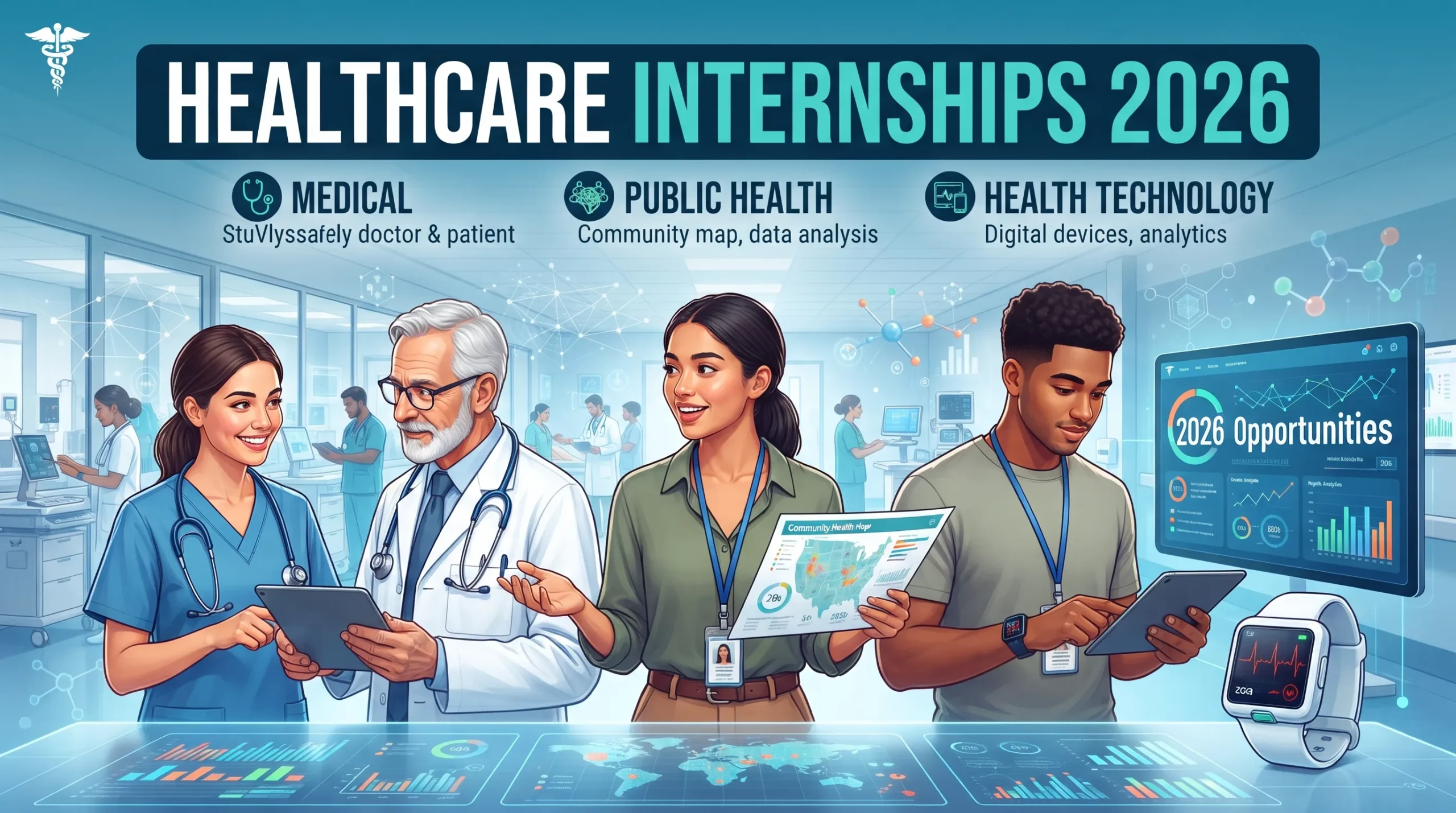
The work can also vary considerably. A medical intern may observe clinical teams and support supervised patient-care activities. A public health intern may assist with community programs, health research or data collection. A health technology intern might work on electronic health records, healthcare software, data analytics, cybersecurity or digital-health products.
Current 2026 opportunities demonstrate this range. The Federal General Hospital in Islamabad operates a career development program covering internships, house jobs and research programs, while the Indus Hospital & Health Network’s 2026 youth training program offers exposure to medical and non-medical healthcare fields, including public health and hospital operations.
International organizations are also offering specialized health-related internships. For example, the World Health Organization published a 2026 internship opportunity focused on assistive technology, medicines and health products policies and standards.
This guide explains the main types of healthcare internships available in 2026, responsibilities, salary considerations, benefits, eligibility requirements, skills, international opportunities and practical steps for applying.
Healthcare Internship Job Overview
| Category | Details |
|---|---|
| Industry | Healthcare, Medicine and Health Technology |
| Common Roles | Medical Intern, Public Health Intern, Healthcare Research Intern, Health IT Intern |
| Related Fields | Medicine, nursing, pharmacy, public health, biotechnology, IT and data |
| Education | Varies according to the internship |
| Experience Level | Students, graduates and early-career candidates |
| Typical Duration | Several weeks to several months |
| Work Settings | Hospitals, laboratories, offices, research centers and hybrid environments |
| Key Skills | Communication, research, data analysis, teamwork and field-specific knowledge |
| Technical Skills | Excel, statistics, databases, programming or health information systems where applicable |
| Potential Employers | Hospitals, universities, NGOs, government agencies, pharmaceutical firms and health-tech companies |
| Career Paths | Clinical, public health, research, healthcare administration and health technology careers |
Why Healthcare Internships Are in Demand
Healthcare organizations need professionals across a much wider range of functions than direct patient care.
Modern healthcare depends on:
- Doctors and nurses
- Pharmacists
- Laboratory professionals
- Public health specialists
- Researchers
- Health administrators
- Data analysts
- Software engineers
- Cybersecurity professionals
- Biomedical engineers
- Health economists
- Policy specialists
At the same time, healthcare systems are becoming increasingly digital.
Electronic health records, telemedicine, medical devices, health analytics, artificial intelligence and digital patient services are creating new roles at the intersection of healthcare and technology.
This means students can enter healthcare through different educational backgrounds.
Growing Importance of Health Technology
Health technology internships can involve:
- Electronic health records
- Healthcare software
- Telehealth platforms
- Medical databases
- Health data analytics
- Artificial intelligence
- Medical devices
- Cybersecurity
- Digital patient services
- Health information systems
Students interested in technology do not necessarily need to become doctors to build a career in healthcare.
Medical Internships
Medical internships are generally intended for students pursuing medical or clinical careers.
The exact responsibilities depend heavily on the student’s educational level, local regulations and the organization’s supervision requirements.
Possible activities can include:
- Observing clinical procedures
- Supporting healthcare teams
- Reviewing medical literature
- Assisting with research
- Participating in supervised clinical education
- Preparing documentation
- Learning hospital procedures
- Supporting quality-improvement projects
Clinical interns should understand that an internship does not automatically authorize someone to diagnose patients, prescribe medication or independently perform medical procedures.
Those activities depend on professional licensing, education and local regulations.
Hospital Internship Opportunities
Hospitals can provide exposure to several departments.
Depending on the program, students may encounter:
- Internal medicine
- Surgery
- Pediatrics
- Emergency medicine
- Radiology
- Pathology
- Cardiology
- Pharmacy
- Nursing
- Administration
- Public health
- Medical research
The Federal General Hospital in Islamabad currently describes internship, house-job and research pathways across multiple departments through its digital career development portal.
Public Health Internships
Public health focuses on improving the health of populations rather than treating individual patients alone.
Public health interns may work on:
- Health education
- Disease prevention
- Community outreach
- Epidemiology
- Health surveys
- Program evaluation
- Research
- Health policy
- Health promotion
- Data analysis
Public Health Research
Research is a major part of public health.
An intern may help:
- Develop research questions.
- Review existing literature.
- Collect approved data.
- Clean datasets.
- Analyze results.
- Prepare reports.
- Present findings.
Depending on the project, students may use statistical software, spreadsheets or programming languages.
Community Health
Community-based internships can provide practical exposure to healthcare challenges outside hospitals.
Students may participate in:
- Health awareness campaigns
- Community surveys
- Maternal and child health programs
- Nutrition initiatives
- Disease-prevention campaigns
- Health education
- Outreach activities
The Indus Hospital & Health Network’s 2026 Youth Training Program, for example, describes exposure to hospital operations, patient care, public health and community-focused healthcare work.
Healthcare Research Internships
Research internships are particularly useful for students considering careers in medicine, public health, biotechnology, pharmaceuticals or academia.
Research projects may involve:
- Clinical research
- Biomedical research
- Epidemiology
- Public health
- Pharmaceutical research
- Health economics
- Medical technology
- Laboratory science
Typical Research Responsibilities
Interns may:
- Search scientific literature
- Organize research data
- Assist with approved experiments
- Maintain research records
- Perform statistical analysis
- Prepare presentations
- Support manuscript preparation
- Conduct literature reviews
Research internships can also strengthen applications for graduate school or advanced professional education.
Health Technology Internships
Health technology is one of the fastest-growing areas within healthcare.
Technology students can find internships involving:
- Healthcare software
- Digital health
- Electronic medical records
- Health data
- Telemedicine
- Medical AI
- Cloud computing
- Cybersecurity
- Mobile health applications
Health IT Responsibilities
A health IT intern might assist with:
- Software testing
- Database management
- Technical support
- System documentation
- Data migration
- User-interface improvements
- Application development
- Information security
Healthcare Data Internships
Healthcare generates large amounts of data.
Data interns may work with:
- Patient records
- Hospital operations data
- Public health datasets
- Medical research data
- Healthcare utilization information
- Financial or administrative data
Common skills include SQL, Python, Excel, statistics and data visualization.
Because health information can be highly sensitive, students should understand privacy, security and responsible data-handling practices.
Healthcare Internship Salary Range
Healthcare internship compensation varies significantly according to country, profession, employer and program structure.
Some internships are paid, while others provide academic credit, training or practical experience without a salary.
A current 2026 healthcare training opportunity in Pakistan, for example, lists a program fee rather than an employee salary, demonstrating why candidates should carefully distinguish between paid employment internships, educational placements and training programs.
A general comparison is:
| Region | Common Compensation Structure |
|---|---|
| United States | Paid hourly internships are common in many professional and research settings |
| Canada | Paid placements are available, particularly in university and professional programs |
| United Kingdom | Compensation varies by employer and internship type |
| Australia | Paid and academic-placement arrangements both exist |
| Germany | Compensation depends on employer, university arrangement and internship structure |
| Pakistan | Some organizations provide stipends while others offer training or academic placements |
| International Organizations | Compensation and eligibility vary by individual program |
There is no reliable single worldwide healthcare intern salary.
Before accepting an opportunity, check whether the advertised amount is:
- Salary
- Monthly stipend
- Hourly pay
- Scholarship
- Travel allowance
- Housing support
- Academic placement
- Training fee
This distinction is especially important when searching for international healthcare internships.
Employee Benefits
Depending on the program, healthcare interns may receive:
- Stipend or salary
- Professional supervision
- Clinical exposure
- Research experience
- Training
- Networking opportunities
- Internship certificate
- Academic credit
- Access to professional events
- Career mentoring
- Research publications or presentations
- Potential employment opportunities
The most valuable benefit may be practical experience.
A student who completes a well-structured internship can gain a clearer understanding of workplace expectations and determine which healthcare specialization is most suitable.
Visa Sponsorship for International Healthcare Internships
International healthcare internships require additional planning because healthcare is often a regulated sector.
An internship advertisement does not automatically mean that the employer will sponsor a visa.
Possible immigration arrangements may include:
- Student internship authorization
- University-sponsored placements
- Temporary work authorization
- Research visas
- Training programs
- Graduate work authorization
- Post-study work routes
The appropriate route depends on the destination country, internship duration, educational status and type of work.
Clinical internships can have additional requirements involving professional registration, vaccination records, background checks, language proficiency or institutional approval.
Before Applying Abroad
Confirm:
- Whether international students are eligible.
- Whether a university affiliation is required.
- Whether work authorization is needed.
- Whether visa sponsorship is available.
- Whether professional registration is required.
- Whether health screening or vaccination documentation is required.
- Whether the position involves direct patient contact.
For international medical students, the distinction between clinical observation, clinical training and employment is particularly important.
Eligibility Requirements
Healthcare internship eligibility varies significantly.
Medical Internships
Medical programs may require applicants to be:
- Medical students
- Medical graduates
- Nursing students
- Pharmacy students
- Allied health students
The exact requirements depend on the country and program.
Public Health Internships
Public health internships may accept students studying:
- Public Health
- Epidemiology
- Medicine
- Nursing
- Biology
- Statistics
- Health Administration
- Economics
- Social Sciences
Health Technology Internships
Technology-focused healthcare programs may accept students studying:
- Computer Science
- Software Engineering
- Information Technology
- Data Science
- Artificial Intelligence
- Cybersecurity
- Biomedical Engineering
The Federal General Hospital’s current career-development platform demonstrates that healthcare organizations can provide separate pathways for clinical internships, house jobs and research opportunities.
Required Healthcare Internship Skills
Communication
Healthcare depends heavily on communication.
Interns should be able to:
- Listen carefully
- Ask appropriate questions
- Write clearly
- Communicate professionally
- Work respectfully with different teams
Teamwork
Healthcare is collaborative.
Students may work alongside:
- Doctors
- Nurses
- Pharmacists
- Researchers
- Administrators
- Technologists
- Laboratory professionals
Being able to work within a multidisciplinary team is important.
Research Skills
Research-focused interns should understand:
- Literature searches
- Basic research methodology
- Data collection
- Documentation
- Statistics
- Academic writing
Data Analysis
Basic data skills can benefit students across many healthcare areas.
Useful tools include:
- Excel
- SQL
- Python
- R
- Power BI
- Statistical software
Technical Skills
For health technology roles, employers may seek:
- Programming
- Databases
- APIs
- Cloud computing
- Cybersecurity
- Software testing
- Data analytics
The required technical depth depends on the position.
Education and Experience
Healthcare internships are available to students at different stages of education.
Medical students may pursue clinical or research placements.
Public health students can look for community health, epidemiology and health-policy opportunities.
Technology students can target digital health, health IT and healthcare data roles.
Recent graduates may also qualify for some programs.
For example, the Pakistan Digital Authority’s 2026 internship program states that its opportunities include final-year students and fresh graduates, with economics and finance among its preferred areas.
Can Students Without Medical Degrees Work in Healthcare?
Yes.
Healthcare organizations need many non-clinical professionals.
A computer science graduate can work on healthcare software.
A data scientist can analyze health datasets.
A cybersecurity professional can protect hospital systems.
A business graduate can work in healthcare administration.
A public health graduate can work on population-health programs.
The healthcare industry therefore offers career opportunities well beyond clinical medicine.
Available Locations
Healthcare internships exist in many countries and cities.
United States
Major healthcare, pharmaceutical, biotechnology and research organizations offer internships across clinical research, public health, technology and administration.
Canada
Opportunities can be found through hospitals, universities, public health organizations, research institutions and health technology companies.
United Kingdom
The UK has a large healthcare and medical research ecosystem, including opportunities through universities, healthcare institutions and research organizations.
Australia
Australian healthcare internships can involve hospitals, research institutions, public health and digital health.
Germany
Germany has opportunities across hospitals, biotechnology, pharmaceutical companies, medical devices and healthcare technology.
Pakistan
Pakistan offers healthcare internships through hospitals, universities, nonprofit organizations, government institutions and healthcare technology companies.
Islamabad, Rawalpindi, Lahore and Karachi are among the cities where students can find healthcare-related opportunities.
The Federal General Hospital’s current internship and research platform is based in Islamabad, while the Indus Hospital & Health Network operates healthcare training initiatives in Pakistan.
How to Apply for Healthcare Internships in 2026
1. Choose Your Healthcare Area
Start by identifying your preferred track.
For example:
Clinical: medicine, nursing, pharmacy and allied health.
Public Health: epidemiology, community health and health policy.
Research: biomedical, clinical and population research.
Technology: software, data, cybersecurity and digital health.
Administration: healthcare operations, finance and management.
2. Prepare a Targeted Resume
Your resume should emphasize relevant education, skills and projects.
Include:
- Degree
- University
- Relevant coursework
- Research experience
- Volunteer work
- Technical skills
- Certifications
- Academic projects
- Clinical experience where applicable
Do not list clinical skills or qualifications you do not actually possess.
3. Prepare Supporting Documents
Depending on the internship, you may need:
- Resume/CV
- Cover letter
- Academic transcript
- Student identification
- Recommendation letter
- Proof of enrollment
- Professional registration
- Vaccination records
- Background documentation
International programs may have additional requirements.
4. Search Multiple Internship Titles
Do not search only for “Healthcare Intern.”
Also search for:
- Medical Intern
- Clinical Research Intern
- Public Health Intern
- Healthcare Data Intern
- Health IT Intern
- Digital Health Intern
- Hospital Administration Intern
- Biomedical Research Intern
- Healthcare Analyst Intern
- Epidemiology Intern
- Pharmaceutical Intern
- Medical Technology Intern
5. Apply Through Official Sources
Hospitals, universities, government agencies and international organizations often publish their own opportunities.
For example, the Federal General Hospital currently provides a digital application process for internships, house jobs and research programs.
WHO also publishes specific internship calls through its official website, including specialized health-product and assistive-technology opportunities.
Tips to Increase Hiring Chances
Choose a Specific Direction
“Healthcare” is a huge field.
An applicant who says they are interested in everything may appear less focused.
Instead, identify a direction such as:
- Public health
- Clinical research
- Digital health
- Healthcare data
- Hospital administration
- Medical technology
Gain Relevant Experience Before Applying
Volunteer work, university research and academic projects can help.
For example, a public-health applicant could conduct a small research project using a public dataset.
A health-tech applicant could build a healthcare dashboard.
A medical student could participate in supervised research.
Learn Basic Data Skills
Even healthcare students can benefit from understanding:
- Excel
- Statistics
- Data visualization
- Research methodology
These skills are useful in clinical research, public health and healthcare administration.
Protect Patient Privacy
Never include confidential patient information in a personal portfolio.
Do not upload:
- Patient names
- Medical records
- Hospital identification numbers
- Private photographs
- Confidential research data
Use public, anonymized or institutionally approved datasets.
Prepare for Interviews
Common questions may include:
- Why are you interested in healthcare?
- Why did you choose this internship?
- What healthcare problem interests you?
- Tell us about a research project.
- How do you work with a team?
- What did you learn from your previous experience?
- How would you handle confidential information?
Prepare examples from your education, projects or volunteer experience.
International healthcare internships can involve different immigration categories depending on the destination.
Potential pathways include:
- Student internship authorization
- University placement programs
- Research visas
- Temporary training authorization
- Graduate work permits
- Post-study work programs
- Employer-sponsored employment
Clinical positions can have additional professional requirements.
For example, an international medical student should not assume that permission to enter a country automatically gives permission to provide clinical services.
Always verify immigration and professional licensing requirements with the relevant government authority, university and healthcare institution.
Cost of Living for International Healthcare Interns
Before accepting an international internship, calculate the complete cost of participation.
Consider:
- Accommodation
- Food
- Transportation
- Health insurance
- Visa expenses
- Flights
- Local registration costs
- Phone and internet
- Emergency funds
Also check whether the organization provides:
- Housing
- Meals
- Transportation
- Relocation assistance
- Travel reimbursement
- Stipends
Some healthcare programs may involve participation fees rather than salaries, so calculate the total financial cost before committing.
Frequently Asked Questions
1. What is a healthcare internship?
A healthcare internship is a temporary educational or professional placement where students gain practical experience in clinical care, public health, research, healthcare administration or health technology.
2. Can medical students apply for healthcare internships?
Yes. Medical students can apply for clinical, research, public health and hospital-based internships depending on their education level and the requirements of the program.
3. Can non-medical students work in healthcare?
Yes. Healthcare organizations also employ professionals in technology, data science, cybersecurity, administration, finance, research and other non-clinical areas.
4. Are healthcare internships paid in 2026?
Some are paid, while others provide stipends, academic credit, training or unpaid educational experience. Candidates should verify the exact compensation structure before applying.
5. What skills are useful for healthcare internships?
Communication, teamwork, research, data analysis and professional ethics are useful across healthcare. Specialized roles may also require clinical, statistical, programming or technology skills.
6. Can international students apply for healthcare internships?
Yes, depending on the program and destination. International applicants may need appropriate student or work authorization and, for clinical positions, additional professional requirements.
7. Are public health internships available in 2026?
Yes. Public health internships can involve epidemiology, health education, community programs, research, health policy and program evaluation.
8. What is a health technology internship?
A health technology internship combines healthcare with technology. Interns may work on healthcare software, electronic records, digital health platforms, data analytics, cybersecurity, AI or medical technology.
9. Can a healthcare internship lead to a full-time career?
Yes. An internship can provide practical experience, professional contacts and industry knowledge that may help with future employment, although a permanent job is never guaranteed.
10. Where can I find healthcare internships?
Look at official hospital, university, government, nonprofit, research institution and healthcare-company career pages. Specialized international organizations such as WHO also publish internship opportunities directly.
Final Thoughts
Healthcare internships in 2026 offer opportunities across far more areas than traditional clinical medicine.
Medical students can gain supervised clinical or research experience. Public health students can work on population-health programs, epidemiology and community initiatives. Technology students can enter digital health, healthcare data, software development and cybersecurity.
The best internship depends on your education and long-term career goals.
If you are pursuing medicine, look for reputable clinical or research placements with appropriate supervision.
If public health interests you, focus on epidemiology, community health, research and health policy.
If technology is your strength, consider health IT, digital health, healthcare analytics, artificial intelligence and cybersecurity.
Current 2026 programs demonstrate the breadth of the sector. Hospitals are offering structured internship and research pathways, nonprofit healthcare organizations are providing exposure to both medical and public-health work, and international organizations such as WHO are offering specialized opportunities related to health products and assistive technology.
Before applying, carefully check eligibility, compensation, supervision, professional requirements and—if applying internationally—visa and work authorization rules.
Most importantly, choose internships where you can learn something relevant to your future career. A meaningful healthcare internship can help you develop professional skills, understand how healthcare organizations operate and build experience that supports your next educational or career step.