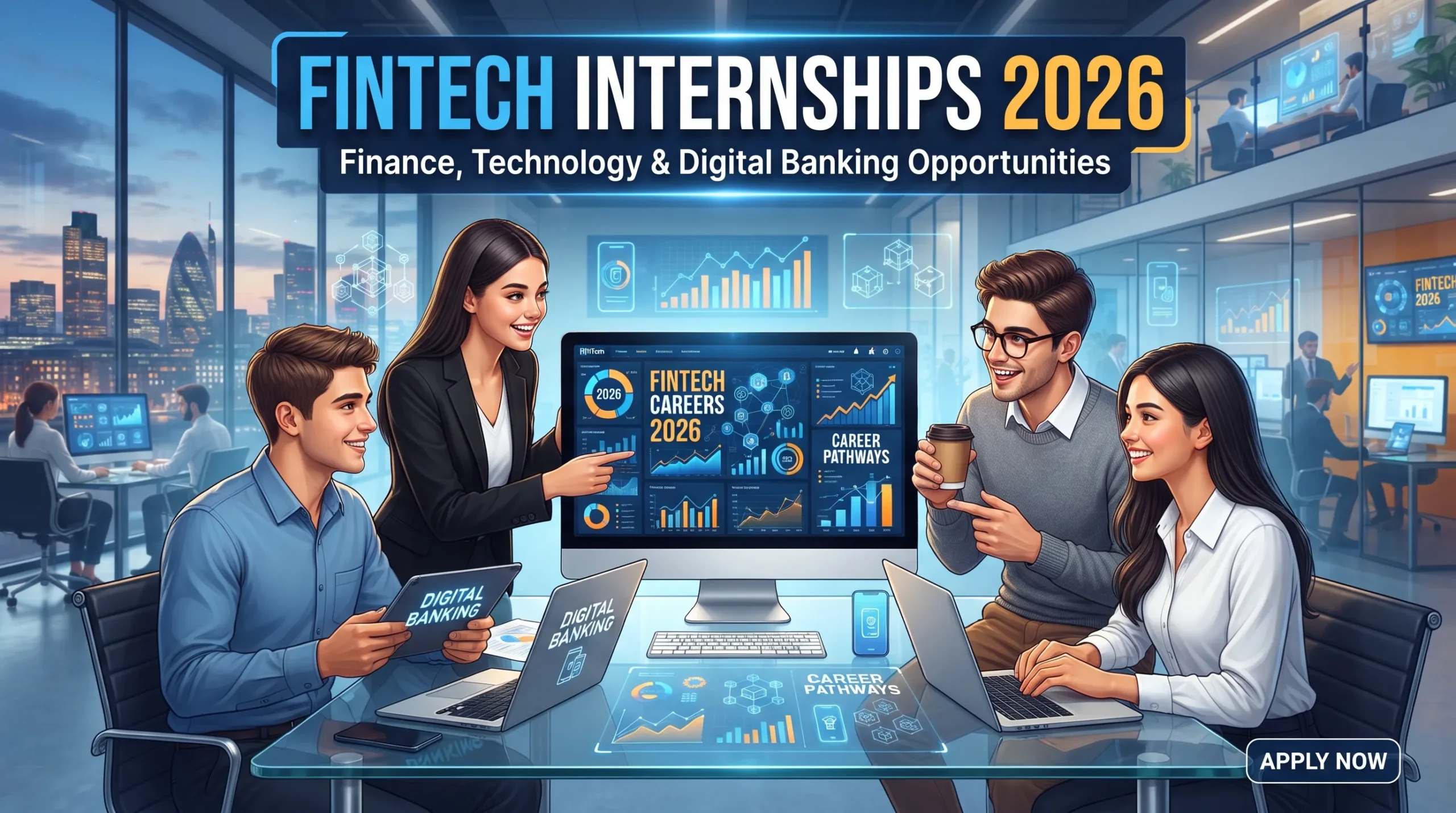
Financial technology, commonly called FinTech, is changing how people and businesses save, borrow, invest, transfer and manage money. Mobile wallets, digital banking apps, online payments, open banking, artificial intelligence, blockchain and automated financial services have created a growing need for professionals who understand both finance and technology.
For students and recent graduates, a FinTech internship in 2026 can be an excellent way to enter this rapidly developing industry.
Unlike traditional finance internships, FinTech placements can involve software development, data analytics, cybersecurity, digital payments, financial products, compliance technology, artificial intelligence and product management. At the same time, candidates with backgrounds in finance, economics, accounting or business can find opportunities where financial knowledge is combined with technology.
The range of opportunities is visible in current internship programs. For example, a 2026 easypaisa internship program included areas such as product, information security, finance, risk, treasury, data science, IT and compliance, demonstrating how broad the FinTech field can be.
There are also specialized opportunities. A 2026 FinTech internship listed through the Khyber Pakhtunkhwa Information Technology Board included work involving digital-payment financial data, dashboards, reconciliation, budgeting and financial-inclusion initiatives, with a listed stipend of PKR 45,000.
This guide explains what FinTech interns do, which skills employers look for, potential salaries and benefits, digital banking opportunities, eligibility requirements, international options and how students can build stronger applications.
FinTech Internship Job Overview
| Category | Details |
|---|---|
| Industry | Financial Technology / Financial Services |
| Common Roles | FinTech Intern, Digital Banking Intern, Payments Intern, Finance Technology Intern |
| Related Fields | Banking, payments, software, data, cybersecurity, AI and finance |
| Education | Finance, Computer Science, IT, Economics, Accounting, Business or related fields |
| Experience Level | Students, recent graduates and entry-level candidates |
| Typical Duration | 6 weeks to 6 months, depending on the program |
| Work Settings | On-site, hybrid and selected remote roles |
| Technical Skills | Python, SQL, APIs, databases, Excel, Git and data analysis |
| Finance Skills | Financial analysis, accounting, payments, risk and basic banking |
| Potential Employers | Banks, FinTech companies, payment providers, startups and technology firms |
| Career Paths | FinTech Analyst, Product Analyst, Software Engineer, Data Analyst, Risk Analyst |
What Is a FinTech Internship?
A FinTech internship is a temporary professional placement where students gain practical experience at the intersection of finance and technology.
The exact work can be very different from one employer to another.
One intern might develop APIs for a payment platform. Another could analyze transaction data. A finance student might help with financial reporting or reconciliation, while another intern could work on fraud detection, digital banking products or customer experience.
Common FinTech internship areas include:
- Digital banking
- Mobile payments
- Payment gateways
- Open banking
- Financial analytics
- Risk management
- Fraud detection
- Cybersecurity
- Blockchain
- Cryptocurrency technology
- Artificial intelligence
- Data science
- Product management
- Compliance
- RegTech
- Accounting technology
- InsurTech
This diversity makes FinTech particularly attractive to students who do not want to choose exclusively between a finance career and a technology career.
Why FinTech Internships Are in Demand
Financial services are increasingly delivered through digital platforms.
Customers expect to be able to:
- Open accounts online
- Transfer money through mobile apps
- Make instant payments
- Pay bills digitally
- Apply for financial products online
- Monitor investments
- Receive personalized financial services
- Verify their identity digitally
Behind these services are teams of software developers, financial analysts, product managers, data scientists, cybersecurity specialists, compliance professionals and banking experts.
The growth of digital financial services therefore creates opportunities for students with different educational backgrounds.
Digital Banking Is Creating New Career Paths
Traditional banking remains important, but digital banking has created new technology-driven functions.
For example, current Bank of Punjab career listings show roles within its Digital Banking Group involving solution delivery, business planning, analytics and other technology-related banking functions.
This means students interested in FinTech should not limit their internship search to companies that have “FinTech” in their name.
Banks, payment companies, software companies, financial institutions and technology startups can all offer relevant experience.
FinTech Internship Responsibilities
The responsibilities depend on the internship track.
Digital Banking
Digital banking interns may support teams working on:
- Mobile banking applications
- Online account services
- Digital customer journeys
- Product features
- Customer experience
- Digital transactions
- Banking operations
Payments
Payment-related interns may work with:
- Payment gateways
- Digital wallets
- Merchant payments
- Transaction processing
- Payment reconciliation
- Payment APIs
- Transaction reporting
Financial Analysis
Finance-focused interns can assist with:
- Financial reports
- Revenue analysis
- Budgeting
- Forecasting
- Reconciliation
- Financial models
- Business performance analysis
Data and Analytics
FinTech companies generate large volumes of transaction and customer data.
Interns may:
- Clean datasets
- Analyze transaction trends
- Build dashboards
- Prepare reports
- Identify patterns
- Support forecasting
- Assist data scientists
Software Development
Technical interns may contribute to:
- Backend applications
- APIs
- Databases
- Payment integrations
- Mobile applications
- Testing
- Automation
A current FinTech internship program in Islamabad, for example, includes a backend/API track involving open banking, payment gateways, REST APIs, authentication and database design.
Risk and Compliance
Financial companies must follow strict rules.
Interns may assist with:
- Risk analysis
- Transaction monitoring
- Compliance documentation
- Internal controls
- Customer verification
- Fraud monitoring
- Regulatory reporting
FinTech Internship Salary Range
Internship compensation varies substantially by country, employer, role and program.
Some FinTech internships are paid through monthly stipends, while others may offer hourly wages, fixed internship salaries, academic credit or no compensation.
Current 2026 opportunities demonstrate this variation. The KPITB internship listing for a FinTech Intern shows a stipend/salary of PKR 45,000, while other programs do not publicly disclose compensation.
A general overview is:
| Location | Common Internship Compensation |
|---|---|
| United States | Usually hourly or fixed paid internship compensation |
| Canada | Often hourly or fixed-term paid placements |
| United Kingdom | Commonly paid internships, depending on employer |
| Germany | Varies according to employer and internship structure |
| Australia | Paid opportunities available across financial and technology companies |
| Pakistan | Monthly stipends are common |
| Remote | Depends on employer and employment arrangement |
These are compensation structures rather than guaranteed salary figures.
Always check the specific internship advertisement for the actual amount.
What About Monthly and Yearly Salaries?
Internships are normally temporary positions, so comparing them directly with permanent annual salaries can be misleading.
Once an intern transitions into a full-time role, compensation can change significantly depending on whether they become:
- Financial analyst
- Product analyst
- Software engineer
- Data analyst
- Risk analyst
- Cybersecurity analyst
- Business analyst
- FinTech product manager
Therefore, the long-term career value of an internship should be considered alongside its immediate stipend.
Employee Benefits
FinTech internships can offer valuable benefits beyond financial compensation.
Depending on the employer, interns may receive:
- Monthly stipend
- Paid internship
- Mentorship
- Professional training
- Real-world projects
- Networking opportunities
- Completion certificate
- Exposure to financial products
- Technical training
- Career development
- Flexible working arrangements
- Potential full-time employment
Some programs are explicitly designed to provide practical exposure and mentorship.
For example, the easypaisa 2026 internship program described hands-on corporate exposure across several functions, including product, finance, information security, data science and IT.
Standard Chartered’s Pakistan early-career program also describes its summer internship as an opportunity for students to work alongside professionals and tackle real business challenges.
Digital Banking Internship Opportunities
Digital banking is one of the most accessible areas for students interested in FinTech.
Interns may work on products such as:
- Mobile banking
- Digital wallets
- Online payments
- Digital account opening
- Customer onboarding
- Card services
- Digital lending
- Personal finance tools
The work can combine business, finance and technology.
Digital Banking Skills
Useful skills include:
- Financial services fundamentals
- Customer experience
- Product management
- Data analysis
- SQL
- Excel
- APIs
- Mobile applications
- Cybersecurity fundamentals
- Regulatory awareness
You do not necessarily need advanced programming skills for every digital banking internship.
Product, finance, operations, risk and business-development positions may be more suitable for candidates from business or finance backgrounds.
FinTech Skills Employers Want
Financial Knowledge
Students should understand basic concepts such as:
- Revenue
- Expenses
- Profit
- Interest
- Loans
- Payments
- Credit
- Risk
- Financial statements
- Banking operations
A technology student does not need to become a professional accountant, but basic financial literacy can be extremely useful.
Python
Python is useful for:
- Data analysis
- Automation
- Financial modeling
- Machine learning
- APIs
- Data processing
It is particularly valuable for students interested in data-driven FinTech roles.
SQL
SQL is important when working with transaction databases and financial information.
Learn:
- SELECT
- WHERE
- JOIN
- GROUP BY
- Aggregate functions
- Subqueries
- Basic database design
Excel
Excel remains useful in finance and business environments.
Learn:
- Formulas
- Pivot tables
- Charts
- Lookup functions
- Data cleaning
- Basic financial modeling
APIs
APIs are fundamental to modern financial technology.
Understand:
- REST APIs
- HTTP methods
- JSON
- Authentication
- API requests and responses
- Basic security principles
Data Analysis
Learn how to:
- Clean data
- Identify trends
- Calculate metrics
- Create dashboards
- Interpret results
- Communicate findings
Cybersecurity
Financial services are highly sensitive to security risks.
Basic knowledge of:
- Authentication
- Authorization
- Encryption
- Identity management
- Secure APIs
- Fraud detection
can be valuable.
Education and Experience Requirements
FinTech internships are open to students from several disciplines.
Common educational backgrounds include:
- Finance
- Accounting
- Economics
- Business Administration
- Computer Science
- Software Engineering
- Information Technology
- Data Science
- Mathematics
- Statistics
- Engineering
Current programs demonstrate this multidisciplinary approach.
For example, easypaisa’s 2026 internship listing included BBA, MBA, computer science, accounting and finance, ACCA, economics, marketing and software engineering among relevant educational backgrounds.
The State Bank of Pakistan’s 2026 summer internship program likewise listed disciplines including economics, business administration, accounting, finance, commerce, mathematics, statistics and information systems and technology.
Can Fresh Graduates Apply?
Yes, depending on the program.
Some internships specifically target currently enrolled students, while others accept recent graduates.
The Pakistan Digital Authority’s 2026 internship program, for example, is designed for final-year students and fresh graduates and includes economics/finance among its preferred disciplines.
Always read the eligibility section before applying.
FinTech Internship Opportunities in Pakistan
Pakistan’s digital financial ecosystem provides several potential routes for students interested in FinTech.
Digital Wallets and Payment Companies
Digital payment companies can provide exposure to:
- Mobile wallets
- Payment processing
- Digital transactions
- Product development
- Financial inclusion
- Customer experience
Banks
Banks increasingly operate technology-focused divisions covering:
- Digital banking
- Mobile applications
- Payments
- Data analytics
- Cybersecurity
- IT
- Product development
Government and Regulatory Institutions
Government institutions can also provide useful financial-technology experience.
The State Bank of Pakistan’s 2026 internship program included finance, economics, accounting, statistics and information systems/technology among eligible disciplines.
The Pakistan Digital Authority’s internship program also includes technology, data analysis, policy and finance-related streams.
Cities With FinTech Opportunities
Students can look for opportunities in:
- Islamabad
- Rawalpindi
- Lahore
- Karachi
A 2026 easypaisa internship program, for example, listed Islamabad, Karachi and Lahore as internship locations.
International FinTech Internships
FinTech opportunities are not limited to Pakistan.
Major financial centers around the world offer internships involving:
- Digital banking
- Investment technology
- Payments
- Financial analytics
- Risk
- Blockchain
- Wealth technology
- InsurTech
- RegTech
Potential locations include:
- New York
- Toronto
- London
- Singapore
- Dubai
- Frankfurt
- Sydney
- Hong Kong
- Amsterdam
International students should carefully check eligibility because some financial-sector internships may require existing work authorization.
Visa Sponsorship for International FinTech Internships
Visa sponsorship should never be assumed.
An international FinTech internship may require you to already have legal authorization to work in the destination country.
Potential routes can include:
- Student work authorization
- University-approved internships
- Temporary work authorization
- Internship-specific permits
- Graduate work authorization
- Post-study work programs
- Employer-sponsored employment after graduation
Requirements depend on the destination country and your individual circumstances.
Financial institutions may also impose additional restrictions for certain positions involving sensitive financial information, regulated activities, government contracts or security-sensitive systems.
Before applying internationally, confirm:
- Whether international students are accepted.
- Whether sponsorship is available.
- Whether you need existing work authorization.
- Whether the internship must be linked to your degree.
- Whether nationality or residency restrictions apply.
- Whether the employer provides relocation support.
How to Build a FinTech Portfolio
A portfolio can significantly strengthen an application, particularly when you have limited professional experience.
Project 1: Personal Finance Dashboard
Create a dashboard showing:
- Income
- Expenses
- Savings
- Categories
- Monthly trends
Use Excel, Power BI or Python.
Project 2: Payment Data Analysis
Use a legitimate public dataset to analyze:
- Transaction volumes
- Average transaction values
- Payment methods
- Trends
- Unusual patterns
Do not use real private financial information.
Project 3: Simple Financial API
Build a small application that consumes a public financial API.
Document:
- API requests
- Data processing
- Authentication
- Error handling
- Security considerations
Project 4: Fraud Detection Model
For students with data-science skills, create a demonstration fraud-detection model using an appropriate public dataset.
Explain:
- Dataset
- Features
- Model
- Evaluation method
- False positives
- Limitations
A project does not need to be complicated. It needs to demonstrate that you understand the problem and can explain your approach.
How to Apply for FinTech Internships in 2026
1. Choose Your Track
First decide which part of FinTech interests you most.
For example:
Finance: financial analysis, accounting, treasury and risk.
Technology: software engineering, APIs and infrastructure.
Data: analytics, data science and business intelligence.
Product: digital banking, customer experience and product management.
Security: cybersecurity, fraud and identity.
This makes it easier to tailor your resume.
2. Create a Targeted Resume
Highlight skills relevant to the specific internship.
For a technical role, emphasize:
- Python
- SQL
- APIs
- Git
- Databases
- Software projects
For a finance role, emphasize:
- Financial analysis
- Accounting
- Excel
- Economics
- Financial modeling
- Research
For product roles, emphasize:
- Market research
- Analytics
- Communication
- Product projects
- Customer research
3. Search Multiple Job Titles
Do not search only for “FinTech Intern.”
Also search:
- Digital Banking Intern
- Payments Intern
- Banking Technology Intern
- Financial Analyst Intern
- FinTech Analyst Intern
- Product Intern
- Risk Intern
- Data Analyst Intern
- Finance Technology Intern
- Business Analyst Intern
- Open Banking Intern
- Cybersecurity Intern
4. Use Official Career Pages
Banks and financial technology companies frequently advertise internships through their own career portals.
For example, Standard Chartered maintains a dedicated Pakistan student opportunities page, while Bank Alfalah lists its ALFA LEAD summer internship program for third-year students on its careers website.
5. Apply Early
Popular internship programs can have limited seats and early deadlines.
The 2026 examples above demonstrate that some programs have specific application windows and fixed internship periods.
Prepare your resume, transcripts, portfolio and references before applications open.
Tips to Increase Your Hiring Chances
Combine Finance and Technology
The biggest advantage of a FinTech candidate is often the ability to understand both sides.
A finance student who can use Python and SQL can stand out.
Likewise, a computer science student who understands banking, payments and financial risk can be valuable.
Understand the Product
If applying to a digital banking company, actually use or research its products.
Understand:
- Who the customers are
- What problem the product solves
- How customers interact with it
- What competitors offer
- Where the product could improve
This can make interview answers much stronger.
Learn About Financial Security
Never treat cybersecurity as optional in FinTech.
Understand why financial applications need strong:
- Authentication
- Authorization
- Encryption
- Fraud monitoring
- Data protection
- Access controls
Prepare for Behavioral Interviews
You may be asked:
- Why FinTech?
- Why this company?
- Tell us about a project.
- Describe a difficult problem.
- How do you work in a team?
- What financial technology interests you?
- How would you improve a digital banking product?
Prepare specific examples rather than memorized answers.
Keep Your Knowledge Current
FinTech changes quickly.
Follow developments in:
- Digital payments
- Open banking
- AI in finance
- Fraud prevention
- Digital identity
- Embedded finance
- Financial APIs
- Regulatory technology
You do not need to become an expert in every trend, but understanding the industry can improve your interviews.
International candidates should investigate the specific immigration system of the country where the internship is located.
Potential options may include:
- Student internship authorization
- Student work permits
- Temporary work visas
- Graduate work programs
- Post-study work permits
- Employer-sponsored employment
An internship and a permanent job can have completely different immigration requirements.
If your long-term objective is to work internationally after graduation, investigate whether the country offers a pathway from study or internship to graduate employment.
Always verify current rules through the relevant government immigration authority before making travel or employment decisions.
Cost of Living for International FinTech Interns
FinTech internships are often located in major financial centers, where living costs can be high.
Before accepting an international internship, estimate:
- Accommodation
- Food
- Transportation
- Taxes
- Health insurance
- Visa costs
- Flights
- Phone and internet
- Emergency expenses
Also check whether the employer provides:
- Relocation assistance
- Accommodation
- Housing allowance
- Travel reimbursement
- Meals
- Transportation
A well-paid internship may still be financially challenging in an expensive city, so calculate your expected net income and total living expenses before accepting an offer.
Frequently Asked Questions
1. What is a FinTech internship?
A FinTech internship is a temporary professional placement where students gain practical experience combining finance and technology. Roles can involve digital banking, payments, software, data, risk, cybersecurity or financial analysis.
2. Who can apply for FinTech internships?
Students and recent graduates from finance, accounting, economics, business, computer science, IT, data science, mathematics and related fields may qualify, depending on the employer.
3. Are FinTech internships paid in 2026?
Many FinTech internships are paid, but compensation varies. For example, a 2026 KPITB FinTech internship listing showed a PKR 45,000 stipend/salary.
4. What skills do I need for a FinTech internship?
Useful skills include financial literacy, Excel, SQL, Python, data analysis, APIs, databases, communication and problem-solving. Technical requirements depend on the specific internship track.
5. Can finance students apply for FinTech internships?
Yes. Finance, accounting and economics students can be strong candidates for financial analysis, risk, payments, compliance, product and business roles within FinTech.
6. Can computer science students apply for FinTech internships?
Yes. Computer science students can target software engineering, APIs, digital banking, cybersecurity, data science, automation and platform-development roles.
7. Are there digital banking internships in 2026?
Yes. Banks and financial institutions continue to operate digital banking and technology-focused internship and early-career programs. Bank Alfalah, for example, lists its ALFA LEAD summer internship program for third-year students.
8. Can international students get FinTech internships abroad?
Yes, but eligibility depends on the employer, destination country and work authorization. Visa sponsorship should not be assumed.
9. Can a FinTech internship lead to a permanent job?
Yes. Some companies use internships as talent-development or hiring pipelines. However, conversion depends on performance, available positions, eligibility and business requirements.
10. How can I get a FinTech internship without experience?
Build relevant academic or personal projects, learn fundamental finance and technology skills, create a targeted resume, apply to multiple related job titles and prepare thoroughly for interviews.
Final Thoughts
FinTech internships in 2026 offer students an opportunity to enter an industry where finance and technology increasingly overlap.
The most attractive feature of FinTech is its variety. You do not have to be a programmer to work in FinTech, and you do not have to study finance to enter the sector.
A finance student can move toward digital banking, risk, payments or financial analysis. A computer science student can pursue APIs, software engineering, cybersecurity or cloud infrastructure. Students with data backgrounds can explore analytics, fraud detection and artificial intelligence.
The best preparation is therefore to identify the area that interests you and build skills around it.
For a technical FinTech career, focus on Python, SQL, APIs, databases, Git and cybersecurity fundamentals.
For finance-focused positions, strengthen Excel, accounting, financial analysis, economics and financial modeling.
For product and digital banking roles, develop data analysis, customer research, communication and product-management skills.
Current 2026 programs show that FinTech opportunities can be found not only at dedicated technology startups but also at banks, digital-wallet companies, government institutions and financial-services organizations.
Finally, do not judge an internship only by its stipend. A position that gives you meaningful project experience, mentorship and exposure to real financial technology can become an important stepping stone toward a full-time career.
Start building your skills now, create a small portfolio, monitor official career pages and apply early. The combination of finance knowledge + technology skills + practical experience can make you a strong candidate for the expanding FinTech job market.